
Agiorgitiko: Greece's Most Planted Red Wine

Updated: Aug 16

In a nutshell
Colour: Red – plus rosé, from lightly sparkling to bone dry
Name: Greek Αγιωργίτικο, "the one of Saint George" – after the old name of the village of Nemea
Origin: probably Argolida and Corinthia in the eastern Peloponnese
Appellation: a single one: PDO Nemea, since 1971 – varietally pure, no exceptions
Plantings: around 3,160 hectares (ELSTAT 2020), two thirds to three quarters of them in Nemea
Typical: cherry, strawberry, red currant – herbs, black pepper, soft tannins
Berry: thin-skinned – sensitive to heat stress on the valley floor and to autumn rot
Maturity tiers: Reserve: min. 2 years of ageing (12 months barrel, 6 bottle) · Grande Reserve: min. 4 years (18 months barrel, 18 bottle)
New quality tier: "Nemea Lions" – stricter than the PDO, recognisable by the lion seal on the bottle
Comparison: the Greek answer to Merlot: round and approachable, with a spicy edge
All scores on this page come from our own tastings; we do not sell wine. Where we quote a
figure like "from 39 of our own tastings", we count wines that are varietally pure or at
least half Agiorgitiko – blends with a small share stay out.
What is Agiorgitiko?
Agiorgitiko is the most planted red quality grape of Greece – after the white bulk carriers
Savatiano and Roditis the third-largest variety in the country overall. We have tasted it in
45 bottles across five decades, from 1978 to 2025, from the 6.80-euro cellar-door wine to
the icon bottling – hardly any Greek grape can be experienced this broadly, and none
punishes an indifferent buyer as reliably.
Its home is the eastern Peloponnese: Argolida and Corinthia are considered its probable
origin, and that is also where its cultivation is centred. The statistics office ELSTAT
recorded around 31,616 stremmata for 2020, roughly 3,160 hectares across 4,287 holdings; two
thirds to three quarters of them stand in the PDO Nemea, which has existed since the
first OPAP ratification in 1971. The name leads to Saint George: for centuries the village
of Nemea was called Agios Georgios, and "Agiorgitiko" simply means "the one from there".
The variety itself is more approachable than its great northern rival, but not undemanding:
the thin-skinned berry copes badly with heat stress on the valley floor and is prone to
rot in autumn rain – a detail that makes the vineyard's altitude the most important line
never printed on a label (more on that below). And the myth is part of the package: Nemea is
where Heracles slew the Nemean lion, which is why the deep red wine of the region carries
the byname "blood of Heracles". The lion still appears on labels – for instance on the
(89+), which runs as PGI Peloponnese because the winery near Corinth lies outside the PDO,
though stylistically it sits very close to classic Nemea. One structural detail separates
Agiorgitiko from Xinomavro: it holds PDO status only in Nemea, while Xinomavro has
earned that honour in several regions.
What does Agiorgitiko taste like?
The leitmotif is red fruit: cherry, sour cherry, strawberry, raspberry, red currant,
cranberry. To that comes an almost constant herbal streak, often a solid dose of black
pepper. In one unoaked Agiorgitiko we even noted flint and "freshly moistened riverbed" –
the variety can be mineral and idiosyncratic, not just fruity. There is also a demonstrable
north–south contrast: on the Peloponnese red fruit dominates, in northern Greece
(PGI Drama, PGI Pangeon) the picture shifts darker – blueberry and black cherry, with
silkier tannins.
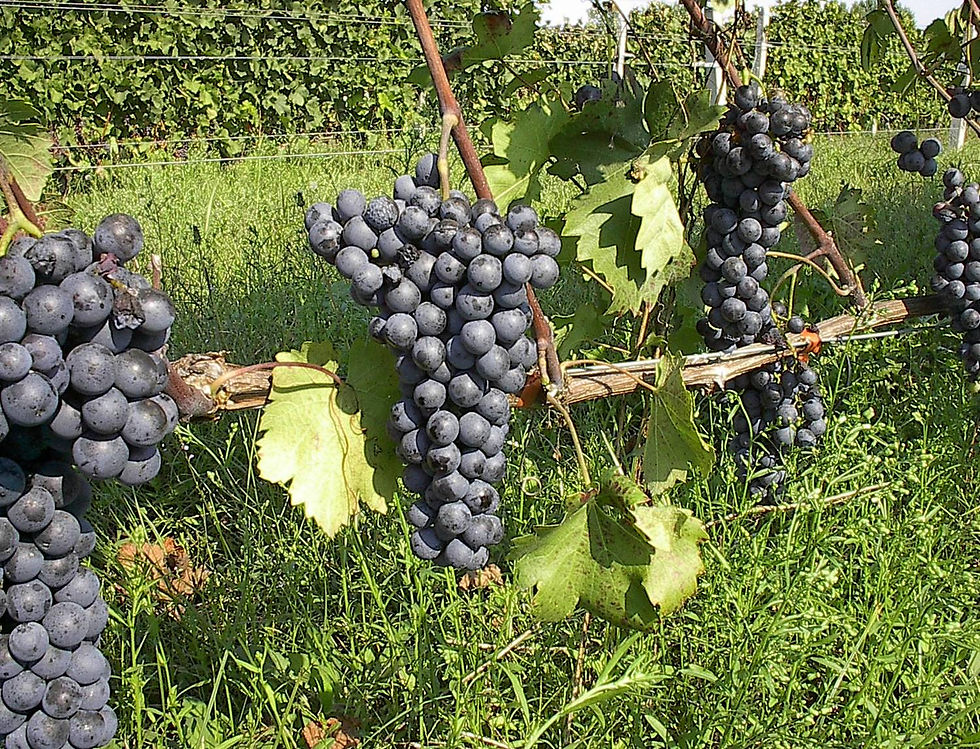
The tannin is not a fixed varietal trait but a question of the cellar: from the velvety,
balanced everyday wine to the barrique wine that fills the whole mouth. The alcohol spans
just as widely, from 11.5 per cent in old mass-market Nemeas to 15 per cent in modern
ambition bottlings.
The variety has one limit: great layers of aromatic complexity are the exception.
Agiorgitiko is animating enough to carry a whole meal – but a mediocre example shows
oxidative notes by day two, whereas a poorly made Xinomavro still wins you over with tomato,
strawberry and good acidity.
Nemea – the homeland
The PDO Nemea prescribes 100 per cent Agiorgitiko – varietally pure, no exceptions. The
zone spans 17 communities from Aidonia and Ancient Nemea via Koutsi, Gymno and Psari to
Asprokambos, and it is topographically as fragmented as hardly any other Greek appellation:
the vineyards lie between 230 and more than 1,000 metres.
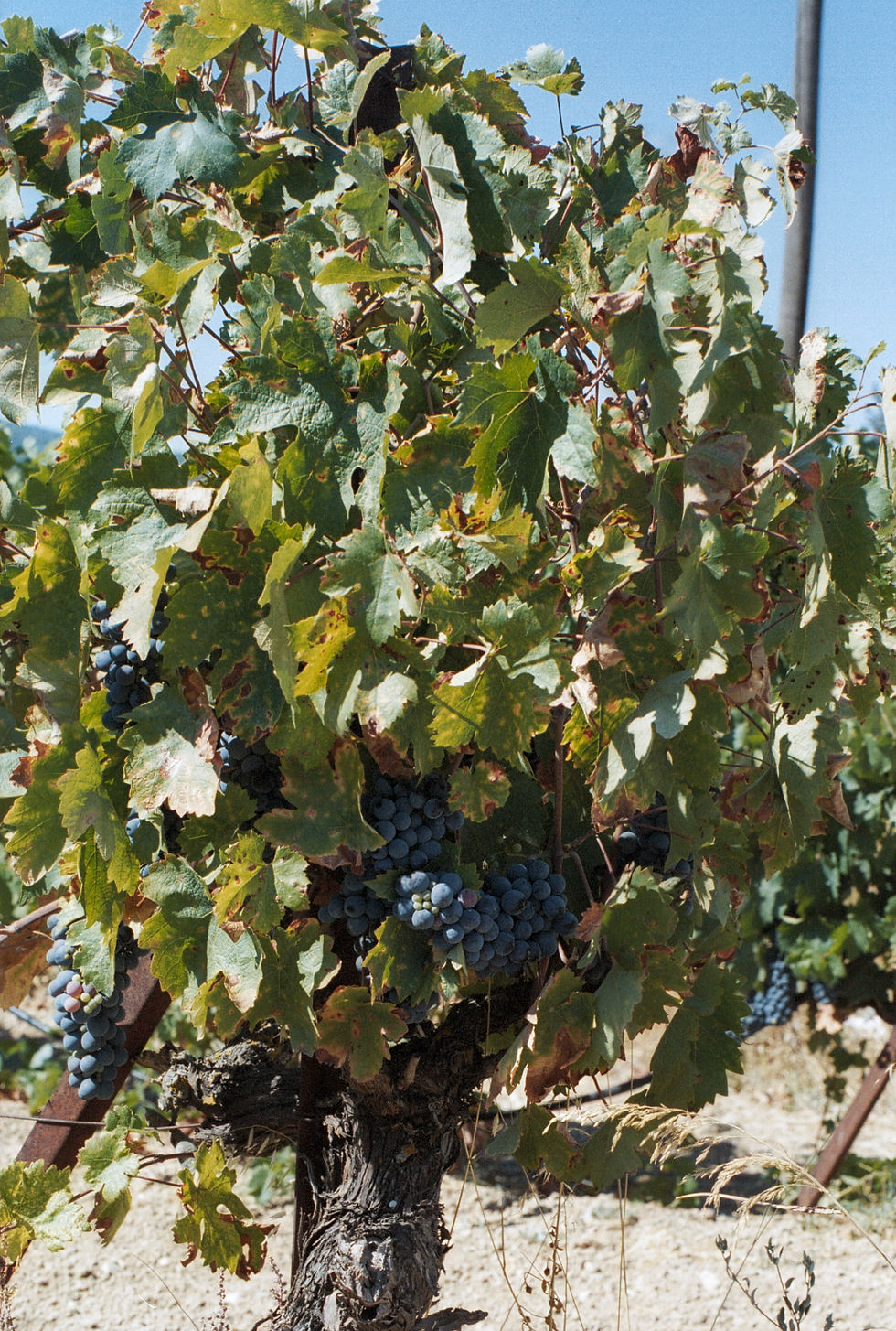
How differently Nemea tastes in practice – from 78 to 95+ points – is shown by our
17 wines in one line-up, framed by two exceptional bottles. That is also where the
uncomfortable verdict stands: in this segment quality is patchy, you have to look closely.
The most important key to looking closely is altitude – which is why it gets its own section
here.
The three elevations of Nemea – the key to the appellation
Nemea divides into three altitude tiers, and they explain more about the wine in your
glass than any back label:
The valley floor (230 to 450 metres) carries heavy red clay and alluvial soils. Grapes
ripen fast here, yields are high, sugar arrives before aromatic maturity – the result is the
soft, warm, commercial Nemea that both carries and burdens the appellation's reputation. In
hot years, heat stress hits the thin-skinned berry exactly here.
The mid-slopes (450 to 650 metres) are considered by many producers the appellation's
best balance: enough warmth for full red fruit, enough altitude for acidity and structure.
The most famous village of these sites is Koutsi – poor limestone soils, steep slopes,
naturally small yields and a slow, even ripening. From here comes the
(90) from 50-year-old vines at 380 metres; and
(90) farms clay-limestone parcels between 300 and 550 metres, from the upper valley into
the mid-slope.
The high plateau (650 to more than 1,000 metres) around Asprokambos is the cool
reserve of the appellation: thin, gravelly limestone soils low in organic matter, wide
day–night swings, the most aromatic and longest-lived wines with the highest acidity. If
you are looking for a Nemea that recalls cool climate rather than the warm south, look here.
This spread is why the debate about a stronger internal differentiation of the terroirs –
which Yiannis Karakasis has argued for years – is anything but academic: a valley Nemea and
a plateau Nemea from the same year are two different wines under one name.
Beyond altitude, the appellation has a second, legally defined axis: the maturity tiers.
A Nemea Reserve must age at least two years, twelve months of them in barrel and six in
bottle; the Grande Reserve doubles that to four years with eighteen months each of
barrel and bottle. The tier also appears in Greek on the label – "Epilegmenos" for the
Reserve, as on the
(84) from our ageing chapter. How much the tier means in the glass depends on the producer:
the
(90) fills it with substance.
Nemea Lions – the lion returns, this time as a quality seal
To that debate the appellation itself has given an answer: "Nemea Lions", the
quality tier announced in 2024 by the Nemea winemakers' association, modelled on great wine
regions such as Tuscany and Rioja. It is a **voluntary certification standard of the
association, not a change to PDO law** – and its requirements are concrete:
**single-vineyard wines from vines at least ten years old, at most 800 kilograms of yield
per stremma, at least 13 per cent alcohol, at least 24 months of total maturation, and a
sensory approval.** The tier announces itself on the bottle with a seal bearing the Nemean
lion. The association's president Nikos Vlachos put the ambition in a nutshell: they had
worked with a forty-year-old rulebook that governed everything in the zone – and agreed on
something "that changes the architecture of the region".
One may be excited – and should look closely at the same time, because the candidates that
have become known so far are partly surprising. Among the first lion contenders is said to
be the Apocalypsis of Barafakas Winery, with the 2017 vintage; we know the same wine
from the
– the 2017 itself has not yet crossed our glass. For a seal with grand-cru ambitions, wines
below 90 points would be a crooked start. As soon as the first bottle with the lion lands in
our glass, it will appear on this page – the full assessment including our first reservation
stands in the
The circle thus closes rather neatly: the lion Heracles slew in the myth returns as a
benchmark – no longer label decoration, but a promise. Let us hope it roars convincingly.
Which vintages?
Nemea rewards a look at the harvest year more than its reputation as a reliable everyday
red suggests – and the elevation tiers from above read along with every vintage.
The reference year is 2020 (9 out of 10 in our vintage database, the best value of
the series): a mild summer, then a cool, sunny, dry September without harvest rain to speak
of, small yields, immaculate fruit. Christos Aivalis of Aivalis Estate called it "the best
year of the past 30 years", George Palivos of Palivou Estate highlighted the phenolic
potential at fresh acidity. How close light and shadow sit is shown by the year after:
2021 (6) is considered the "oenologist's year" – a heatwave of 45 to 47 degrees
brought small, thick-skinned berries with plenty of colour and concentration, but low
acidity and high pH. One year apart, three points of difference.
2018 (6) is the terroir vintage of the series – and the best proof that the
elevation tiers are no academic matter: summer rain and downy mildew hit the valley basin
and diluted the wines, while Koutsi and the other high sites landed at 7 to 8, the
valley wines at 4 to 5. Tselepos spoke of excellent fruit in the Koutsi subzone,
Skouras was "initially discouraged, satisfied with the overall result" – the same vintage,
two worlds, separated by a few hundred metres of altitude and a thin-skinned berry.
2019 (7) brought late, healthy ripening with markedly high acidity – a good year,
not a great one, which looked better in the national average than in Nemea itself. 2022
(8) turned harmonious and classic after late frosts and hail at the end of March:
generous on the valley floor, more precise in the high parcels. 2023 (6) is the
honest weak spot among the reds: rain in May and June brought downy mildew, and the humid
September air forced a hasty harvest for fear of botrytis – with the more firmly extracted
wines, caution about green tannins pays off. 2024 and 2025 both stand at 7, for
opposite reasons: in 2024 a heat dome with twelve days above 40 degrees settled over the
zone, blocked ripening and cost 10 to 40 per cent of the crop depending on the site; 2025
began with frost and hail in late March but was rescued by a summer without heatwaves
in the critical ripening window and north winds from mid-August – balanced wines at 25 to
50 per cent less volume.
In practice: with valley wines the year matters more than with high-site wines – 2018
demonstrated it. If you buy selectively, take 2020 and 2022; with 2023 the look at the
producer pays twice.
The styles
Young & fruity
The style with the most drinkability – and our secret favourite. No oak, short maceration,
stainless steel. The
(89) proves that Agiorgitiko is fun entirely without barrel: sour cherry, black pepper,
butter caramel on the nose. The
delivers, for under 10 euros, a vibrating fruit profile that makes you forget every
international variety – 90 points. Add Barafakas'
(86) with just four months of tank ageing and the
(87) at around 8 euros. Drink lightly chilled – that is how this style works best.
Reserve & oak
The pair of opposites can be read off two wines. The
sees, according to Julia Harding MW, only five months of second-fill oak and manages with
12.5 per cent alcohol: refreshing and elegant at once, 92 points for around 10 euros.
The
goes the opposite way – twelve months of French barriques, 70 per cent new, 14 per cent
alcohol, 90 points. In between sit
with mostly used oak and
(89) with at least two years in bottle before release.
At the very top stand the icons. The
from PGI Pangeon takes 94 points; according to the winery, the Areti was the first
Agiorgitiko ever produced outside Nemea. The
comes from an ungrafted vineyard near Nemea more than 100 years old – wild yeasts,
15 hectolitres per hectare, very finely polished tannin, 94 points. And the
holds, at 95+, the highest score we have ever given a varietally pure Agiorgitiko:
black cherry liqueur, violets, graphite, sea breeze.
Aged
The ground rule first: aged Agiorgitiko often turns brittle like dry wood – there is even a
recurring fault picture we call "the sharpness of over-aged Agiorgitiko": burnt, metallic,
bitter.
And yet it is precisely the very old bottles that surprise. The
opened for its 45th birthday, was remarkably supple – 90 points. The
a plain standard bottling at 11.5 per cent alcohol, also reaches 90, the
still 89 after 34 years.
Two patterns stand out. First, ageing does not run along price: the worst old bottle is of
all things the export flagship of the three big houses, the
at 78 – twelve points below the plain Boutari bottling. Second, the real losers are the
*middle-aged* wines:
landed at 82 after eleven years,
at 83 after thirteen.
What preserved the old Nemeas was not alcohol but carrying acidity. Ageing potential is
real, but the exception – it hangs on the bottle and the storage, not the price bracket.
The full evidence stands in our
Agiorgitiko rosé
The rosé is the most underrated expression – and in practice always a blend: among the nine
Agiorgitiko rosés in our database not a single one is varietally pure; the highest declared
share is 80 per cent.
The most convincing example is the
80 per cent Agiorgitiko, off-dry with 18 grams of residual sugar, 2.4 bar of sparkle and
just 11 per cent alcohol – for us the best off-dry rosé of Greece in its vintage, 91
points. Drier and with proper grip comes the
half Grenache Rouge, half Agiorgitiko, 88 points.
Downwards the span is wide: the
reaches 79, the
only 70 due to oxidative notes. Here the look at the producer pays particularly.
Agiorgitiko as a blending partner
Unlike Xinomavro, which owns a blending tradition with PDO Rapsani, Agiorgitiko has no
appellation of its own in a blend: **because PDO Nemea applies exclusively to varietally
pure Agiorgitiko, every cuvée must move down to PGI level** – including the most famous
one.
That is precisely the story of the
80 per cent Agiorgitiko, 20 per cent Cabernet Sauvignon, 18 months in new French barriques
– and therefore PGI Peloponnese. George Skouras brought Burgundian know-how to the
Peloponnese; his Megas Oenos counts as the unofficial ambassador of Greek wine, and in our
blind flight against five 2019 Bordeaux it tied for first place: 94. Its little brother
reaches 87.
The second great partner is Syrah: the
is internationally perhaps the best-known Agiorgitiko cuvée of all (90+); we liked the
half Agiorgitiko, half Syrah, even better (91+). For the racier wines, though, we
consider Cabernet Sauvignon the better choice. With Merlot, Agiorgitiko works on
the principle of like meets like, above all in the more easy-going wines – for instance
(90+) and
(85+).
The biggest surprise was a wine entirely outside these patterns: the
a cuvée of Agiorgitiko, Mavrodaphne and Cabernet Sauvignon – a 40-year-old "vin de table"
at 93 points. It still does not appear in our best-of list: Achaia Clauss never
disclosed the ratio of the three varieties, so we do not know whether Agiorgitiko truly
plays the lead here.
What Agiorgitiko contributes to a blend: fruit and approachability in youth, a recognisably
floral aromatic profile, finesse, and moderate alcohol in the fresher examples. What it
does not usually deliver: tannic backbone, structure, ageing reserves – which is exactly
why the Cava Clauss is the exception that stands out.
In these wines Agiorgitiko is a minority or equal partner – they are not Agiorgitiko
wines in the narrower sense, but worthwhile:
The whole cuvée landscape – from the Bordeaux trios via Mavrodaphne to open threads like an
Agiorgitiko-Xinomavro cuvée – is played through in our article
(in German).
What does Agiorgitiko go with?
Agiorgitiko brings what counts at the table: soft tannin, juicy red fruit, herbal spice and
moderate alcohol.

From our tasting practice comes one very concrete recommendation: **wild boar and aubergine
goulash** pairs superbly with Agiorgitiko's aromatics. From there the field opens up –
herbal spice and red fruit lead naturally to lamb, grilled meat from the charcoal
grill and the classic moussaka, for aubergine and Agiorgitiko are a proven pair. The
moderate acidity of the fresher examples makes tomato dishes unproblematic, where
tannic reds usually chafe. Spicy hard cheese like kefalotyri, on the other hand, calls
for the oak-aged Reserve with more grip.

Rule of thumb: the younger and less oaked the wine, the lighter the chill and the more
flexible it is at the table.
Agiorgitiko as an alternative to …
If you like soft, fruity reds, Agiorgitiko is your grape – at prices that no longer
exist in better-known regions: several wines at 90 points and more sit below 10 euros
with us, and the
cost 6.80 euros at the cellar door.
Instead of Merlot: the kinship is so close that the two varieties are even blended with
each other – soft meets soft. If you drink Merlot for its round approachability, you will
find the same softness in Agiorgitiko plus a herbal-peppery edge.
Instead of young Chianti: Sangiovese also spoils you with cherry – but after a few
sips you find yourself wanting to pull the cork of an entirely different bottle. With
Agiorgitiko that does not happen: ten times rather Agiorgitiko than Sangiovese.
Instead of Côtes du Rhône: if you value that mix of red fruit, black pepper and herbal
spice, you will find it again in Agiorgitiko, often at lower alcohol.
The best Agiorgitiko wines of our tastings
*One row per wine and vintage; where a wine was tasted twice, the later tasting counts. Sorted by points.*
95+ – Philos Wines Apeiro "∞" 2015 (PGI Corinthia)
94 – Domaine Skouras Megas Oenos 2019 (PGI Peloponnese)
94 – Ktima Biblia Chora Areti red 2013 (PGI Pangeon)
94 – La Tour Melas Palies Rizes 2020 (PGI Fthiotida)
92 – Domaine Costa Lazaridi Château Julia Agiorgitiko 2020 (PGI Drama)
92 – Kokotos Estate Agiorgitiko 2020 (PGI Peloponnese)
91+ – Ktima Dyio Ipsi Dialogos red 2019 (PGI Ilia)
91+ – Ktima Pavlidis Emphasis Agiorgitiko 2018 (PGI Drama)
91 – Barafakas Winery Treis Magisses 2021 (PDO Nemea (rosé exception: 80 %))
91 – Ktima Biblia Chora Areti red 2016 (PGI Pangeon)
91 – Palivou Estate Nemea 2018 (PDO Nemea)
90+ – Ktima Pavlidis Thema red 2017 (PGI Drama)
90+ – Olympia Land Estate Pheidias 2016 (PGI Ilia)
90 – Acra Winery Nemea Agiorgitiko 2020 (PDO Nemea)
90 – Ktima Driopi Reserve Agiorgitiko 2018 (PDO Nemea (Koutsi))
90 – Nemea Winery Nemea 2019 (PDO Nemea)
90 – Panagiotopoulos Wines Agiorgitiko Cube 2015 (PGI Trifilia)
90 – Cavino Nemea 1978 (PDO Nemea)
90 – Boutari Nemea 1998 (PDO Nemea)
*A note on the scale: our older articles still use the 20-point scale (18.5/20 corresponds
roughly to 95/100). All scores on this page are converted to the 100-point scale.*
The verdict
In one sentence: Agiorgitiko is Greece's soft, fruity red with a herbal-peppery edge – best
drunk young and lightly chilled, at prices that no longer exist in better-known regions.
If you do not know the variety yet, the easiest start is the
around 8 euros, 87 points, uncomplicated and varietally true. If you want to know how
far the grape reaches upward, take a bottle from the best-of list.
One note on that: the oldest bottles on this page, the Cavino Nemea 1978 and the
Boutari Nemea 1998, are archive wines from our own cellar. They stand here as evidence
that Agiorgitiko can age – not as a shopping tip. You will no longer find them in shops.
All Agiorgitiko notes
Here are all wines in our database in which Agiorgitiko plays the lead – vintages from 1978
to 2025, scores from 70 to 95+ points. Almost all are varietally pure or carry a declared
Agiorgitiko share of at least half. Two two-variety cuvées join them where the producer
does not state the ratio – Agiorgitiko is listed first in both, and in the glass it
audibly carries the wine.
Philos Wines Apeiro "∞" 2015 (95+), Domaine Skouras Megas Oenos 2019 (94), Ktima Biblia Chora Areti red 2013 (94), La Tour Melas Palies Rizes 2020 (94), Domaine Costa Lazaridi Château Julia Agiorgitiko 2020 (92), Kokotos Estate Agiorgitiko 2020 (92), Ktima Dyio Ipsi Dialogos red 2019 (91+), Ktima Pavlidis Emphasis Agiorgitiko 2018 (91+), Barafakas Winery Treis Magisses 2021 (91), Ktima Biblia Chora Areti red 2016 (91), Palivou Estate Nemea 2018 (91), Ktima Pavlidis Thema red 2017 (90+), Olympia Land Estate Pheidias 2016 (90+), Acra Winery Nemea Agiorgitiko 2020 (90), Boutari Nemea 1998 (90), Cavino Nemea 1978 (90), Ktima Driopi Reserve Agiorgitiko 2018 (90), Nemea Winery Nemea 2019 (90), Panagiotopoulos Wines Agiorgitiko Cube 2015 (90), Giannikos Winery The Lion 2018 (89+), Barafakas Winery Apocalypsis 2015 (89), Kourtakis Nemea 1990 (89), Lafazanis Winery Geometria Agiorgitiko 2020 (89), Barafakas Winery Saint Modesto 2021 (88), Lafazanis Winery Geometria Agiorgitiko 2023 (88), Lafazanis Winery Geometria Agiorgitiko 2024 (88), Ktima Pavlidis Emphasis Agiorgitiko 2016 (87+), Nikolaou Estate Nemea Agiorgitiko 2020 (87+), Domaine Skouras Akres 2025 (87), Barafakas Winery Idea red 2021 (86), Dionysos Winery Agiorgitiko 2021 (86), Domaine Spiropoulos Porfyros 1996 (86), Fteri Vinum Winery Viale die Parioli 44 2020 (85+), Astir X Winery Fare Rebels red 2017 (84), Semeli Estate Oneiros Helios 2019 (84), Tsantali Nemea Reserve Epilegmenos 1993 (84), Nicolas Repanis Agiorgitiko 2011 (83), Palivou Estate Anemos 2013 (82), Loukas Winery Ariston 2021 (80), Semeli Estate Charisma 2021 (80), Dionysos Winery Agiorgitiko Moschofilero 2021 (79), Kourtakis Kouros Nemea 1992 (78), Cavino Pandora 2021 (70), Dionysos Winery Orizontes rosé 2021 (70).
Read on: our Agiorgitiko deep dives
This page gives the overview – the depth stands in our four big Agiorgitiko articles:
the vertical from 1978 to 2021, with all the ageing data, the history of the great export
houses of the 1990s and the comparison of an old Nemea with two famous Bordeaux of the
same vintage.
the style spectrum from unoaked to single vineyard (in German).
how the grape fares 750 kilometres north of Nemea (in German).
**Agiorgitiko-Cuvées** –
the complete partner map: Cabernet, Merlot, Syrah, Mavrodaphne, Pinot Noir, Grenache and
Moschofilero (in German).
Stay in the loop
We keep tasting new Agiorgitikos – from the 8-euro bottle to the icon wine – and write
every note ourselves. If you do not want to miss one:
Free, cancel any time.
Image credits
Landscape and vine photos via Wikimedia Commons: ulrichstill – Nemea Wine-Olives Corinthia Peloponnese (CC BY-SA 3.0 DE) · Zde – Vine tree near Archeological site of Nemea (CC BY-SA 4.0) · Elisavetch – Agiorgitiko (public domain). The two bottle photos are from our own tastings.


Comments