
An Agiorgitiko Tasting

Updated: Aug 17
We've already talked about Agiorgitiko on this blog at length – though as a blending partner for international varieties such as Cabernet Sauvignon, Merlot or Syrah. As a single varietal? Nowhere to be found. And yet we long ago devoted a whole masterclass to the other Greek variety that lays claim to being king among the red grapes – Xinomavro. So Agiorgitiko gets somewhat short shrift here, and that isn't entirely fair.
Because according to the official ELSTAT data for 2020, the variety covered 31,616 stremmata (3,161.6 hectares), spread across 4,287 holdings (of which a good two-thirds to three-quarters lie in the PDO Nemea alone, depending on the source). That made it the most widely planted red grape in Greece and – after Savatiano and Roditis – the third largest overall. It holds PDO status only in Nemea, however, whereas Xinomavro has earned that honour in several appellations at once, whether as a single varietal or in a blend.
Going through our tasting notes from the past year, I also notice that an Agiorgitiko sits in joint fourth place – so the variety evidently does manage to thoroughly convince us at least now and then. Specifically, it's the Philos Wines – Apeiro "∞" 2015 (100% Agiorgitiko, Peloponnese, dry, 14.5%). A single-varietal Agiorgitiko from old vines. The estate is based in Dafni, one of the 17 municipalities within the PDO Nemea zone, though the Apeiro itself – marketed as unfiltered and from a single vineyard – possibly sits deliberately outside the PDO classification. This was my very first sip of this wine (I'd never had the entry-level Philos bottling in my hands). The nose is simply stunning – perhaps the most complex bouquet I had from a Greek red last year: black-cherry liqueur, violets, graphite, sea breeze. On the palate the individual parts aren't yet fully meshed; the mid-palate feels a touch loose, but the salt-rimmed fruit and a minutes-long finish drive it to 95+ points regardless. Hard to believe it's ten years old. A tip: let the wine travel through different temperatures – warmer means more cherry-plum depth, the oak melts in, and the age shimmers through. 2015 was truly a magical vintage for Agiorgitiko; the Ktima Biblia Chora Areti 2015 proved that only recently. The Apeiro is one of the best Agiorgitiko wines I've ever come across – more precisely, the best insider-tip representative of this variety I've ever had. In Germany the wines are available through Wine and Nature. The price is absolutely fair, so no "bargain blockbuster", but this is serious quality.

And looking at the tastings of older vintages, it's once again an Agiorgitiko that has impressed most from the 1970s: the Cavino Nemea 1978 (PDO Nemea, 100% Agiorgitiko, Peloponnese, dry). It earned a respectable 90 points – something I hadn't seen with Xinomavro before the 1990s. The wine was opened in 2023 as part of a small tasting to mark its 45th birthday, alongside several mature wines of the same vintage, including a Château Mouton Rothschild 1978 and a Château Margaux 1978. Cavino, founded in 1958 – exactly twenty years before this wine – is today probably better known for producing Greek wines found at discounters worldwide. Expectations were therefore not especially high. Yet the wine turned out to be a genuine revelation. On the nose, seductive blueberry aromas; on the palate, remarkably supple for its age, with a long, reverberating finish marked by sea buckthorn and fascinating bloody notes. Vinified from 100% Agiorgitiko, as the PDO Nemea requires, this bottle beat both the Mouton Rothschild 1978 (which sadly offered no pleasure, presumably because of a poor bottle and not because of the actual wine quality) and the Château Margaux 1978, which showed a beguiling peppery, cassis-driven nose but remained rather rough on the palate. Of course, at this age the rule applies: there are only good bottles, not good wines – but the impression this Nemea left was undeniable.

These two data points, then, do seem to underline the variety's potential. The thing is just that the picture between these extremes is very mixed. But precisely because one needs these impressions too, in order to have more than mere highlights, I now want to report on a tasting we held back in July 2024, which nonetheless still holds instructive impressions. It was a tasting without any great blockbusters, with wines from Nemea and beyond. It was accompanied by a wild-boar-and-aubergine stew, which pairs very well with the aromatics of Agiorgitiko. Some wines convinced – but you can also see that in this segment the quality of Greek wines is patchy and that you have to look closely before reaching for a bottle on the shelf (where, of course, you'll often see the label in Germany too). We begin with the youngest wine and then work our way ever further back into the past.
The Agiorgitiko 2021 from Dionysos Winery (PGI Peloponnese, 100% Agiorgitiko, 12–12.5%) opens our tasting. Dionysos Winery, founded in Athens in 1936 and, with over 11 million litres of annual production, one of Greece's larger wine producers, sources the grapes from the Corinthos wine district in the Peloponnese. The wine runs as a PGI and should not be confused with the house's separately bottled PDO Nemea, which comes with barrique ageing. In Greece the price is around 4 euros – clearly the entry segment. This is the best wine from Dionysos Winery I've had in the glass so far. Red-berried nose. Still fresh on the palate. Grippy tannin. Good balance between acidity and alcohol. Only the finish is a little disappointing. Especially on the second aftertaste there are still some slightly unclean notes. Faintly musty. 86 points.

The Idea Nemea 2021 from Barafakas Winery (PDO Nemea, 100% Agiorgitiko, 13–13.5%) is our first PDO wine in this tasting. Barafakas is a family business in Nemea with a winegrowing history reaching back to the 1920s; the modern winery was founded in 2002 by Christos Barafakas. The vineyards lie at 200 to 815 metres of altitude within the topographically highly varied Nemea zone. The Idea is vinified in stainless steel – five days of pre-fermentation extraction, fermentation at 24–26 °C, then four months of tank ageing – and sees no wood. In Greece it sits at around 7–8 euros; a UK merchant recommends it to people who like young Rioja. There's relatively much spice on the nose. On the palate the tannin is still rather austere. Then a short, fruity wave, but a rather short finish. Faintly metallic aftertaste. 86 points.

So far in the 2021 vintage we've thus got to know a rather disappointing Nemea and an Agiorgitiko without that strict designation of origin that was at least not thrilling. In 2020 things get better as far as both representatives are concerned. We begin with the Nemea.
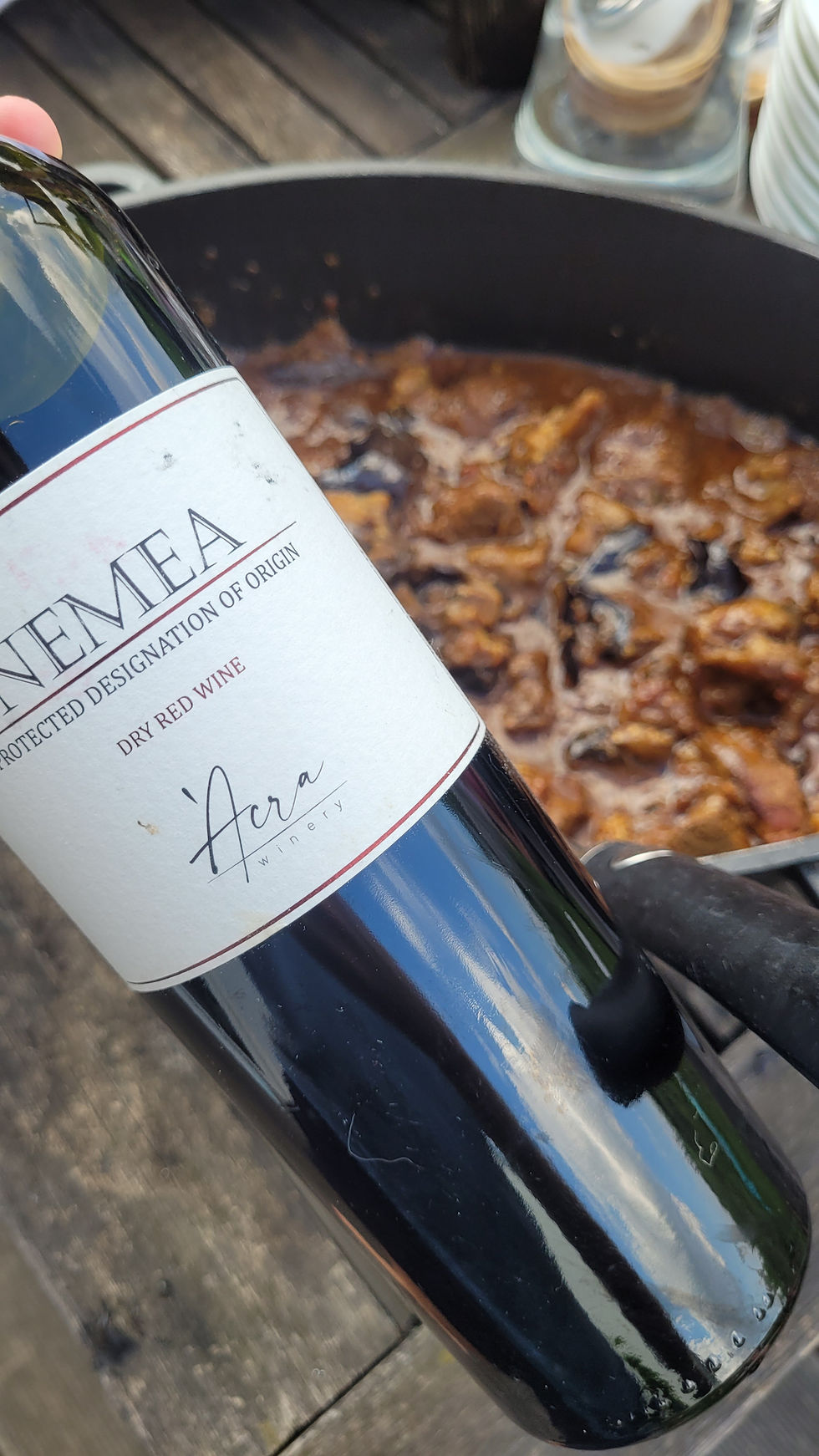
The Nemea Agiorgitiko 2020 from Acra Winery (PDO Nemea, 100% Agiorgitiko, 14.5%) comes from the debut phase of a very young Nemea project. Acra was founded in 2021 by Spiros Papandreou (chemist and oenologist) and Dimitris Papandreou (mechanical engineer); the vineyards had already been taken over in 2020. Around 4 hectares on clay-limestone soils between 300 and 550 metres of altitude, i.e. in the lower-to-middle altitude band of the appellation. Striking is the lyre training – a divided, open canopy system that offers good light exposure and ventilation but, because of the high effort involved, is rather rarely used. The estate was still in organic conversion in 2020. In the cellar the wine was aged for 10–11 months in French oak, mostly used, partly new, in 225-litre barrels, followed by around 6 months of bottle ageing. Falstaff awarded the 2020 90 points. A wine with a great deal of nougat, already on the nose and on the finish, and it is distinguished by very polished tannin. Good minerality. Light sea-buckthorn notes that emerge from beneath the red and black berries. An overall very rounded level. 90 points.
In this vintage too, however, the traditional region did not convince consistently at such a high level. The Agiorgitiko Nemea 2020 from Nikolaou Estate (PDO Nemea, 100% Agiorgitiko, organic, 13.5–14%) reached 87 points. Nikolaou is a family winery in Nemea with roots in the 1930s; founder Giannis Nikolaou studied in Bordeaux, and organic farming has been practised since 1999. The wine comes from a single vineyard in Koutsi at around 350 metres of altitude, calcareous soil, south-western exposure, vines about 15 years old. Hand-harvesting takes place at the end of September, fermentation is with indigenous yeasts in stainless steel, after which the wine matures for up to 18 months in 300- to 600-litre French oak barrels, followed by further bottle ageing. At only around 4,000 bottles, this is clearly the house's ambitious estate bottling. A solid introduction to a mineral wine for under 10 euros, organically grown, wild-fermented, hand-picked, well balanced, very good concentration. A little short on the finish, but clearly more potential. For now, more like 87 points.

Outside the PDO, by contrast, things looked excellent in 2020. The Kokotos Agiorgitiko "Three Hills" 2020 from Ktima Kokotos (PGI Peloponnese, 100% Agiorgitiko, 12.5%) comes from a winery in Stamata in Attica, north-east of Athens. The estate's own vineyards there lie at around 450 metres of altitude, are certified organic and sit on limestone and schist subsoil. For the Three Hills, however, Kokotos sources the fruit from partner vineyards in Nemea – so the wine is not an estate wine in the narrower sense. The fact that it runs as PGI Peloponnese and not as PDO Nemea, even though the grapes come from the PDO zone, underlines that it is more of a regionally stylised Kokotos interpretation of Nemea fruit than a classic PDO-type wine. The variety history is interesting too: older vintages (2016, 2018) still contained 10% Cabernet Sauvignon; the switch to 100% Agiorgitiko appears to have happened from 2019. The grapes are hand-picked and cooled at night, then destemmed. Extraction lasts 8–10 days, fermentation around 15 days in stainless steel at 20–22 °C. After that, according to Julia Harding MW, the 2020 spent five months in second-fill oak – trimmed entirely for early accessibility. Production is 10,000 bottles. Very intense nose. Red-fruited, but plums too. Refreshing on the palate, building slowly, with a good lingering finish. Smoky, despite only a short ageing of a few months in used wood. A refreshing and at the same time elegant wine at 12.5% alcohol. Agiorgitiko as I'd like to see it more often. Drink lightly chilled. 92 points – superb quality for just 10 euros.

And then there's one more wine we should discuss here, one that draws the spotlight away from Nemea – even further away, in fact, which given the price (around 235 euros) it definitely has to. The Palies Rizes 2020 from La Tour Melas (100% Agiorgitiko, 14.5%) – the name means "old roots" – is based on a more than 100-year-old, own-rooted, i.e. pre-phylloxera Agiorgitiko vineyard in Floiountas near Nemea, which Panos Zoumboulis rediscovered in 2013. The La Tour Melas estate itself, however, sits in Achinos in Fthiotida, central Greece, where Kyros Melas set out in 2000 with the declared aim of producing a Greek wine at "first growth" level. The designation of origin varies depending on the sales channel – from "Wine of Greece" through PGI Sterea Ellada to PDO Nemea, you'll find everything. Cultivation is organic with biodynamic elements, the yields extremely low at 15 hl/ha. In the cellar, fermentation is with wild yeasts, vinification and malolactic fermentation run 80% in stainless steel and 20% in wood, after which the wine matures for 15 months in 400-litre Austrian oak barrels. No fining. La Tour Melas is a member of the international Francs de Pied Association; the 2020 was poured at an official Francs-de-Pied tasting at London's 67 Pall Mall. Julia Harding MW counts it among the producer's top 3 wines. Expressive nose, with plenty of dark fruit, including juniper berry. Very, very finely polished tannin, already very drinkable. Good minerality. Very long lingering finish. A very, very good wine. 94 points. As a Greece fan you perhaps do have to try it at some point. Anyone wanting a more reasonable price, though, should probably reach instead for the Apeiro "∞" 2015 (55.55 euros at Wine and Nature).

We skip the year 2019 and land directly at two wines from 2018. We stay in Nemea, but this time, for the first time, with a Reserve. The Reserve Agiorgitiko 2018 from Ktima Driopi (PDO Nemea Reserve, 100% Agiorgitiko, 14%) comes from Yiannis Tselepos, best known above all from Mantineia, but who also makes Nemea wines with the small Ktima Driopi estate. Tselepos studied oenology in Dijon and then worked for two years at Burgundian estates – the Burgundian streak is no coincidence. The estate lies in Koutsi at 380 metres of altitude, clay-limestone loam soils, steep slopes, 50-year-old vines yielding only 7 tonnes per hectare. After 25 days of extraction with cold maceration, the wine matures for 12 months in French barriques (70% new, 30% second fill) and a further 6 months in bottle. Production is 20,000 bottles; the 2013 received 93 points from Parker's Wine Advocate. The wine's concentration is already visible in the glass from the noticeably darker colour. On the nose, a mix of blackberry and olive tapenade – one might think of a Bordeaux blend from a very warm vintage. On the palate, though, then too little complexity. A wine that scores very well in some vintages and worse in others. Here a slightly astringent impression remains. Tannin is there, but not at a level that could keep up with a big steak. Just about 90 points.

So you can certainly sense the ambition that comes with the Reserve designation. But in fact another wine convinced us more in this tasting, in the same vintage – one that doesn't come from Nemea at all and sits in a similar price range (both around 17–20 euros). The Emphasis Agiorgitiko Single Vineyard 2018 from Ktima Pavlidis (PGI Drama, 100% Agiorgitiko, 15%) comes from the northern Greek inland region of Drama in Macedonia – far from the variety's ancestral home. Ktima Pavlidis was founded in 1998 by Christoforos Pavlidis and works in a clearly terroir-oriented way: own vineyards, manual night harvest, parcel-by-parcel vinification, underground cellars. The Perichora single vineyard lies on the slopes of Menoikio at around 400 metres, south-east exposed, on terra-rossa clay soils with limestone and marl – a study on PGI Drama published in 2025 confirms that the site there significantly influences wine quality. The 2018 matured for 14 months in French oak, followed by 12 months of bottle ageing. Production is limited. Falstaff awarded 92 points; at Mundus Vini the 2018 took gold and the special award "Best of Show Greece Red". At 15% alcohol we're definitely no longer dealing with a light summer wine as with the Kokotos at 12.5% – at Pavlidis in Drama we're among the serious reds, as we know them there from Syrah and Tempranillo too. Despite the high alcohol it surprised with good freshness on the palate. Unfortunately my bottle was no longer intact on the nose, which is why I have to forgo a description of the bouquet here – Falstaff cites herbal spice, nougat, ripe plums and tobacco. On the basis of the palate profile and the external references: 91+ points. (The result is a certain rehabilitation of the estate, given that we gave the 2016 only 87+ points five years after harvest, though we also had a few residual doubts about the bottle there.) A very good example of how convincing Agiorgitiko can be outside Nemea.

For the year 2017 we have only one representative. The Faré Rebels Agiorgitiko 2017 from Astir X Winery (PGI Peloponnese, 100% Agiorgitiko, 12.5%) comes from Kalamata in Messenia – the company's family history reaches back to 1930, and today Astir X works with 88 local growers and around 80 hectares of vineyard. The name "Faré" probably refers to ancient Farai, the former name of Kalamata, and the Greek Revolution of 1821 that began there. The wine sees no wood and is clearly trimmed for fruit and early accessibility. The producer describes it as "full-bodied", which at 12.5% alcohol sounds like a contradiction – and it is one. On the nose still fairly appealing, with vegetal notes. On the palate gripping on the attack, with good acidity too, but then fading very quickly. Not unpleasant on the finish, simply too short. 84 points.

For the year 2016 too we have only one representative – but this time we head to northern Greece, and the wine is far better known. The Areti Red 2016 from Ktima Biblia Chora (PGI Pangeon, 100% Agiorgitiko, organic, 14%) is actually one of my favourite Agiorgitikos outside Nemea. The winery was founded by Vassilis Tsaktsarlis and Vangelis Gerovassiliou, both Bordeaux-trained oenologists – Gerovassiliou is moreover the key figure in the revival of the Malagousia variety. The vineyards lie at around 380 metres in the hills of the Pangeon mountains near Kavala, on gravelly-calcareous-loamy soils, buffered by Aegean breezes. According to Biblia Chora, the Areti is the first wine made from Agiorgitiko ever produced outside the traditional home region of Nemea – a deliberate pioneering project. The wine undergoes cold maceration at 6 °C, is vinified classically and matures for 12 months in French oak. Production is 10,000 bottles. We had enthusiastically given the 2013 94 points in 2021, then eight years after the harvest – a simply magnificent wine with wonderfully fresh fruit aromas, slightly bloody minerality, soft tannin and the drinkability typical of the variety, which there did not come at the expense of a long finish. So I was all the more curious how the 2016 would fare at the same age. The answer: the vintage disappointed me a tiny bit. On the nose a great deal of juniper. On the palate likewise much juniper, but also slightly greenish notes that are somewhat irritating. You have the feeling of tasting the lowest common denominator of the oak across all of Biblia Chora's reds. Smoky lingering finish, but one that excites little. That sounds very negative, above all because I've had distinctly better vintages of this estate in the glass. On the second aftertaste it pulls itself together. The wine will certainly stay at this level for another five years. No question, a very good wine. 91 points.

For 2015 we return to the heartland of Agiorgitiko. The Apocalypsis Agiorgitiko 2015 from Barafakas Winery (PDO Nemea, 100% Agiorgitiko, 13.5%) is the premium bottling of the same estate from which we had the lighter Idea Nemea 2021 further above. For the Apocalypsis, after around ten years of observation and experimentation, the best Nemea parcels on the slopes of Agios Ilias at 380–400 metres of altitude were selected. The wine was fermented in stainless steel and then matured for twelve to fifteen months in French oak (225- and 300-litre barrels), followed by at least two years of bottle ageing before release. WineTaster awarded 91 points in 2022 and described the 2015 as fine and herbal rather than merely ripe and oak-driven. The nose is relatively restrained. On the palate, interesting minerality, which during further tasting also shows on the nose, as a slightly chlorine-like note. The wine is multilayered. At first quite explosive on the attack, it then moves into darker, olive-like, woody, earthy notes – and then seeps away rather quickly into this Greek soil. Hence only 89 points for now. I don't think it's currently in an aromatic trough from which it might still free itself. The wine may be drunk now, if you have it.

Now we enter a range in which, as far as wines from Greece are concerned, my cellar becomes ever more fragmentary. So we jump over 2014 into 2013 – now with wines more than a decade old, and unfortunately also into a range in which the wines that follow have all already passed their peak. Apologies for the spoiler, a real highlight isn't coming any more. But it'll get exciting again in the 1990s, I promise. That also applies, unfortunately, to the Anemos Agiorgitiko 2013 from Palivou Vineyards (PGI Peloponnese, 100% Agiorgitiko, 12.5%). Palivou is a family winery in Ancient Nemea, founded in 1995, that farms over 50 hectares organically and with biodynamic principles. The vineyards for the Anemos lie on the slopes of Giugiza at around 420–460 metres, deep clay soil. The Anemos is the house's entry line – fruit-driven, a short skin-contact time of only six to seven days, designed for early accessibility. Above it stand the PDO Nemea with twelve months of oak and the Ammos Terra Leone with fourteen months in new French oak and amphorae. For an entry wine for under 10 euros you can't expect too much after more than a decade. (The estate's Nemea Reserve is something else entirely – the 2018 received 91 points from us five years ago as a wine that brings the quintessence of the region into the glass – and at the time actually cost around 10 euros too.) It has decent extract, which does it a lot of good at only 12.5% alcohol, without seeming over-extracted. But ultimately simply too much of the fruit has already receded into the background, too many oxidative notes have been added. Aged Agiorgitiko in many cases becomes brittle, like dry wood. And that's exactly what happens with this wine too, which is why here, unfortunately, we're only at 82 points.

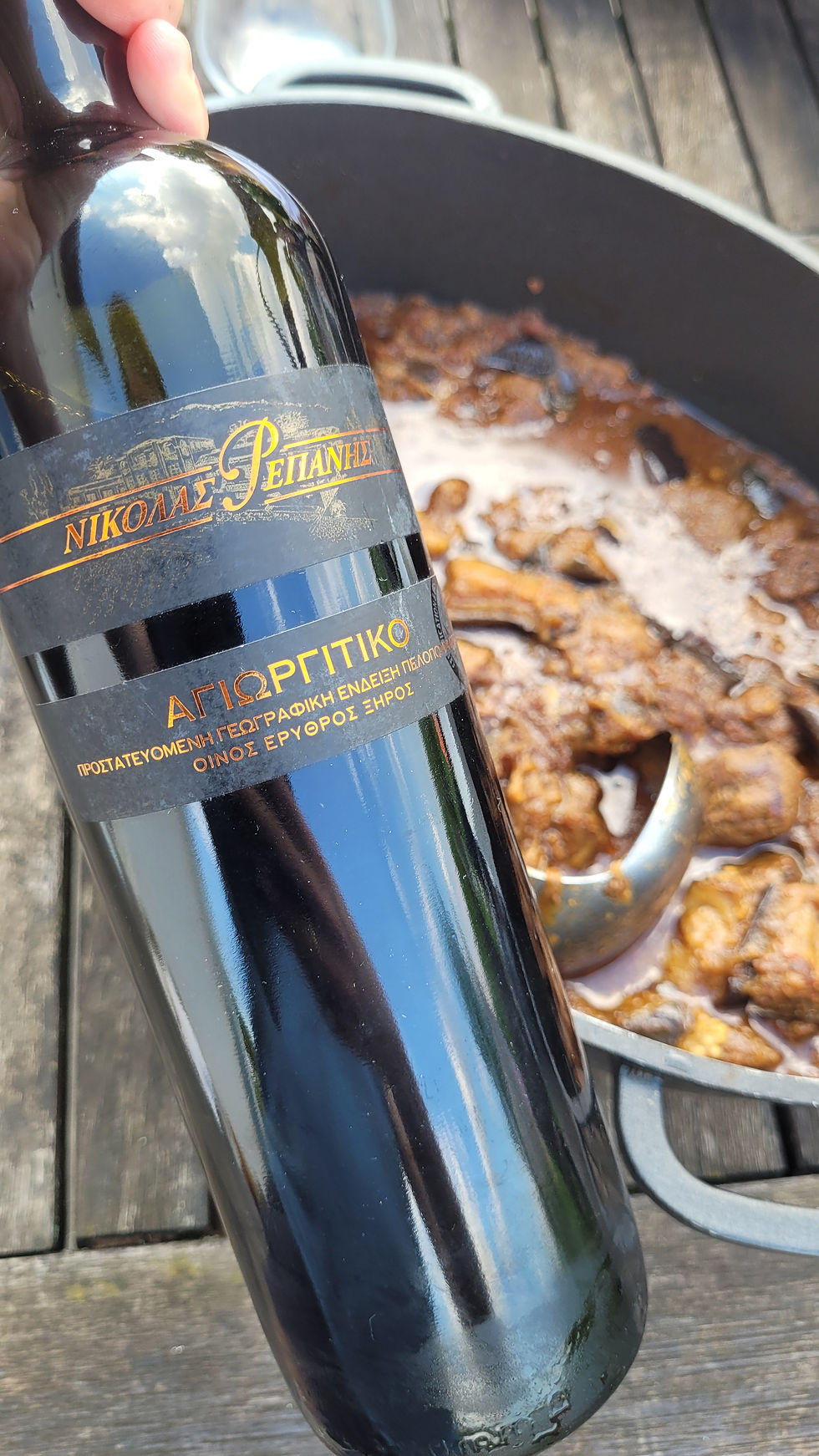
And once more we hop into the past, to the year 2011. The Agiorgitiko 2011 from Nicolas Repanis (PGI Peloponnese, 100% Agiorgitiko, 13.5%) comes from Xerokampos near Nemea. The Repanis family entered the wine business in 1986 and built the winery in 2000 amid the vineyards with a view of the historic town of Nemea. The Agiorgitiko is the house's simple PGI line, designed for fruit and early accessibility, with an official drinking recommendation of three to five years. Above it in the range stand the PDO Nemea wines with six and twelve months of barrique ageing respectively. The 2011 vintage was cool and sunny in Nemea, with higher acidities and lower tannin accumulation than usual – in itself not a bad profile for Agiorgitiko to be drunk young. Fifteen years later the situation naturally looks different. On the nose an interesting mix of light mushroom notes and a touch of curry. On the palate the typical taste of Agiorgitiko that has passed its zenith. A strong rearing-up on the attack, lining the mouth with astringent tannin-acid and sandalwood notes – an impression that then immediately fizzles out. The wine is a bit better than the Anemos before it, hence 83 points.
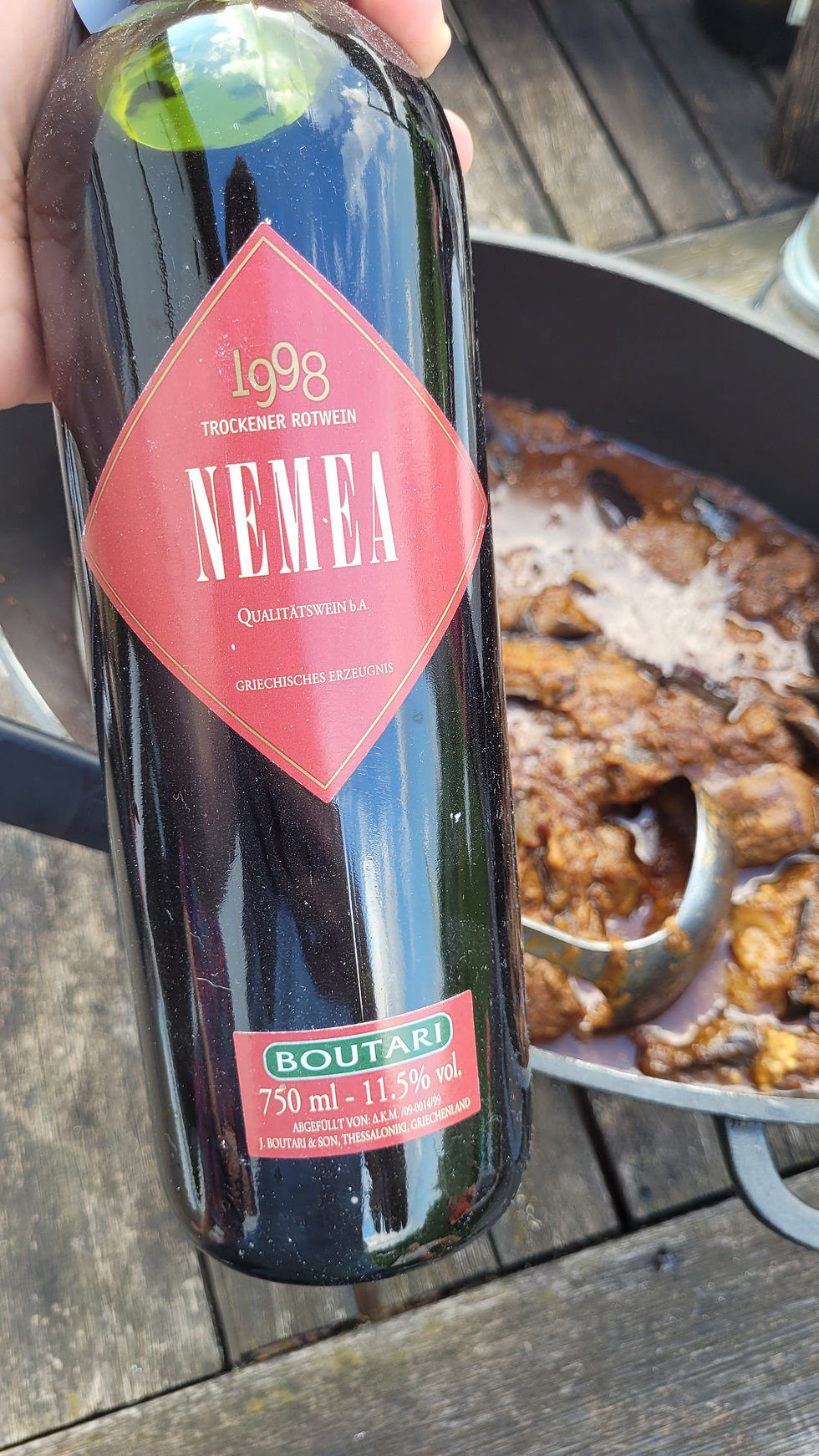
For the last four wines we now jump right to the other end of the timeline – into the 1990s, and thus to the three great houses that shaped the Greek wine export of that era: Boutari, Tsantali and Kourtakis. We begin with the Boutari Nemea 1998 (PDO Nemea, 100% Agiorgitiko, 11.5%). Boutari is one of the most tradition-steeped wine houses in Greece, founded in Naoussa in 1879, with first exports from 1935. In the 1980s the house expanded into Nemea, and the Agiorgitiko Boutari became part of the core portfolio – a standard bottling, not a Reserve wine, at the time available in Ireland for just under 10 euros. Hopes for a standard bottle more than a quarter of a century old were naturally not very high. Admittedly, though, we did allow ourselves a little hope. Because in 2022 Pavlos Gegas had given the only five-years-younger Boutari Nemea 2003 a respectable 91 points – and that with a bottle that did not even come from ideal storage. Gegas described a wine with real tertiary richness: carob, chestnut, espresso, aged chocolate, glazed plum and cherry fruit, plus leather, roasted garlic, dried herbs and hints of fine tawny port. Crucially: despite the maturity, still astonishing energy thanks to fully integrated high acidity and low pH, completely resolved tannins, a long lingering finish. His conclusion: the wine "hints at the hidden potential of great Agiorgitiko."
However, 1998 and 2003 were also quite different vintages. 2003 was the European heat year, which also hit Greece in full force – with very concentrated, structure-rich grapes and corresponding ageing potential. 1998, according to a scientific study on Agiorgitiko in Nemea (Koundouras et al.), was likewise very hot and without summer rainfall, with water stress, accelerated sugar ripeness and phenolically more concentrated grapes on the stressed parcels. All the more puzzling, then, are the mere 11.5% alcohol on our bottle – in a hot, dry year you'd actually expect more. This probably reflects the winemaking practice of a large house in the late 1990s, when concentration was not yet a priority goal for a standard bottling. For comparison: even the far better-rated 2003 reached only 13% – also hardly lavish for a heat year.
So much for the theory. So what does the reality in the glass say? On the nose the wine surprises and carries its caramel-brown colour forward aromatically in the best possible way: a great deal of toffee. On the palate it then helps the wine that, at only 11.5% alcohol, it brings along a decent acidity that carries it throughout, lets no weaknesses arise anywhere and even masks smaller weaknesses on the finish. Surprising, gratifying: still 90 points – but please, no reason to age such a wine any further.
We continue with the second of the three houses. The Tsantali Nemea Reserve Epilegmenos 1993 (PDO Nemea, 100% Agiorgitiko, approx. 12%) comes from one of the most formative names in modern Greek winemaking – one that was declared bankrupt in January 2026. Opening a more than thirty-year-old Tsantali bottle therefore also has something wistful about it. The "Epilegmenos" designation (Reserve) meant, under the Greek rules of the time, at least three years of total ageing, of which at least six months in wood and six in bottle – so not a marketing term but a regulatory promise. Old Tsantali wines have surprised us on this blog several times before: the Reserve Naoussa 1992 reached 92 points in 2024, and with Rapsani we saw that Reserve and Grande Reserve at Tsantali can really make an enormous difference. Would it now be the same with the Agiorgitiko? On top of that: Pavlos Gegas gave the Evangelos Tsantalis Agiorgitiko Nemea 2000 – a wine only seven years younger from the same house – a proud 94 points in 2022, describing forest floor, truffle, old coffee and chocolate notes with astonishingly bright acidity and completely resolved tannins. So quite high expectations – and indeed the wine is also distinctly denser than the Boutari, with considerably more extract. On the nose relatively well preserved: stewed fruit, stewed plums. On the palate, not quite the classic sharpness of over-aged Agiorgitiko that usually springs at you, but rather somewhat more distributed, which makes the whole thing more pleasant. However, a very slight bitter note is added, which unfortunately harms the wine, and right at the end a little stickiness on the lingering finish too. It's these many small weaknesses that each lead to point deductions: in some phases of the enjoyment the wine could well sit at 90 points, but in each of those phases it then does show the corresponding small weaknesses when tasting. Hence, unfortunately, only 84 points. A wine one would wish more for. Anyone with a better-stored bottle may have more luck. Perhaps we simply missed the optimal drinking window – which, if you go by Gegas's 94 points for the 2000 after 22 years, was possibly sometime around 2015.

And then one more year back, to the third of the great houses: Kourtakis. The Kouros Nemea 1992 (PDO Nemea, 100% Agiorgitiko, 12%) is the somewhat more ambitious Nemea line of the house founded in 1895, which from 2000 traded as Greek Wine Cellars. Kouros Nemea was a broadly marketed, accessible standard line – the Washington Post described the 1989 back in 1994 as ripe, soft and medium-bodied, at the time for 8 dollars. In terms of colour the 1992 still holds up quite well. But on the nose the sharpness of over-aged Agiorgitiko that is so typical for me strikes through immediately. The whole thing seems burnt, on the palate too. Plus slight metallic notes, bitterness. On the finish, long and disturbing. At the same time, some darker fruit notes actually still show, above all plum. 78 points.

The truly last sip of this tasting is an even older wine from the same house: the Kourtaki Nemea 1990 (PDO Nemea, 100% Agiorgitiko, 11.5%). While Kouros still had a little ambition with its short barrique ageing, the plain "Kourtaki Nemea" is the pure base bottling – the wine with which Kourtakis became, according to Wines of Greece, the leading private Greek producer of Agiorgitiko reds, at around 30 million bottles of annual production. So here we've definitively arrived in the mass market of early Greek wine modernity, and the 11.5% alcohol – again half a percentage point less than the Kouros – underlines it. If you want to get aged wines from Greece, especially in Germany, you simply can't avoid such estates. But sometimes there are great surprises. So what about this wine from my birth year? The colour again actually relatively good. We're clearly in an upward trend here. The nose also relatively appealing – not as much caramel as before with the Boutari, more coffee-espresso. On the palate, this time nothing of the Agiorgitiko over-ageing sharpness I've scolded so often today. Rather a bit watery, the low alcohol is noticeable. At the same time, though, lots of extract. Astonishing then above all that no off-notes come through here. The wine still convinces with a stable, invigorating acidity. Positively drink-enticing. A little complexity is missing on the finish – there the Boutari is ahead. But many people would probably be able to drink this wine with more pleasure. I myself rate it, because of the slightly lower complexity, at 89 points. That's not bad for such a wine! And one can soberly predict that it will probably still be quite drinkable in five years. So the drinking window probably really only closes in 2029. Pretty crazy for a 35-year-old mass-market bottle.

Conclusion
A really conciliatory end to this tasting, I think. And I hope the read was worthwhile for you too and that there was enough exciting material right to the end. The suspense, by the way, is still quite high for me too – because although I've now opened my old Agiorgitiko bottles, in the meantime a Nemea 1993 from the Cooperative Winery of Nemea has been added … I'll report back!
So what can be said in conclusion? Essentially it was probably unfair towards Agiorgitiko to keep silent about this tasting for so long, as if it had brought something dreadful to light. On the contrary: there were several outstanding wines above 90 points, and especially outside Nemea also at a really good price-performance ratio (if you leave out the icon wine from La Tour Melas). And as for ageability, one really must be pleasantly surprised.
Somehow the outliers that kept tending downward had left me looking back on the tasting a little unsatisfied. A poorly made Xinomavro at least still convinces with variety-typical aromas of tomato and strawberry and brings along good acidity. A mediocre Agiorgitiko falls immediately, especially on the second day, with unpleasant oxidative notes.
What does Agiorgitiko need for the future in order to present itself as the king of Greek reds? Whether the stronger internal differentiation of the terroirs of the PDO Nemea, for which Yiannis Karakasis argues, is the way forward? The carving-out of a premium segment through clearer labelling seems to me personally the step with even more potential for Nemea in the near future. And indeed, in 2024 the "Nemea Lion" designation was announced: single-vineyard wines with stricter requirements, such as vines at least 10 years old, a maximum of 800 kg per stremma, at least 13% alcohol, at least 24 months of total ageing and sensory release. The first wines so distinguished should reach the market soon and we'll then take a look at them. So there's reason to be curious – though the representatives known so far surprise me in part. The Apocalypsis from Barafakas Winery is also said to be among them (with the 2017 vintage) … If a grand cru gets under 90 points, then something has gone clearly wrong. Let's hope the Nemea Lion will roar convincingly.
And in the meantime: beyond Nemea you do already find very good Agiorgitikos without having to search for the needle in the haystack – since only those who are truly convinced of their own terroir for this grape produce it.

Comments