
Domaine Skouras – Akres 2025
PGI Peloponnese
90% Agiorgitiko, 10% Cabernet Sauvignon
Peloponnese, Greece
Red | dry
13%
Drinking window: –2028
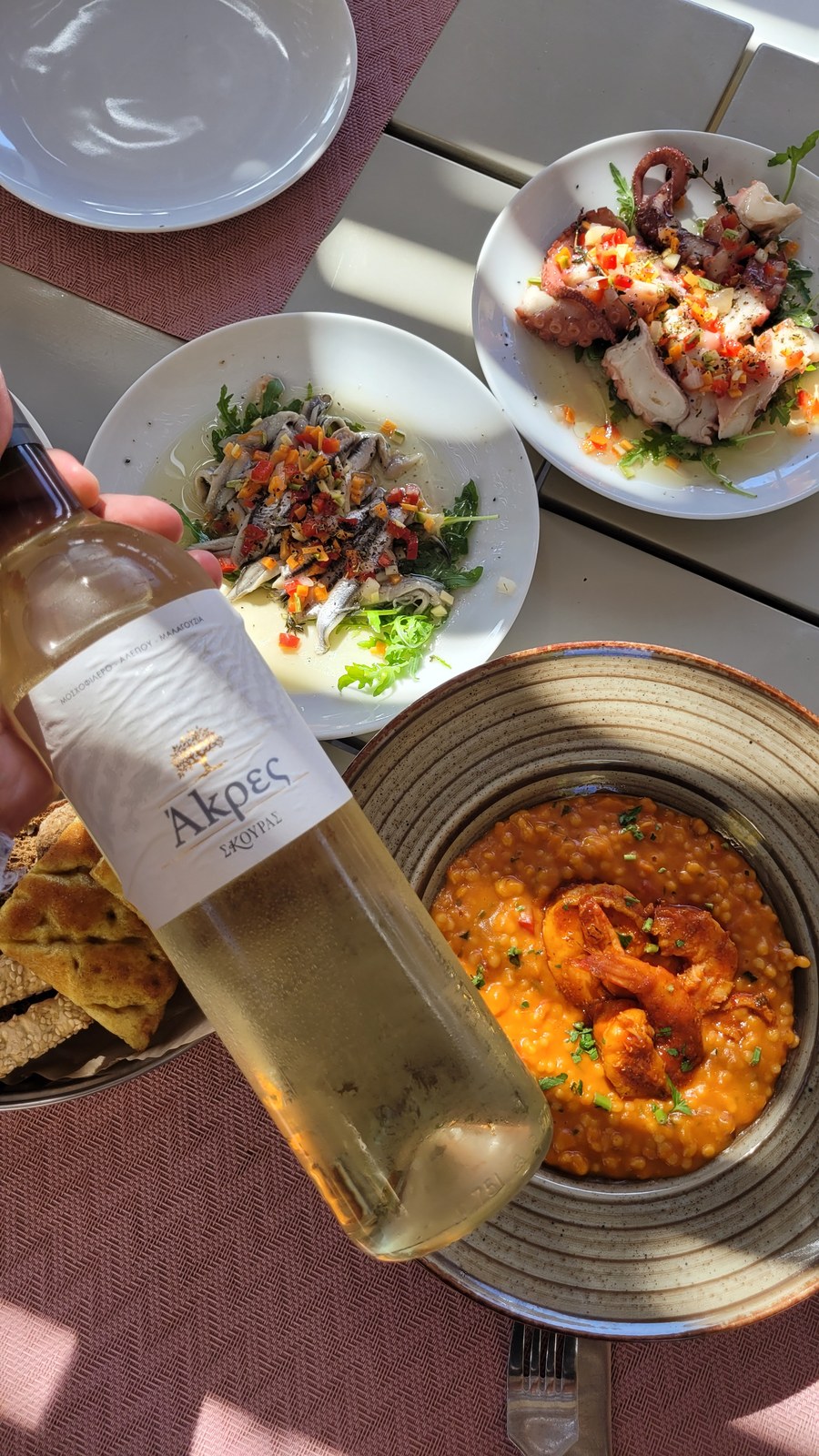
Akres is the unpretentious everyday red from Domaine Skouras, retailing at around €8, a blend of 90% Agiorgitiko and 10% Cabernet Sauvignon from the Peloponnese. You can read it as the little brother of the famous Megas Oenos, the same Agiorgitiko-Cabernet concept, only here, instead of being aged in new barriques, it is deliberately kept lean, with fermentation and brief extraction in stainless steel, full malolactic fermentation, a short spell on the lees and a screw cap. So no oak and no harsh tannin extraction, but rather a fruit-driven, early-drinking red.
I have nothing against Agiorgitiko as a Greek signature in a Bordeaux-style Cabernet-Merlot blend. What bothers me is the more recent tendency, when Agiorgitiko gets only a single blending partner, to pair it mostly with a Syrah. For the more thoroughbred wines, the ones that are more fun, I consider Cabernet Sauvignon the better choice, and of all wines it is this Akres that demonstrates the point, even though it is not at all conceived as a hulking heavyweight.
2025 was not an easy year in Nemea. Drought stress, smaller berries and markedly reduced yields shaped the summer, yet the final ripening went well, without heat spikes, with dry weather and healthy grapes. For a lean stainless-steel wine this means a touch more color and concentration than in a lush year, without it becoming heavy, and the high-altitude sites keep the freshness.
Curious to see what the small Cabernet addition would do, I tasted it. On the nose it is very floral, the varietal violet of Agiorgitiko, plus a hint of eucalyptus in which one senses the Cabernet. On the palate a demanding tannin that at first dries the mouth a little, but then makes way for an at least medium-length finish. There are not many layers of flavor to tease apart; the wine is not especially complex.
And yet this succeeds better than the often-praised Geometria from Lafazanis, which I now know across two vintages myself, at what an Agiorgitiko without oak is supposed to achieve, namely character and genuine drinking pleasure. The backbone and the slight punch come from the Cabernet, which the single-varietal Lafazanis deliberately does not pursue. But then you have to pull it off as cleanly as is done here, otherwise you might be better off doing without it entirely.
Astonishingly good for what it sets out to be, really nothing to fault and cleanly executed throughout. For me that's 87 points.
Tasted: June 2026