
Malagousia: The Greek White Grape That Was Saved
In a nutshell
Colour – White – dry, plus one great sweet exception
Name – Greek Μαλαγουζιά, pronounced ma-la-goo-ZYA; also spelled "Malagouzia" on labels
Home – originally western Greece on the Gulf of Corinth; grown from Macedonia to the Peloponnese
Appellations – not a single PDO – Malagousia is sold everywhere as a regional wine (PGI)
Typical – peach, citrus blossom, jasmine, green herbs – medium body, mild to medium acidity
Styles – from lean and acid-driven to opulent and musky – the grape follows the cellar
Comparison – as adaptable as Müller-Thurgau, not fixed like Muscat
All scores on this page come from our own tastings; we do not sell wine. Where we quote a figure like "from 32 of our own tastings", we count wines that are varietally pure or at least half Malagousia – blends with a small Malagousia share stay out.
What is Malagousia?
Malagousia is the grape with the best rescue story in Greece. Its old home lies in the west of the country, on the Gulf of Corinth around Nafpaktos and Mesolongi – and there it very nearly disappeared. By the middle of the twentieth century the variety stood on the brink; a protected designation of origin never came its way. Every Malagousia on the shelf is a regional wine, no matter how good it is.
That it still exists is owed above all to one man. Evangelos Gerovassiliou came to know the almost forgotten grape as the oenologist of Porto Carras on Chalkidiki and recognised what it could do. In 1981 he revived the 2.5-hectare family vineyard in Epanomi south of Thessaloniki, in 1986 he vinified his first Malagousia there, and in 1994 the first estate bottling reached the market. The experiment has long since become a movement: our 32 tastings span twelve regional-wine zones from Florina in the north to Ilia in the south-west of the Peloponnese.
The rise has a flip side worth knowing: Malagousia is aromatic, easy-drinking and approachable young – exactly the profile that can turn a grape into an interchangeable summer wine. Our scores range from 83 to 95 points. Between a forgettable and a great Malagousia lie worlds, and this page is meant to help you tell them apart.
What does Malagousia taste like?
The varietal picture: peach and exotic fruit, citrus and jasmine blossom, plus a green herbal streak – basil, mint, sometimes lime leaf. The body is medium to generous, the acidity moderate. So far the textbook.
More interesting is what the grape makes of it. The usual comparison with Muscat is misleading – the better match is Müller-Thurgau: a grape that does not bring one fixed aroma but follows the winemaker. Picked cool and raised in steel, Malagousia turns lean and citrusy; with a late harvest and oak it becomes creamy and opulent. The musky note many take for the core of the variety is really a question of alcohol: it appears mainly above about 13 per cent – and then crowds out the finer floral and citrus tones. Our bottles ranged from 11.5 to 13.5 per cent, and the lighter ones were rarely the lesser ones.
At the table Malagousia is uncomplicated: meze, grilled fish, poultry, anything with herbs. The more opulent examples can also handle creamy sauces and ripe soft cheese.
Epanomi and the north

The Thermaic Gulf near Epanomi, Mount Olympus on the horizon – this sea surrounds the PGI's vineyards on three sides. Photo: Kataadj / Wikimedia Commons, CC BY-SA 4.0
Epanomi is where the rescue happened – and it has stayed the benchmark. The Papamola estate vineyard of Ktima Gerovassiliou sits at 110 to 150 metres, surrounded on three sides by a sea just four kilometres away, on sandy soils over clay and limestone bedrock with marine fossils. "Single Vineyard" here means the contiguous estate vineyard of more than 110 hectares, not a single parcel.
What grows there takes the variety to its peak. The Malagousia Single Vineyard 2020 was, at 95 points, the best dry Malagousia we have ever had in the glass – peach, blossom and herbs in perfect balance, with a length you would not credit the variety with. The 2023 (92) confirms the level, the 2021 (91) stayed behind it – three vintages we each tasted young, which makes them cleanly comparable.
Drama is the second centre of the north – and the region that comes closest to Gerovassiliou. Ktima Erithrou Rodou works with yields below 30 hectolitres per hectare and uses only free-run must, without pressing. The results: 2021 (94, the best non-Gerovassiliou of our line-up), 2024 (92) and 2020 (92) – three vintages, three times near the top. Also from Drama comes the Malagouzia 2025 from Estate Manolesakis (92), while the Malagousia 2019 from Costa Lazaridi (83) showed that a big name of the region is no guarantee.
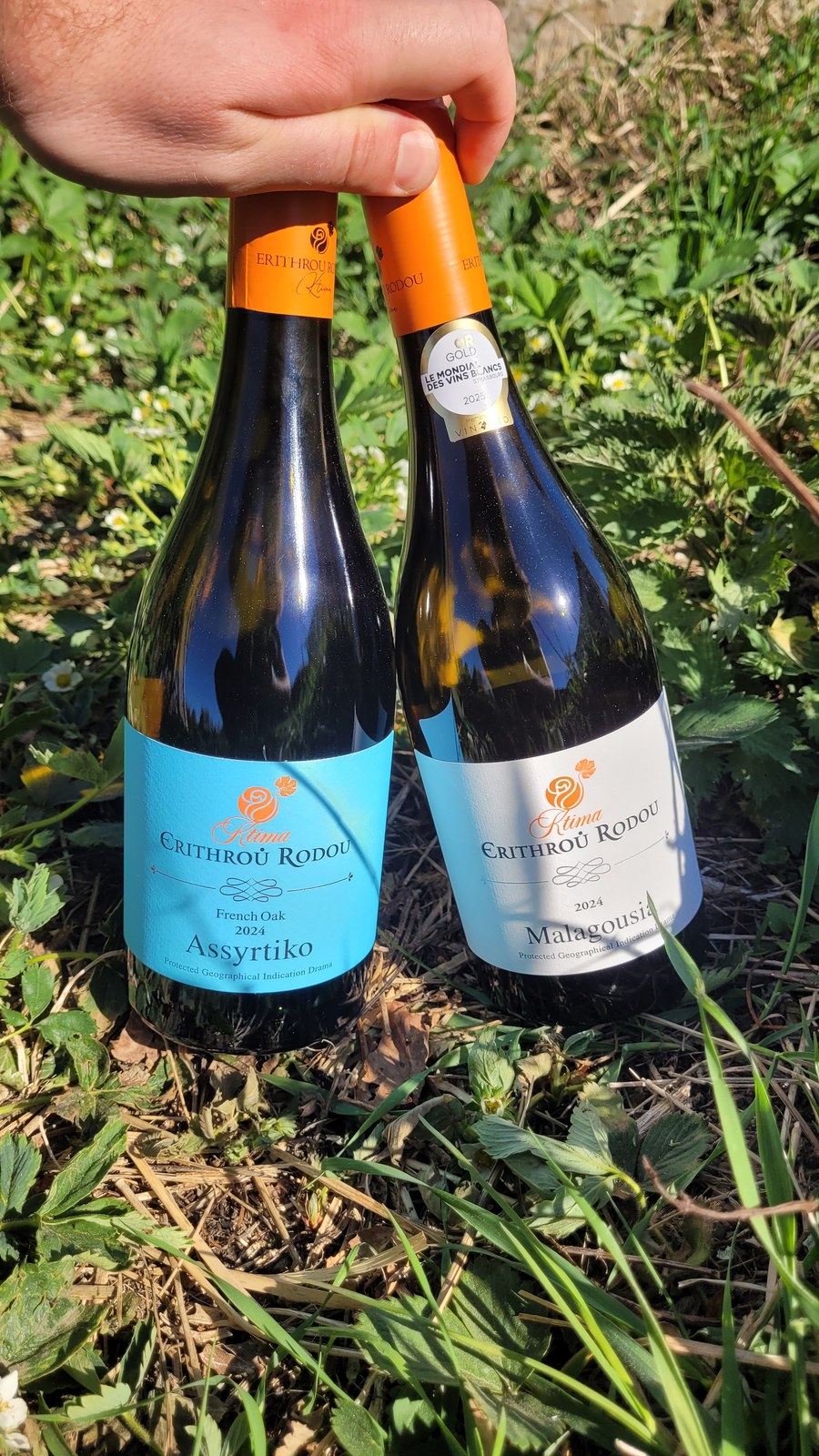
The 2024s from Ktima Erithrou Rodou in Drama – the Malagousia next to its Assyrtiko sibling. Own photo
In the far north-west, in Florina, Alpha Estate stands for the cool reading of the grape. We know the single-vineyard "Turtles" from two vintages: 2025 (92) and 2020 (91) – both precise, herbal, with more drive than most southern examples.
The south and the centre
The Peloponnese contributes as many wines to our Malagousia tastings as Macedonia – the grape stopped being a northerner long ago. The results scatter more widely, though.
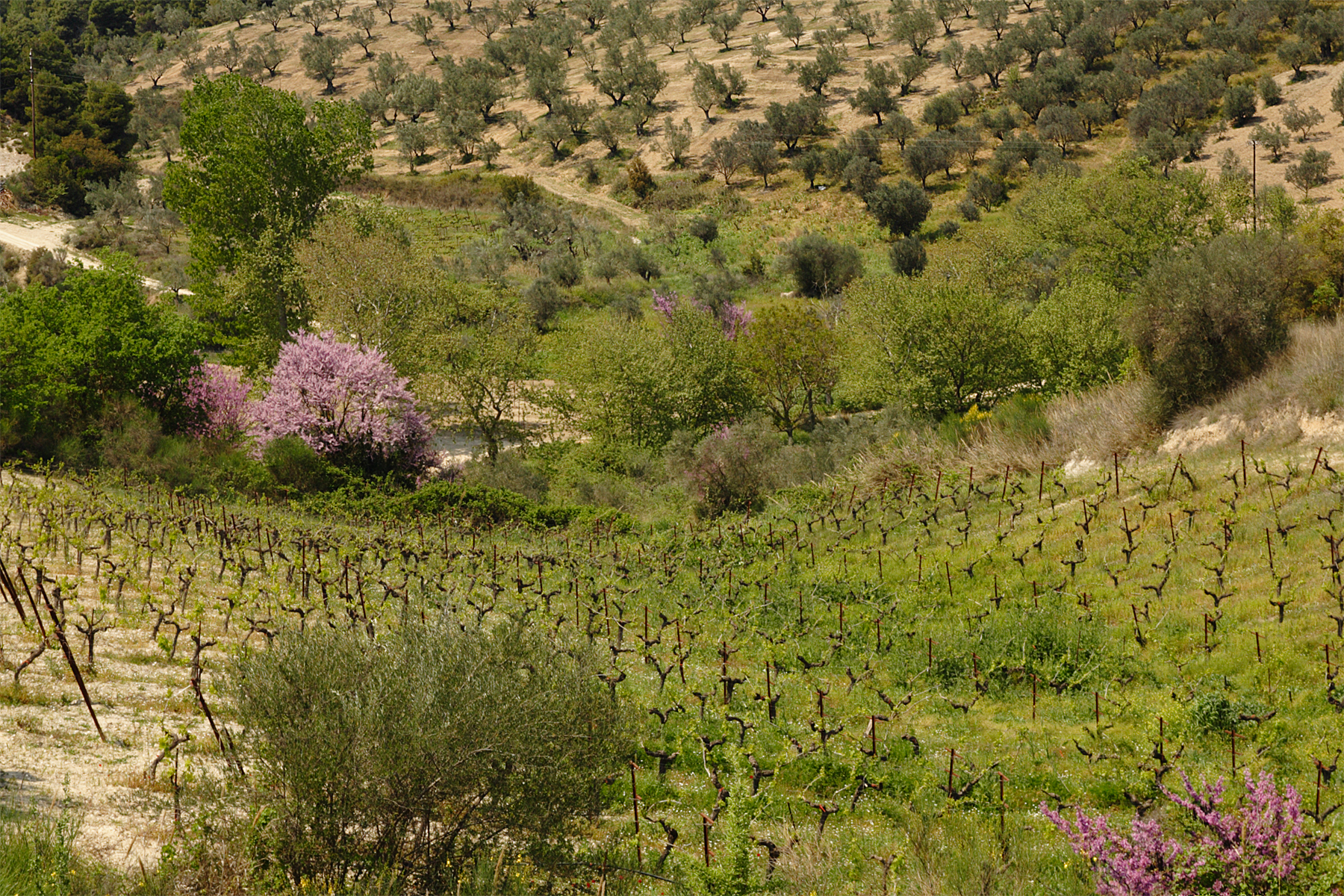
Vines, olives and a Judas tree near Nemea in Corinthia – the cultivated landscape where the southern Malagousias grow. Photo: ulrichstill / Wikimedia Commons, CC BY-SA 3.0 de
The surprise of the line-up comes from Corinthia: the Mavrioros 2020 from Ktima Kissa (93) keeps up with the great names of the north without strain. Behind it, Olympia Land Estate in Ilia shows with the Ekecheiria 2020 (90+) and its regular Malagousia 2020 (89) how much varietal character the south-west can deliver. The Windmill Malagouzia 2019 from Giannikos (90) and the Geometria 2021 from Lafazanis (90) sit on the same solid level. Further down the Peloponnese gets more honest: Nemea Winery (85), Dionysos (84) and Panagiotopoulos (83) show the forgettable side of the grape – clean, easy, interchangeable.
In Attica, Mylonas (90+) convinces from Savatiano country with a driving, salty Malagousia; the Liepouris 2023 (89+) follows close behind. In central Greece the Dryos 2021 from Domaine Hatzimichalis (93+) from the Atalanti valley stands out – one of the highest scores of our Malagousia line-up. The Palaiokastra 2021 from Karadimos (91) from the slopes of Mount Knimida confirms the area, Skoumpris (85) falls away.
Thessaly goes its own way: the Microcosmos from Domaine Zafeirakis from Tyrnavos is the acid-driven counter-position to the opulent varietal picture – a Malagousia closer to cool mountain whites than to peach compote. We saw the 2022 twice: young at 92+, a year later at 91.
The sweet exception – and it sits right at the top
Of the 32 Malagousias in our tastings, exactly one is not dry. And it shares the highest score: the Malagousia from Overripe Grapes 2018 from Gerovassiliou (95) shows what the grape can do when left to overripen on the vine: apricot, honey and blossom, carried by an acidity that takes the weight out of the sweet wine. For a grape with a reputation as an uncomplicated summer white, that is a remarkable double – the same variety, the same vineyard, and at the top a dry and a sweet wine stand side by side.
Does Malagousia age?
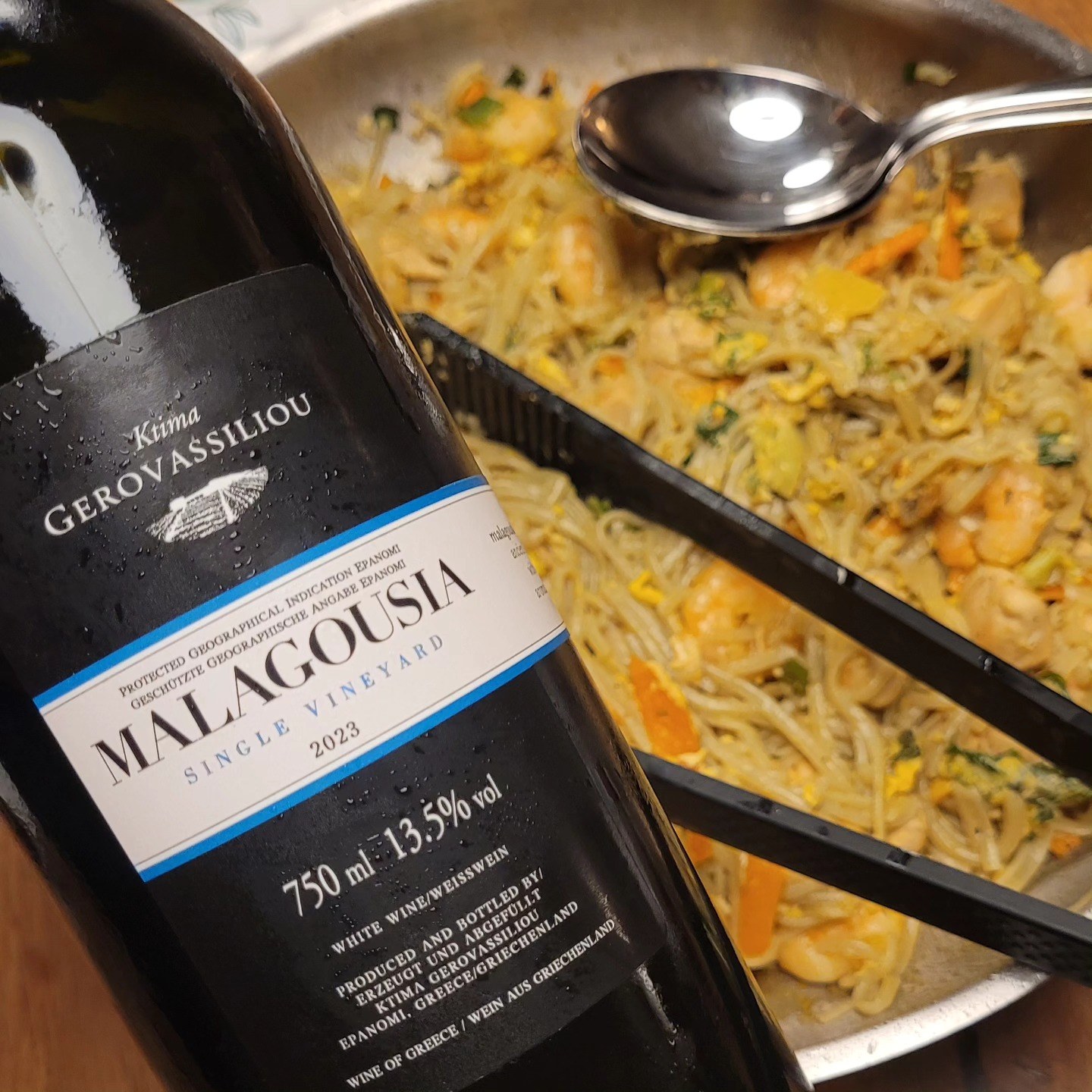
The Single Vineyard 2023 from Epanomi – the wine that gained with bottle age. Own photo
Convention says: drink it young. Two bottles from our tastings tell it with more nuance. The Gerovassiliou Single Vineyard 2023 showed better at almost three years than straight after bottling – we raised our own score from 91 to 92, against every expectation for an aromatic variety. The Microcosmos 2022 from Zafeirakis went the opposite way over a similar span, from 92+ to 91. More than a cautious lesson this does not yield: a well-built Malagousia does not merely survive its first years, it can grow through them – a licence for long cellaring it is not.
Malagousia as a partner
Its best-known appearance in a blend is also its oldest: Gerovassiliou's "White", half Malagousia, half Assyrtiko – the aromatics of one, the backbone of the other. The 2019 vintage reached 93 points with us. Same partnership, different weighting: in the Edenia Bella 2021 from Tsililis Terres (94) Assyrtiko provides almost two thirds, and with 35 per cent Malagousia the result is one of the best white blends in our database. The Stone Hills 2021 from Palivou (91) from Nemea backs the same duo, while the Apla white 2021 from Oenops (88) blends Malagousia with Assyrtiko and Vidiano – here she even leads, with half the blend.
The white grape even turns up in rosé. The Mochthos 2020 from Patsouros (90) pairs her with Syrah, and in the Clos Stegasta Rosé from T-Oinos on Tinos ten per cent Malagousia supplies the floral top note – the 2022 (94+) is the highest-scored rosé in our entire database, the 2023 (91) stays strong. As the lead grape of a rosé, though, Malagousia has never crossed our glass – a gap some winemaker will fill one day.
The grape's quiet reserve shows where she is merely support: in Hatzimichalis' Alfega (89) she keeps pace with Sauvignon Blanc, in the Alepoudaki from Patsouros (89) she tames the Moschato.
Which vintages?
Malagousia is bottled young and mostly drunk within two or three years – the vintage question settles faster here than with the great reds. A look at our vintage database still pays, because the harvest years of the two centres are anything but parallel.
Epanomi. The strong year was 2020 (8 out of 10) – the 95-point Single Vineyard comes from it. 2019 sat higher still at 8.5, and 2025 reaches an 8 again. In between lie smaller harvests: 2023 came to a 6 – all the more remarkable that the Single Vineyard from exactly that year gained with bottle age in our glass. For 2021 no harvest report from Epanomi exists; the year remains unrated, and the 91-pointer from that vintage stands on its own. 2022 sits at an 8 for the whites – the white grapes were picked before the September rain came.
Drama. Here 2020 was the exceptional year (8.5) – the 92-pointer from Erithrou Rodou comes from it. 2025 promises much again at 8, and the Manolesakis from that harvest (92) already delivers on it. The best Drama Malagousia of our line-up, however, the 94-point Erithrou Rodou 2021, came from a middling year (7).
The south and the centre. On the Peloponnese 2020 was solid (7.5) – the year of Kissa's 93. In 2021 the peninsula dropped sharply (5.5), as did Lokris (5.5) – and yet that is exactly where the Dryos (93+) and the Palaiokastra (91) of that vintage come from. Attica swung between a weak 2023 (5) and decent years in 2021 and 2024 (7 each).
In practice this means less than the numbers suggest: the highest scores of our line-up are spread across strong and middling harvests alike. If you want to reach for the years the harvest reports also rank highest, take 2019, 2020 or 2025 in the north.
The best Malagousias of our tastings
95 – Ktima Gerovassiliou Malagousia from Overripe Grapes 2018 · PGI Epanomi · sweet
95 – Ktima Gerovassiliou Malagousia Single Vineyard 2020 · PGI Epanomi
94 – Ktima Erithrou Rodou Malagousia Single Vineyard 2021 · PGI Drama
94 – Ktima Gerovassiliou Malagousia 2025 · PGI Epanomi
93+ – Domaine Hatzimichalis Dryos 2021 · PGI Atalanti
93 – Ktima Gerovassiliou White 2019 · PGI Epanomi
93 – Ktima Kissa Mavrioros 2020 · PGI Corinthia
92 – Alpha Estate Malagouzia Turtles 2025 · PGI Florina
92 – Estate Manolesakis Malagouzia 2025 · PGI Drama
92 – Ktima Erithrou Rodou Malagousia 2024 · PGI Drama
92 – Ktima Erithrou Rodou Malagousia 2020 · PGI Drama
92 – Ktima Gerovassiliou Malagousia Single Vineyard 2023 · PGI Epanomi
91 – Alpha Estate Malagouzia Turtles 2020 · PGI Florina
91 – Domaine Zafeirakis Microcosmos 2022 · PGI Tyrnavos
91 – Karadimos Palaiokastra 2021 · PGI Slopes of Knimida
91 – Ktima Gerovassiliou Malagousia Single Vineyard 2021 · PGI Epanomi
90+ – Mylonas Malagousia 2021 · PGI Attica
90+ – Olympia Land Estate Ekecheiria 2020 · PGI Ilia
90 – Giannikos Windmill Malagouzia 2019 · PGI Peloponnese
90 – Lafazanis Geometria 2021 · PGI Peloponnese
All other Malagousias we have tasted
Liepouris Malagousia 2023 (89+) · Lafazanis Geometria Malagouzia 2020 (89) · Olympia Land Estate Malagousia 2020 (89) · Estate Manolesakis EXIS White 2025 (88) · Oenops Apla white 2021 (88) · Nemea Winery Malagouzia 2021 (85) · Skoumpris Malagouzia 2021 (85) · Dionysos Malagousia 2021 (84) · Domaine Costa Lazaridi Malagousia 2019 (83) · Panagiotopoulos Malagousia 2020 (83)
Read on
· Herbs, Fruits, Flowers – What'll It Be? –
the big comparative tasting that twelve of these notes come from: Malagousia across Greece, wine by wine.
· Blumenstrauß mit Silberband –
aromatic varieties compared, Malagousia against Moschofilero and Chardonnay (in German).
· Assyrtiko as a Team Player –
where Gerovassiliou's "White" appears in the context of its Assyrtiko partners.
· All tasting notes in our database
Newsletter: If you want finds like these delivered straight to your inbox: sign up for our newsletter.
The verdict
Malagousia is the entry point to the Greek white-wine shelf: aromatic, approachable, available at almost every price. That is precisely its risk – many examples never rise above pleasant summer wine. If you take the grape seriously, look for the single vineyards of Epanomi and Drama, try Zafeirakis for the cool counter-position, and treat yourself once to the sweet exception. Then the rescued grape shows why the rescue was worth it.
Picture credits
Landscape photographs via Wikimedia Commons: Kataadj – Epanomi, Thermaikos, Greece (CC BY-SA 4.0) · ulrichstill – Nemea Wine-Olives Corinthia Peloponnese (CC BY-SA 3.0 de). The two bottle photographs are from our own tastings.