
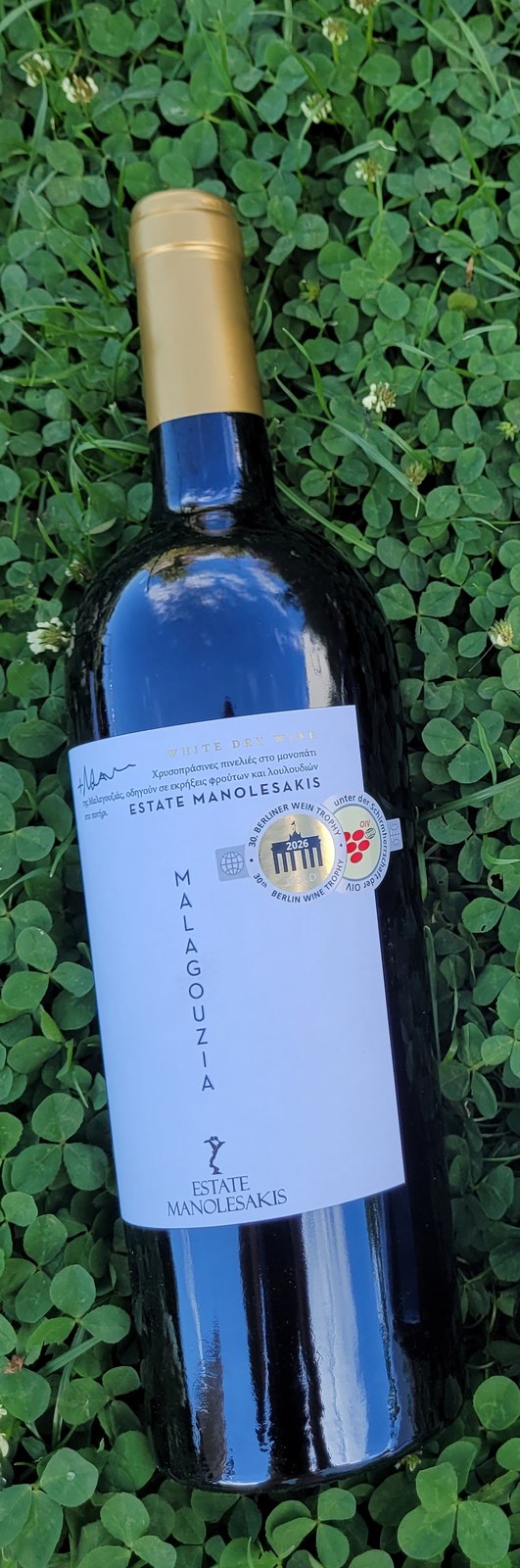
Estate Manolesakis – Malagouzia 2025
PGI Drama
100% Malagousia
Macedonia, Greece
White | dry
11.5%
Adriani is a village in the regional unit of Drama, and Drama is a special case among Greece's wine regions. It is one of the very few without access to the sea, screened all around by mountains, running a continental course and, with the local May rains, receiving considerably more precipitation than the rest of the country. The vintage here therefore often bucks the national trend. In 2025, exceptionally, everything pulled in the same direction. Ample winter snowfall around Falakro and Menikio replenished the water reserves of a region that in the hot 2024 had reached the limits of its irrigation. Mild temperatures during ripening let the grapes mature calmly, and the harvest began on 7 August, well within the normal range and far removed from the July record of the previous year. For the first time, Adriani received its own paragraph in the harvest bulletin of the Greek wine association, and it describes a balanced year with favourable day-night swings and a trouble-free harvest from mid-August into September, interrupted by a few cool rains that were, if anything, beneficial to aromatic ripeness. For Drama, that makes 2025 the strongest vintage since 2020, and the aromatic whites lead the way in this picture. It should be added that so far this is an expectation drawn from a harvest report and not a verdict based on later tasting.
Ktima Manolesakis has been working in Adriani since 1989 and is among the estates that revived the village's viticulture. In 1998 came its own winery, and from 2004 Greek varieties increasingly made their way into the vineyards, among them Malagouzia. This wine comes from a single hectare, a dedicated plot laid out in rows that used to be called "the passage of the horses". Nobody today can say why; the name has been handed down, its origin has not. The parcel lies at 200 to 300 metres, the soil is clayey and studded with small pieces of limestone that provide drainage. At 500 kilos per stremma, that is 5,000 kilos per hectare, the yield is very low, and it is deliberately forced. In a green harvest, unripe grapes are cut away so that the rest ripens cleanly. Picking is done at night, so the grapes arrive cool in the cellar and go into the pre-fermentation cold extraction without temperature shock. The wine then rests for two months on its fine lees and three months in new acacia barrels. Acacia instead of oak is the real decision behind this wine, and it is rare enough to be taken seriously.
And this is exactly where things became interesting in the glass. For me, 2025 is shaping up to be a Malagouzia year anyway; the Turtles from Alpha Estate in PGI Florina stood at 92 points in June, and this one follows suit. The nose alone is decidedly distinctive. Jasmine blossom, along with a fine trace of mint, and by no means in that overwhelmingly perfumed form that Malagouzia can take on if you let it. On the palate the wine sets out surprisingly full and creamy at first, and the acacia ageing comes through beautifully, not as an obvious woody note but as something reminiscent of acacia honey. The combination of jasmine blossom, varietally typical Malagouzia aromatics and this honeyed note is unusual, and I had not encountered it quite like this before. In none of my previous Malagouzia notes does jasmine appear, and neither does ageing in acacia wood. What is interesting here is that the jury of the Decanter World Wine Awards also noted jasmine on the 2024 of this wine, alongside kiwi, gooseberry and green herbs. So it looks less like a snapshot than the recurring expression of this parcel and this style of making.
The result is a rounded, sophisticated and thoroughly harmonious wine. The finish, too, is fairly long. There is a small dip in the last third of the palate, where the very moderate alcohol of 11.5% does not quite carry the fullness of the attack through to the end. This is the only point at which the fine-lees ageing and the acacia promise more than the underlying framework delivers. On the positive side there remains a very respectable acidity for Malagouzia, which keeps the wine memorable despite the creaminess and prevents the floral and honeyed side from feeling heavy.
At the estate the wine costs 21 euros. For a white from a single hectare, with green harvest, night harvest and three months of new acacia, this is no bargain, but it is fair. Within its own range it clearly sits above the entry-level wines of the EXIS line and below the red Pelagia. A very accomplished, individual interpretation of the variety, one worth treating yourself to even if you have already had a few Malagouzia in the glass. For me that is 92 points.
Tasted: August 2026