
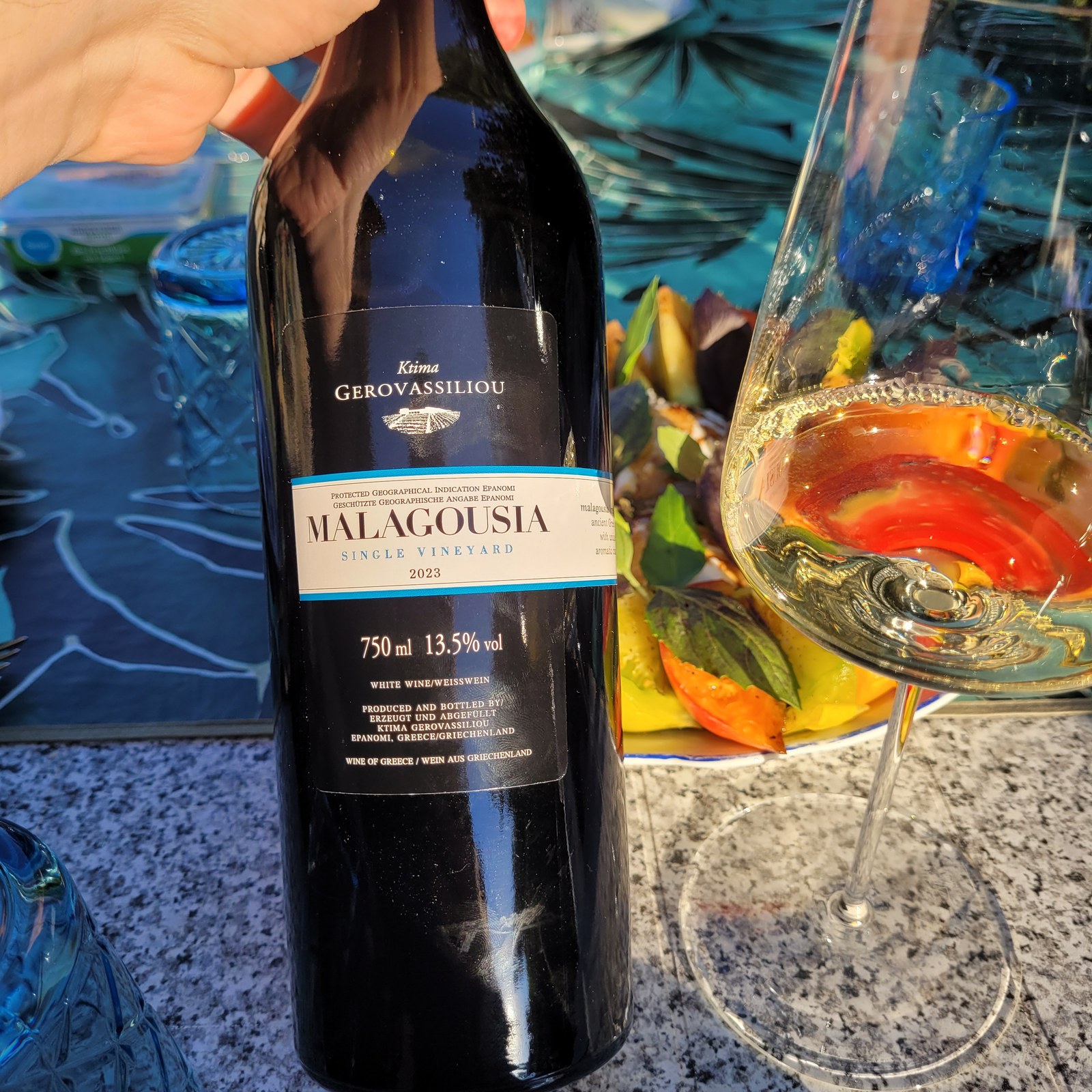
Ktima Gerovassiliou – Malagousia 2023
Single Vineyard
PGI Epanomi
100% Malagousia
Macedonia, Greece
White | dry
13.5%
Anyone who tastes Greek wines does not want to be uncritical, and constructive criticism is part of the job. Sometimes, though, you realise in hindsight that you overshot the mark. That is exactly what happened to me with this 2023, and this note is the correction.
A little backstory. The Malagouzia from Ktima Gerovassiliou has been quite the roller coaster for me across the vintages. In 2021 I rated the 2020, with a year of bottle age, at 95 points, and that was no fluke but a wine that released a wave of peach into the room the moment it was uncorked. I tried the 2021 in 2022 at the same age and arrived at 91. It lacked fruit, which was fighting against a floral overlay, and the difficult summer made itself felt. I then had the 2023 in 2024, again with a year of bottle age, likewise at 91 and placed rather at the lower end of this run. Because all three tastings took place at the same wine age, the comparison is unusually clean. What differs is genuinely the vintage and not the maturity.
And the vintage gave reason for restraint. As a maritime flatland site, Epanomi lies on the Thermaic Gulf, climatically the opposite of the Macedonian neighbours with which people like to lump the appellation. Naoussa is a continental slope site, Amyndeon sits at 600 to 700 metres, and Drama has no access to the sea at all. The coastal location buffers heat and punishes moisture, and 2023 was a wet year. The estate itself describes the vintage as late and labour-intensive, with strong fungal pressure, but reports the grapes as healthy in the cellar; the Malagouzia was picked by 7 September at the latest, so still before the September rainfall. For Epanomi, 2023 thus remains an average year that expressly does not make the leap Naoussa made in the same year, and it lies very clearly below 2020. Part of this is the observation that the reporting on Epanomi is at its core the harvest report of this very estate. There is no independent second voice for this appellation.
The addition "Single Vineyard," by the way, does not refer to an individual parcel here but to the contiguous estate vineyard at Papamola, which now covers over 110 hectares and is therefore an unusually large single vineyard. It sits at 110 to 150 metres, on sandy soils with clayey subsoils and calcareous rock in which marine fossils are found, and it is surrounded on three sides by the sea, just four kilometres away. Evangelos Gerovassiliou, who as oenologist at Porto Carras saved the Malagouzia from extinction, began reviving the then 2.5-hectare family vineyard in 1981; the first vinification here took place in 1986. The wine itself, after cold skin contact, ferments predominantly in stainless steel at 18 degrees, with a smaller portion in French oak, after which it rests several months on the lees.
With this expectation in mind, that is to say a weaker vintage, almost three years on the clock and a variety regarded as one to drink young, the wine in the glass was a surprise. Well stored, it has developed superbly. On the nose it does indeed show stone fruit. On the palate it now possesses a wonderful texture, really good acidity for a wine from this variety and, alongside, a lovely creaminess; nothing more is really needed. The 13.5% suits it exceptionally well, there is nothing hot about it, and the whole thing comes across as round and balanced. Even almost three years after the harvest, there is not a trace of oxidative notes. Above all in the mid-palate and the finish it presents itself remarkably consistently, and it now makes an excellent food companion, one that can certainly handle heartier dishes too. It is this texture, combined with the fruit that keeps stirring and, even in a second and third echo, still very gently pokes its head out and recalls the fruitier vintages of this wine, that now makes it truly outstanding for me.
Compared with the 2020, the lush nectarine is of course missing, that peach wave of back then. By now, though, I see the 2023 less as a disappointing compromise than as a wine with backbone, over whose fundamentally more serious, more structure-driven character fruity overtones keep settling.
That is remarkable beyond this one bottle, too. Of the wines where I have had the same vintage in the glass several times over the years, close to two thirds have held steady or declined, while a good third have gained. Of all things, a Malagouzia now belongs to that group, while the only other Malagouzia in this run, the Microcosmos from Domaine Zafeirakis in the 2022 vintage, took the opposite path between 2023 and 2024.
The external criticism of this wine was above mine from the outset. Peter Moser gave it 93 points for Falstaff in April 2024 and expressly credited it with ageing potential, Monica Larner in the Wine Advocate in September 2025 gave it 92 points, the Decanter World Wine Awards 2024 silver with 91 points, and on top of that came gold at the Concours Mondial de Bruxelles. Moser's note on the ageing potential in particular reads, from today's perspective, as more accurate than my restraint at the time.
In terms of price the wine makes a statement anyway. In Greece it stands at around 17.70 euros, in Germany at about 24 euros, and the current vintage costs the same, unchanged, in Greece. For a white wine that after three years seems not tired but better, that is a very good ratio. This is why I am revising my earlier rating upward. For me that is 92 points.
Tasted: August 2026