
T-Oinos – Clos Stegasta Rosé 2023
PGI Cyclades
35% Assyrtiko, 35% Mavrotragano, 20% Augoustiatis, 10% Malagousia
Cyclades, Greece
Rosé | dry
12%
T-Oinos is the prestige project of Alexander Avatangelos and Gérard Margeon on Tinos: conceived as an idea in 1999, planted from 2002, on the market with its first wines in 2008, and advised by Stéphane Derenoncourt since 2016, while Thanos Georgilas – previously at Opus One and Château Latour – makes the wines. It is a place with a deep history, for winemaking traces on Tinos date back to 4,000 BC, twenty different wines were counted in 1768, and until 1909 the island filled around 30,000 barrels a year. The vines – bush vines, individually tied to stakes against the wind, 10,000 plants per hectare at a yield of just 25 hectolitres – grow at 400 to 450 metres in the Stegasta, Sparveri and Agios Dimitrios parcels, on granite and sandy loam or schist respectively. Stegasta, the roughly 470-metre-high plateau with its granite boulders, owes its name to the Greek word for "roofed," after the sheltered old pressing sites in the vineyards; the Meltemi cools things here by three to four degrees, and summer fog serves as protection from the sun. And yes, wild goats are a genuine plague.
The Clos Stegasta Rosé is the house's top rosé, positioned clearly above the simpler Mavrosé. It is made from 35% Assyrtiko, 35% Mavrotragano, 20% Augoustiatis and 10% Malagouzia, direct-pressed, fermented in stainless steel with yeasts isolated from the estate's own vineyards, and aged up to six months on the fine lees. 2022 was the first vintage of this wine – and that is exactly where the real story lies for me, because I tasted the 2022 in 2024 at around two years of age and rated it 94+, thus with explicit ageing potential. The 2023 comes in three points below that for me.
As a vintage, 2023 almost explains this gap by itself. The blend, planting density, yield and vinification have remained identical to 2022, yet while 2022 is regarded as an excellent, cool and homogeneous vintage (the wine came in at 13%), 2023 was warm and low in rainfall, with late budbreak and heat peaks. The harvest was correspondingly earlier – on 15 September instead of 18 September – and only 12% ends up in the glass. T-Oinos does not publish acidity figures, but the picture fits: the earlier, tighter harvest in the hot year saved the acidity, while texture and complexity remained thinner.
That matches my impression exactly. The nose is quite herbal, with green apple, but overall relatively restrained. On the palate the attack is very forceful, then a strong acidity takes command, accompanied by a friable mouthfeel – by no means as supple as the house's own Mavrosé 2025, which I tasted alongside it. The complexity one would hope for instead is not there, and in the finish little remains apart from the acidity; only a slight bitter note draws attention to itself once more. The ageing potential I saw in the 2022 I do not see here.
James Suckling saw it differently in January 2025, awarding the 2023 94 points, and Simos Georgopoulos of FNL came in at 8.5 out of 10. My verdict lies well below that. 92 might perhaps still be justifiable, but the cohesive overall impression is lacking, as is the complexity on the finish. At around 60 euros in Greece – a high-priced rosé segment, well above the Mavrosé at around 35 euros, which for me sits on the same quality level – that is an honest point of friction.
91 points.
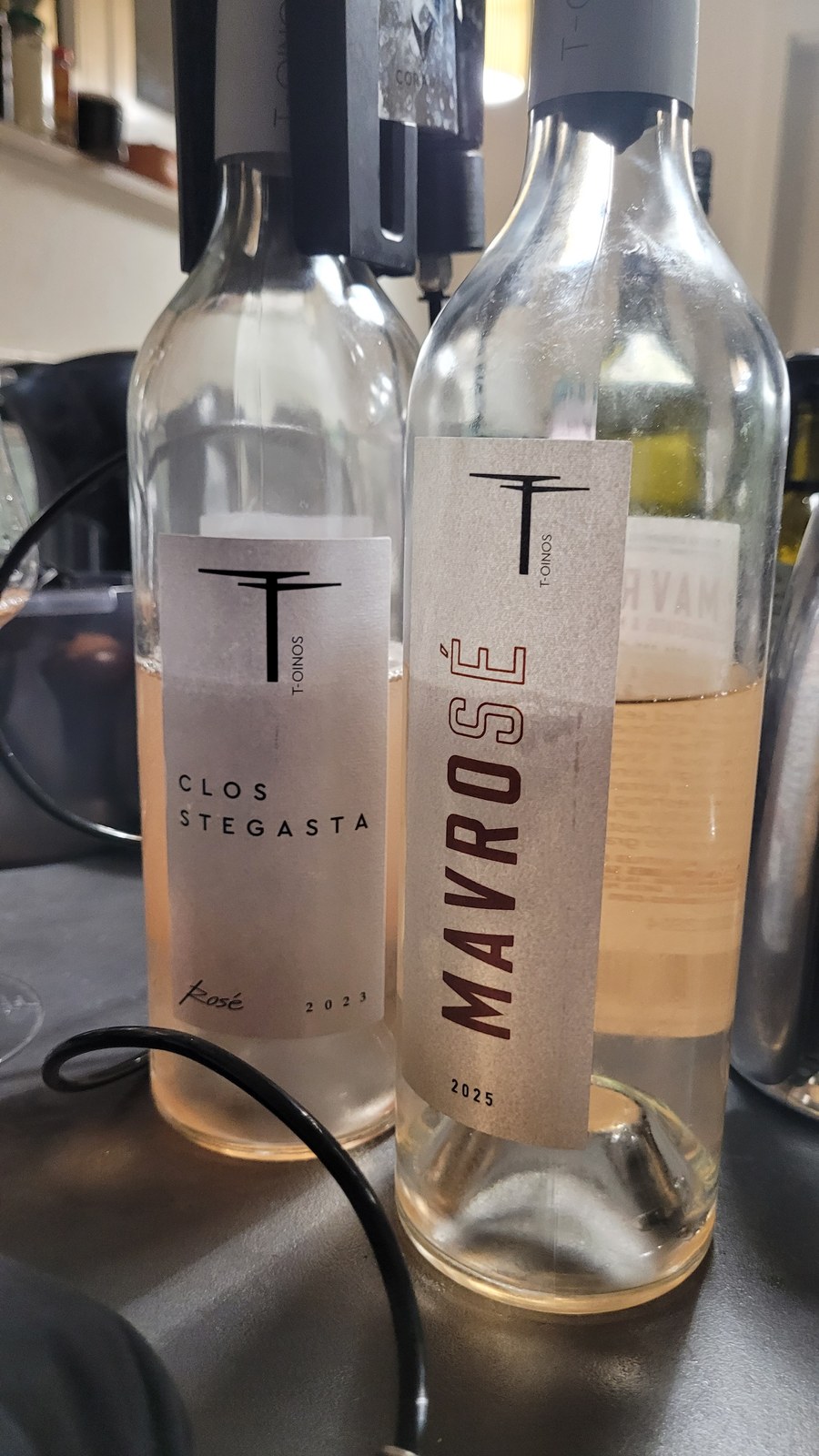
Tasted: May 2026
Other vintages:
T-Oinos – Clos Stegasta Rosé 2022 (94+, 2024)