
Limnio – from Aristotle to the Greek wine revolution

Updated: Aug 17
Which Greek red grape variety do you suppose sits in most of the bottles in my collection? No, not Xinomavro (in German) – I own that mostly as a single-varietal wine, which limits the number. No, not Agiorgitiko (in German) either, which is also often used as a blending partner – though then rather in cuvées with international varieties, usually more as a small addition to Bordeaux blends with Cabernet Sauvignon and Merlot. (For how it tastes as a single varietal, see our Agiorgitiko guide.) No, I'm talking about Limnio (not to be confused with Limniona), a variety that leads a widespread but inconspicuous existence in a great many bottles.
Limnio comes from the island of Limnos in the north-eastern Aegean, where it is traditionally known by the local name Kalampaki – named after the barren, dry hilltop sites on which it was grown. There is good reason to identify it with the ancient Lemnia grape – the vine that Aristotle described as a speciality of the island of Lemnos and which could therefore count as the oldest grape variety still cultivated today. True, the wine of Lemnos was already praised by Homer and Hesiod, but these early sources do not name the variety itself – only Aristotle actually pins the grape down. That makes Limnio one of the most culturally and historically charged grape varieties in Greece. In quantitative terms, however, the picture is modest: at the beginning of the 1990s, 371 hectares nationwide were still planted with Limnio; by 1999 the area had shrunk to 122 hectares. Even on its home island Limnio is a marginal presence today: as late as 1947 there were 7,000 stremmata (1 stremma = 0.1 ha) of Limnio there as against 5,000 stremmata of Muscat of Alexandria. Meanwhile the ratio has reversed: 7,000 stremmata of Muscat, only around 400 stremmata of Limnio. The variety was simply displaced by the higher-yielding Muscat.
Today the variety's centre of gravity is northern Greece. The most important appellations are PDO Limnos (single-varietal) and PDO Slopes of Meliton in Sithonia/Halkidiki, where the red PDO wine consists of 70 % Limnio and 30 % Cabernet Sauvignon or Cabernet Franc. Beyond that, Limnio is found in the PGI areas of Halkidiki, Mount Athos and Ismaros/Maronia in Thrace – and, of course, as a blending partner in countless blends from Macedonia.
In the glass, Limnio is anything but the prototypical dark, massive Mediterranean red. The colour is of rather moderate intensity, the aromatics shaped by fresh red berries and aromatic herbs, the tannins silky, the acidity medium, the alcohol on the higher side. Vinified as a single variety, this often yields astonishingly elegant wines; in blends, Limnio brings freshness, contour and definition.
At a tasting almost exactly a year ago, in April 2025, we wanted to taste our way through Limnio in its various guises, and for that purpose opened a range of wines and vintages.
The youngest wine of the tasting was the Avaton 2021 from Ktima Gerovassiliou (PGI Epanomi, 14.5 % vol). The blend is mostly Limnio, with smaller amounts of Mavrotragano and Mavroudi. Mavrotragano, after all, has lately been making a name for itself beyond Santorini too. Mavroudi is an important variety in northern Greece, even if it is genetically often very ill-defined. The standing of the Limnio variety for Evangelos Gerovassiliou becomes clear when you consider that the winemaker singled it out as the red counterpart to the Malagousia he rescued – even if the identically shaped bottle, in its red version, isn't a single-varietal wine at all. On the nose plenty of dark berries, but also plenty of spices and herbs, plus a little cherry and a trace of cocoa. On the palate the tannin is rather restrained at the front of the mouth. It all happens at the back of the palate. There, some quite green notes come through, and also a certain bitterness that is still quite distracting at the moment. On the finish, though, the wine is really rather delicate – some ethereal and floral aromas come through as well. 92+ points – but definitely lay it down for a few more years. It still seems too young. Will more come of it?

In general I am a little unsure about the young Avaton vintages. It seems to me that there could be a tendency here of the kind I otherwise know from Gerovassiliou's Syrahs and Syrah-based wines: too many angular green notes that require a great deal of maturity and make it hard to catch the perfect moment. Some of these wines pass their peak before they shed their unruly youth.
Another data point: at a separate tasting in December 2025 I had the Avaton 2020 in the glass (14 % vol), which drinks very easily and was marked by a lot of nougat – aromatically rounder than the 2021, but likewise still at "only" 92+ points, because the tannin is still very much in the foreground.

The Avaton 2017 (likewise 14.5 % vol) is a case study that argues against the idea that much more will come of the 2021. We last tasted it in 2021 and back then, at the tender age of only four years, already awarded it 94 points. At the time it showed wonderfully clear red fruit on the nose, underpinned by discreet sage notes. On the palate distinct nougat was added, wrapped in wonderfully fine tannins that were neither overly silky nor mushy. A wine that drank fantastically – only on the finish did the alcohol after all dominate a touch too much. Four years later, at the tasting in spring 2025, the wine had changed remarkably. Much of the nougat that was so appealing back then has faded. The nose is now much more narrowly focused on red fruit, plus some vegetal notes such as beetroot and slightly bitter hints of orange zest or kumquat. On the palate an extreme concentration of eucalyptus aromas stands out, of a kind I have rarely encountered in Greek wines – you would sooner think of a Cabernet from Australia. Overall clearly less aggressive than the 2021, but also no longer quite as delicate as at the first encounter. The alcohol remains relatively noticeable. Ultimately 92 points – the wine has not developed in the hoped-for direction.

That said: a few days after the tasting I tasted again to see how the wines develop with oxygen. With the 2017, the nougat does indeed come back with plenty of air. But it quickly shows oxidative notes and rapidly becomes the poorer choice – slipping down to 90 points. The Avaton 2021, by contrast, is now no longer quite so austere and demanding. It shows its juniper, its blackberry, its good structure. So there is certainly reason to hope that in a few years it will still climb to 93 or 94 points.
The Ktima Gerovassiliou Red 2019 (PGI Epanomi, 14.5 % vol) is the estate's house wine – and here it is dominated by Syrah. Limnio and Merlot account for only around 20 % each. So are we hitting the problem I just complained about – twice over? But – what a wonderful, delicate nose. Delicate and at the same time densely packed with all manner of fruit, some strawberry too, a little in the way of aromas of dried rose-hip blossom. But everything still very fresh. On the palate the soft Merlot caresses you at first, before the Syrah takes over and largely defines the wine. 91+ points – I am pretty enthusiastic about this vintage and am sure that in five years it will be a quite outstandingly matured wine at 93 points. What also makes me confident here is that I tasted the 2008 vintage (back then still a blend exclusively of Merlot and Syrah) with 15 years under its belt and it was still clearly worth 90 points – remarkable for an entry-level wine.

After jumping briefly from 2021 to 2017 for the sake of a direct comparison and then returning to 2019, we now pick up the proper descending order again with the 2017 vintage – and in doing so we change the setting. From maritime Epanomi we move to the Athos peninsula. The story of the Tsantali wines from there is too good not to tell briefly: in 1969, during a storm, Evangelos Tsantalis discovered the overgrown vineyards by the monastery of Agios Panteleimon. Together with the monks he began their revival in 1973, and since 1981 the wines have been marketed as "Regional Wines of Mount Athos". The roughly 80 hectares of vines at 220–250 m altitude are predominantly farmed organically. From this site we had no fewer than three wines in the glass that evening – all blends of Limnio and Cabernet Sauvignon, but with different proportions, different ageing and very different ages.
The Metochi Chromitsa 2017 (PGI Agion Oros Athos, 14 % vol), with 65 % Cabernet and 35 % Limnio, relies more heavily on the international partner, with a longer maceration and more time in barrel. On the nose distinctly more barnyardy than the previous wines, plenty of leather. On the palate still very coarse tannin. On the finish a little black tea. Not a bad wine, but rather contrived. A wine that will surely still be performing at a high level in a few years, but it doesn't thrill right now. 87+ points.

Its little brother, the Agathon 2017 (PGI Agion Oros Athos, 13 % vol), splits the varieties 50/50 and matures for around 8 months in French barriques – 2–3 months less than the Metochi. Proper cherry on the nose, a tiny bit of Greek mountain tea. On the palate the herbal side is indeed quite pronounced, which stands out in comparison with the preceding wines. On the finish, however, rather unspectacular. On the positive side it should be noted that it is definitely not a classic Cabernet – Limnio does get its say here. 87 points.

And once again a jump that throws the chronology into disarray – this time a bigger one, straight into the year 2006, from which I also still had an Agathon 2006 in the cellar (14.5 % vol, likewise 50/50 Limnio and Cabernet Sauvignon). Clearly riper on the nose, but little mushroom, and plenty of herbs instead. On the palate too, a lot of tea. Astonishing acidity for 14.5 % alcohol – in fact too strong for any delicate tertiary aromas to come through. Only 85 points, but also no reason to think this wine will fall apart in the next five years.

Also from Athos, but from an entirely different source, come the wines of Metochi Mylopotamos – the small organic winery of the Holy Cell of St Eustathios, a dependency of Megisti Lavra, the oldest monastery on the Holy Mountain. The winegrowing tradition here goes back to before 973 AD. After a long period of decline, the monk Epiphanios spearheaded the revival of the vineyards from 1990; today the vineyard area comprises around 5 hectares, organically farmed. The Metochi Mylopotamos Red 2017 (PGI Agion Oros Athos, 14 % vol) is a blend of Limnio, Merlot and Cabernet Sauvignon. On the nose an almost bewitchingly sweet scent of blossom and sweet red fruit. On the palate pleasing acidity that balances that impression and supplies enough freshness. The finish, however, is then rather short and disappointing. 88 points.
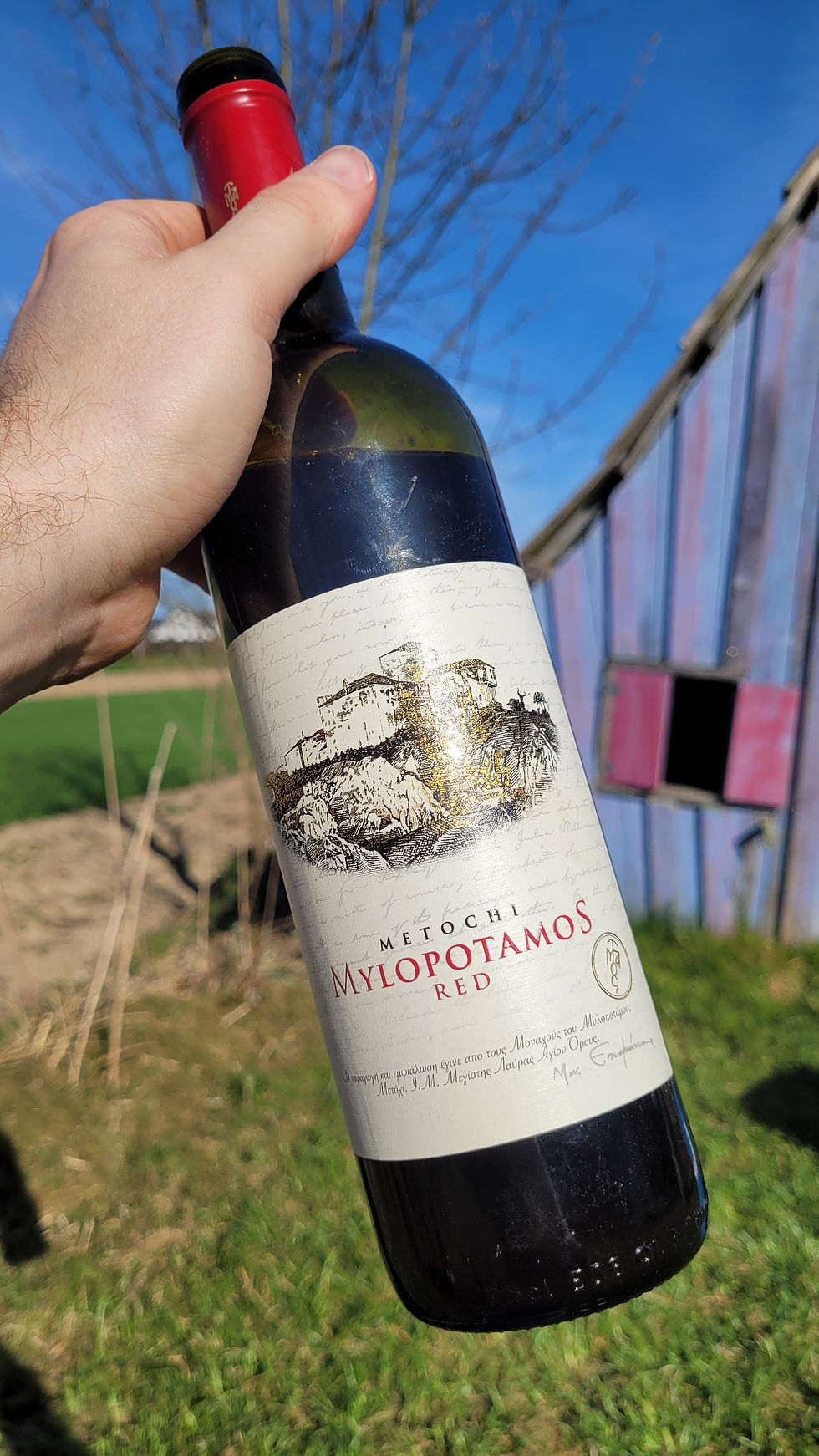
From the same monastery, but a different league: the Mylopotamos Epifanis 2016 (PGI Agion Oros Athos, 14.8 % vol) – the monastery's top product and, according to the best vintage-specific sources, probably 100 % Limnio. Absolutely fascinating nose of plum with some earthy undertones. On the palate outstanding acidity that carries the wine a very long way. Very fine but present tannin that spreads out across the whole palate. Plus a good salinity. Long, herbal echo. An outstanding introduction to the strengths of the variety. 93 points.

Now we jump again. Even further, and this time for good. Into the old millennium – to one of the most significant red wines in more recent Greek wine history, Château Carras, whose more recent releases have disappointed me more than once. (Most recently I had the Château Carras 2012 in the glass in November 2024 in a restaurant in San Diego. That was a strong tannic frame with too little aroma. Admittedly, the rather poor Greek food at Meze Greek Fusion and the sommelier's condescending presentation probably didn't help. So if you add an extra point, I arrive at 91 points. Too little for a wine like this. But I'll get hold of another bottle soon and report back.)

Domaine Porto Carras in Neos Marmaras on Sithonia was one of the most ambitious wine projects of modern Greece. From the mid-1960s onwards, the shipowner Giannis Carras had a vineyard laid out on the slopes of Mount Meliton which today comprises around 475 hectares and is regarded as the largest organic vineyard in Greece. The style was set by none other than Émile Peynaud, who besides the vinification also had a say in the choice of varieties and did much to establish international varieties such as Cabernet Sauvignon, Cabernet Franc and Merlot in Greece – Porto Carras was one of the first estates on which these varieties were grown. From 1976 Vangelis Gerovassiliou worked as an oenologist at Domaine Porto Carras – yes, the same Gerovassiliou whose Avaton and house wine we had just tasted. He remained at Porto Carras until the beginning of 1999, before devoting himself entirely to his own estate in Epanomi.
In 1982 the PDO Slopes of Meliton was recognised – the first Greek appellation of origin to allow international grape varieties in the blend. The rule for the red PDO wine reads: 70 % Limnio, 30 % Cabernet Sauvignon and Cabernet Franc. This formula very probably codified a house style that had already been practised at Porto Carras since the 1970s. In practice, however, the story is somewhat more complicated. Under the Château Carras label, the 1981 already contained, alongside Cabernet Sauvignon and Cabernet Franc, Limnio and Merlot as well – that is, a four-way blend that differs from the PDO formula. For the 1984 there is no comparably solid evidence of the exact composition. The parallel prestige bottling Porphyrogenitos, by contrast, demonstrably followed the three-way blend of Limnio, Cabernet Sauvignon and Cabernet Franc from 1975 onwards – the 70/30 framework is very likely for 1975, but is not directly documented with percentage figures.
The Château Carras 1997 (Côtes de Meliton V.Q.P.R.D., 13 % vol) falls squarely in the period when the PDO formula was established. Gegas lists Cabernet Sauvignon and Limnio in his metadata; the exact composition cannot be conclusively clarified without a label or data sheet. Hopes for this wine were quite high, given that the Greek critic Pavlos Gegas wrote about the vintage in 2016 in downright rhapsodic terms: sous bois, smoked bacon, salinity, red cherries and blackberries, plum, dry tar – plus flawless tannins, outstanding acidity and a deep, linear finish. 93+ points. On the nose ripe notes of undergrowth, but also bacony aromas. By no means a wine you would date to the 1990s by its colour – still astonishingly fresh. On the palate plum, blackberries, an excellent freshness. Here we are dealing with only 13 % alcohol, and that does this wine a great deal of good, especially in comparison with the other wines tasted. The acidity, too, is spot on. On top of that, a salinity that simply won't quit. Unparalleled among the Greek wines I have tasted so far. 94 points.

And another thirteen years further back. The Château Carras 1984 (Côtes de Meliton, 12.5 % vol) comes from the very early PDO phase, still under Gerovassiliou as oenologist, only two years after the appellation was recognised. Whether the 70/30 Limnio formula already applied here or still a different ratio – possibly with Merlot, as in the 1981 – cannot be cleanly clarified from the public sources. So how does it compare with the 1997? At the beginning very slightly musty, but that blows off quickly. Then a very iodine-like nose. Sloe, sea buckthorn. On the palate that terrific salinity again – but here really carried by even more astonishing fruit. Red berries, beetroot, something bloody. Long echo. Good acidity. With just 12.5 % alcohol, a genuinely refreshing wine – but don't serve it too warm. And fascinating tannins: not really polished, still too biting, strong – but making room for the aromatics. A fascinating wine. 95 points.

That sounds like a genuine highlight – it really cannot get any better than that, can it? Well, there is one more wine in my cellar that would have made the perfect finale: the Domaine Porto Carras Porphyrogenitos 1975, the icon of Greek winegrowing par excellence. A blend of Limnio, Cabernet Sauvignon and Cabernet Franc – the PDO's 70/30 framework is likely to apply here as well, but for the 1975 it is not directly documented with percentage figures. Unlike with Château Carras, Merlot is not documented for any recorded vintage of the Porphyrogenitos. Porphyrogenitos was never made every year, but was a selective prestige bottling: known vintages are 1975, 1977, 1993 and 2001. The wine matured for 24 months in French oak and then for about 15 years in bottle before it even came onto the market – the 1975 appeared only in 1990. At a vertical tasting in 2014, Yiannis Karakasis MW described the 1975 as "truly overwhelming", with aromas of earth, truffle and mushrooms, but at the same time still with freshness, fruit and high complexity. Jancis Robinson tasted it separately in December 2015. I had actually intended to open it for its 50th birthday. In the end, though, I did not quite dare. Perhaps this year?


Comments