
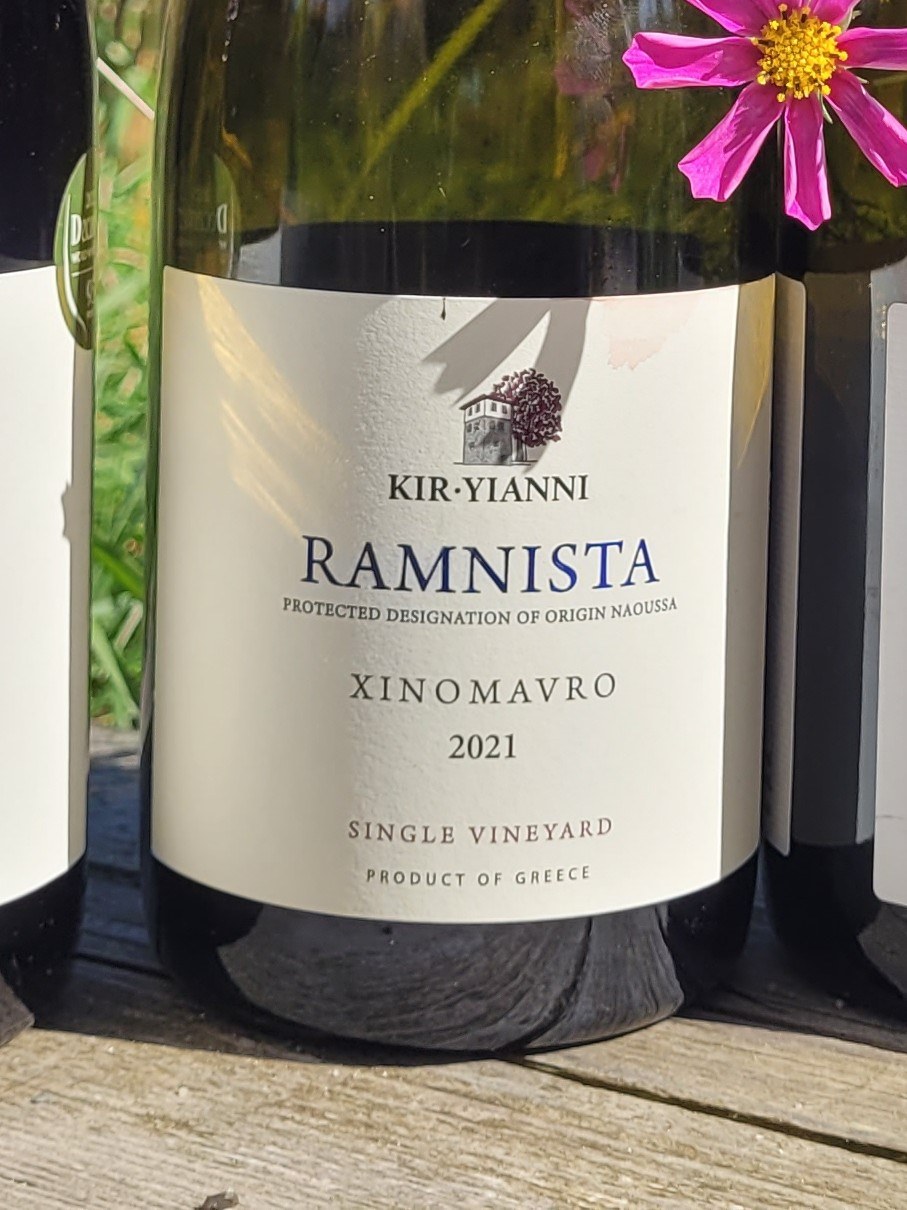
Ktima Kir-Yianni – Ramnista 2021
Single Vineyard
PDO Naoussa
100% Xinomavro
Macedonia, Greece
Red | dry
14.5%
The Ramnista is the traditionalist among Kir-Yianni's Xinomavros, a single-varietal PDO Naoussa. "Single Vineyard" here does not mean a tiny parcel but nine selected plots of the estate vineyard near Giannakochori, with exposures ranging from north and northwest through east to southeast and west, on soils from sandy to clay loam. Seven of these were planted between 1970 and 1973, making them around 48 to 51 years old at harvest, while the other two date from 2006 and 2010; training is double cordon with 3,000 to 4,000 vines per hectare. The name means "royal hill" in the local dialect. In 2002 no Ramnista was bottled at all, a selection decision by the estate.
The hand-harvest began in 2021 in the first parcel on 21 September, followed by five days of cold maceration at 8 to 10 degrees, fermentation in French wooden fermenters and stainless steel tanks of five tons each at 17 to 23 degrees with pigeage and pumping over, two to six days of post-maceration and malolactic fermentation. Each parcel is vinified separately, ages for 14 months in French oak of 225 and 500 litres from first to third fill, and only then is the wine assembled from the parcel lots. The result is 14.5 percent alcohol with 5.6 grams of total acidity per litre and a pH of 3.57.
I have a certain love-hate relationship with the Ramnista. In the past, when I was barely interested in wine, I drank it often and with pleasure, without noting the vintages. But since I have been engaging more professionally with Greek wine, no vintage has really fully convinced me. I had the 2006 in the Xinomavro masterclass in 2024, at 18 years of age in the glass, with fine tannins but already too little primary fruit, 86 points. Also in the masterclass, the 2017 reached 90, rounder and with raisins, but with too little complexity for the name and vintage; the slightly corked 2018 likewise reached 90 and the 2019 reached 88, surprisingly far aged and with a fading finish, so that the simpler Cuvée Villages 2019 at 90 even narrowly overtook it. And in May 2026 the 2010, at 16 years, was again one that did not really convince me, 88 points.
At the end of September 2026 I brought three Xinomavros from the estate to a games night with friends who know Greek wine inside out – the entry-level Naoussa Cuvée Villages 2022, the Diaporos 2020 and this Ramnista 2021. I shuffled the bottles, put them in bags and guessed along myself. I suspected the Ramnista to be in glass one – yet another, I thought, that fails to convince me and, although a year younger than the Diaporos, already seems a few years older. Glass three, on the other hand, I took for the Diaporos, its peppery note seeming unmistakable to me. I announced this grandly at the unveiling, and the embarrassment was great, because the Ramnista was hiding in bag three, and what I had taken for Diaporos pepper was its own.
As a vintage, 2021 in Naoussa was the weakest of the three that evening. In my vintage database Naoussa red stands at 7 out of 10, an elegant vintage with high acidity, in which much depended on the harvest timing and the selection, while 2020 and 2022 each reach 8. Nationally, 2021 fell off markedly at 5.5, the year of the historic heatwave at the end of July and the great forest fires in northern Euboea, in Attica and on the Peloponnese. In Macedonia a cold March delayed budbreak, and the Xinomavro in Naoussa was harvested late, from 21 September to 10 October. Kir-Yianni itself describes, after a dry and hot, disease-free summer, a notably even, phenolically rich vintage, with yields 10 to 15 percent below 2020. From Naoussa 2021 I had so far only had the Earth and Sky by Thymiopoulos in the glass, in 2024 at three years, at 91 points. And now it was precisely this weakest vintage that produced the best wine of the evening.
Glass three was already denser in colour than the other two, and on the nose there were blackberry and raspberry. On the palate gripping tannin, here very well in concert with the acidity, with good drive and a long, peppery echo.
In direct comparison it convinced considerably more than the Diaporos 2020 and the Cuvée Villages 2022, a terrific wine and my highest-rated Ramnista to date, one that comes out trumps quite unexpectedly. It would really have deserved a plus after the score. But I am not willing to bet on that, for I have had bad luck too often with mature Ramnistas, though that may also have been down to storage. Monica Larner gave it 93 points in the Wine Advocate in June 2026; the 2015 received 91 there and the 2016 92. In Greece the wine costs around 22 euros. Anyone who wants to try Ramnista should hear it from a Ramnista sceptic. Buy the 2021, it is great cinema for this price. For me that is 93 points.
Tasted: September 2026