
Lacules Estate – Merlot 2021
PGI Messenia
100% Merlot
Peloponnese, Greece
Red | dry
14.5%
Lacules Estate is the kind of winery that really shouldn't exist. An Austrian architect, Friedrich Gruber, specialized in wine cellar construction from Napa Valley to Monte Carlo, acquired land above Lacules Bay near Koroni on the southwest coast of the Peloponnese in the mid-1990s – and planted vines. His daughter Barbara completed an internship in Napa Valley; her partner Jörg Salchenegger, a PhD chemist, took over the winemaking. The result has little to do with what one expects from the southern Peloponnese.
The heart of the Merlot comes from vines planted in 1981 in the Chandrinos vineyard site in Messinia – at about 340 meters elevation, on intensely red, well-drained Terra Rossa soil. Particularly noteworthy: according to the winery, the vines are own-rooted, meaning they are not grafted onto American rootstock – the Merlot vine's own roots have been digging directly into the Messinian soil for over 40 years. Such vines are rare in Europe but still occur in isolated favored sites. The Lacules Merlot is therefore not a pre-phylloxera museum piece – the vines were planted in 1981, after all – but it is a remarkable example of old, own-rooted Merlot in Messinia. Add to this consistent dry farming without irrigation and very low yields – 2021 was even the first year the estate skipped green harvesting, because the vintage had naturally reduced yields on its own.
The aging of the Merlot involves a peculiarity that is difficult to piece together from public sources, which is why I asked winemaker Barbara Gruber directly: the grapes are fermented in Greece in small stainless steel tanks, with up to five manual pigeages per day – an intensive yet gentle extraction method. For the 2021 vintage, the finished wine was then transferred to Austria and aged there for 18 months in barriques, 70 percent of which were new, predominantly French oak with a small proportion of American oak. Bottling also took place in Austria. This now puts four fundamentally different oak philosophies on the table: Château La Croix relies on minimal new oak and large format barrels, Galatrona on one-third new oak over 18 to 20 months, Hatzimichalis on 100 percent new French barriques for 12 months, and Lacules on 70 percent new oak from mixed origins for 18 months. All three serious single-vineyard Merlots – Galatrona, Alargino, Lacules – share unirrigated cultivation at similar elevations between 300 and 350 meters; what distinguishes them in the glass is above all the winemaking signature. The estate's own winery in Greece is expected to be completed shortly; from the 2027 vintage onward, Lacules Estate plans to carry out all aging on site in Messinia. The fact that the wine currently comes into being between two countries is a pragmatic compromise – and it clearly does not compromise quality.
From Lacules Estate I had already tasted the entire remaining portfolio from the 2021 vintage: the Syrah (96 points, one of the best Syrahs in Greece), the Grenache (93 points, the first vintage of this variety from the estate), and The Chord (92+ points, the cuvée as a second wine). René Gabriel has been rating the Lacules Merlot at top level for years – the 2017 at 19/20, the 2018 and 2021 each at 18/20. Of the Merlot, I knew the 2018 (96 points, exotic-smoky, with candied pineapple on the nose) and the 2019 (94+ points, perfumed-floral, still astringent, but with a concentration next to which a Saint-Émilion Grand Cru Classé seemed like thin water). What distinguishes each of these vintages is a completely distinctive aromatic profile – no Lacules Merlot resembles another.
The 2021 is no exception. The concentration in the glass alone is reminiscent of the Galatrona – here, two wines are no longer separated by country of origin, but only by style. On the nose, one could blindly mistake the wine for an Australian Cabernet: a veritable wave of eucalyptus that clears the sinuses. On the palate, then, incredibly powerful fruit on the attack, followed by a charge of clove. You have to like it – it is idiosyncratic. But it is precisely this idiosyncrasy that defines the Lacules Merlot. Each vintage has its own unmistakable aromatic profile, just as unique as 2018 and 2019 were in their own ways. What stands out: the 2021 is noticeably more open than the 2019 was at the same age after harvest. You can already drink it with great pleasure now – provided you are into the "freaky" aromatic profile. I am.
96 points – on par with the legendary 2018 and just one point behind the Galatrona. With this, the Peloponnese, which according to official vintage assessments is considered more of a power vintage with lower acidity in 2021, has produced a Merlot that need not hide from Tuscan world class. The difference: the Galatrona convinces through its verticality and tension, the Lacules through its sheer concentration and its headstrong aromatic profile. Two philosophies, nearly the same level.
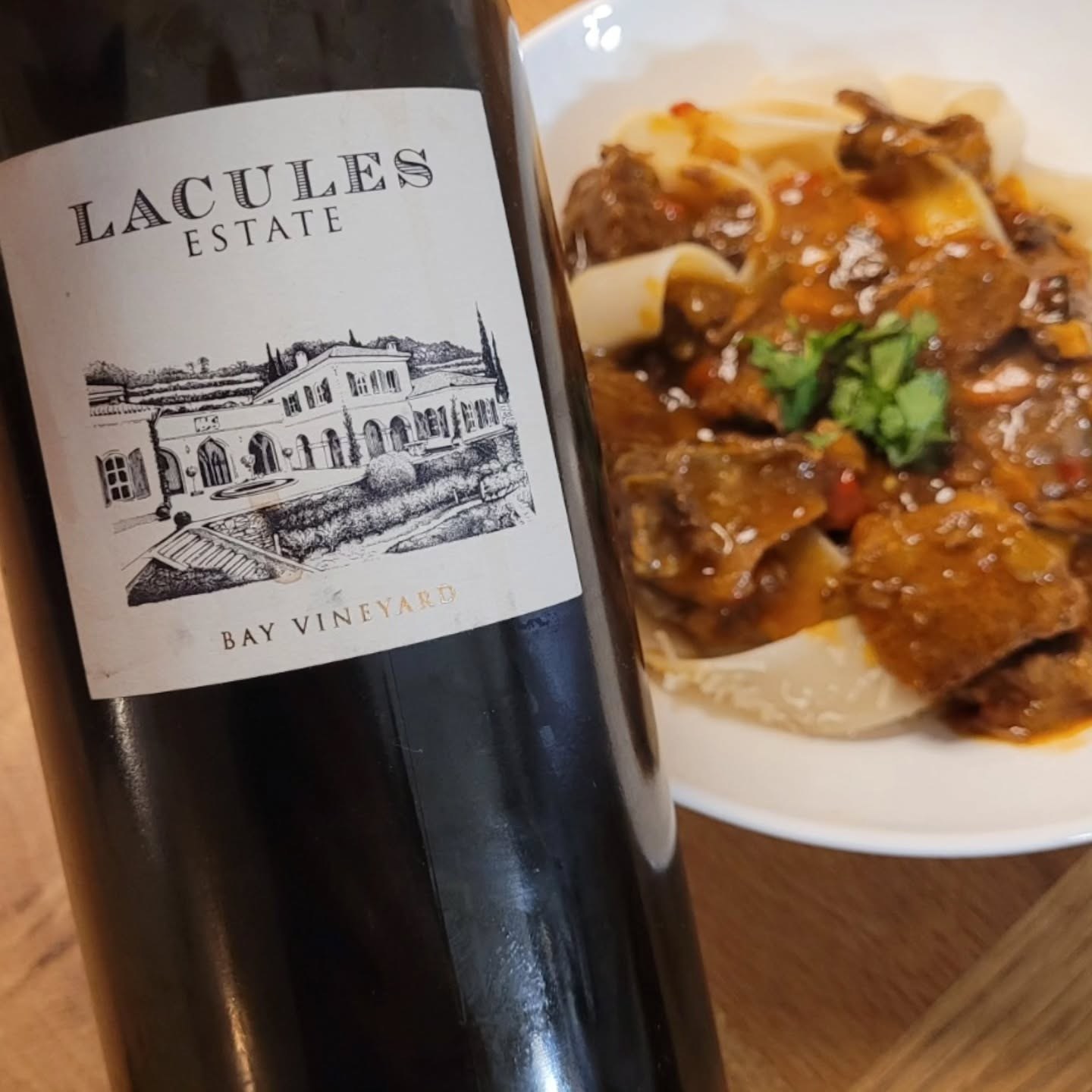
Tasted: February 2025