
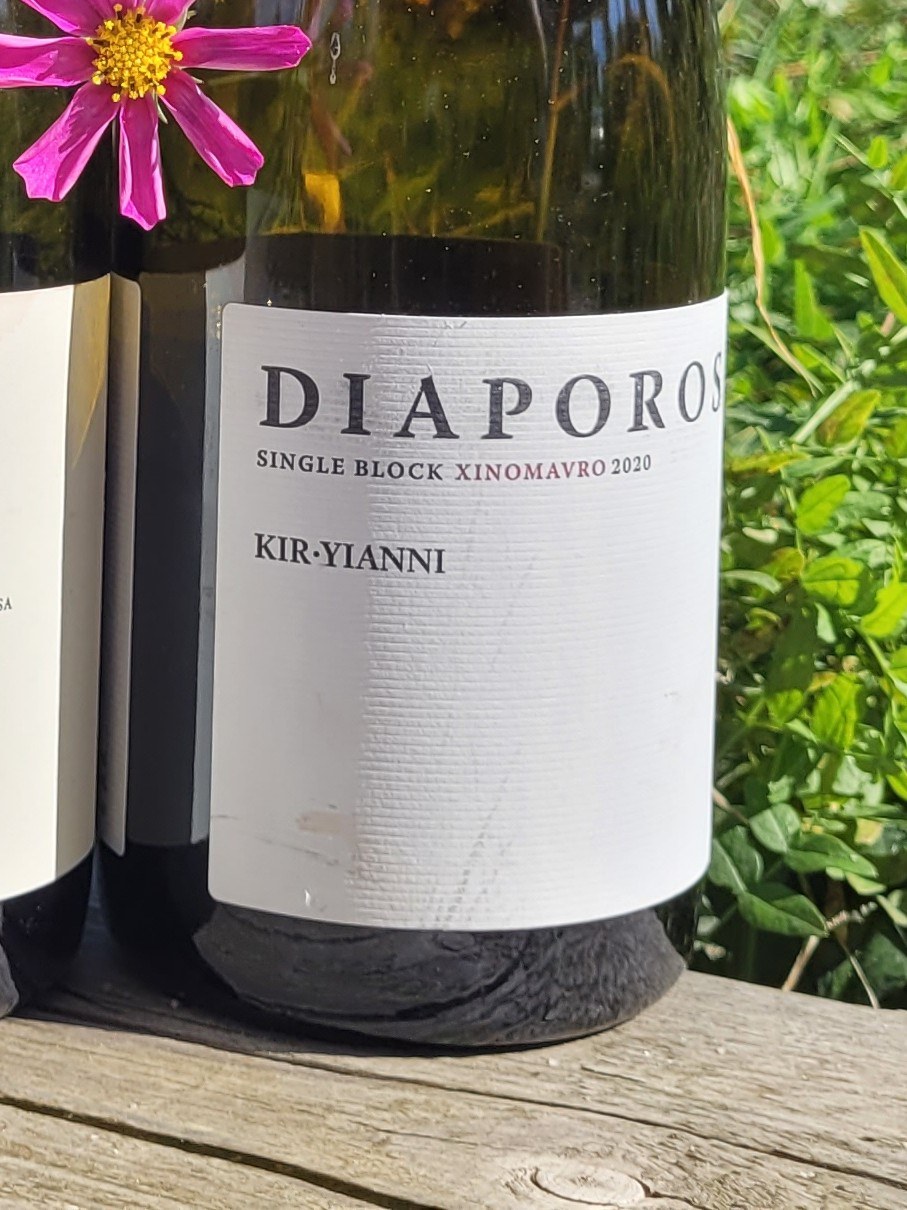
Ktima Kir-Yianni – Diaporos 2020
Single Block
PGI Imathia
87% Xinomavro, 13% Syrah
Macedonia, Greece
Red | dry
15%
At a games night with friends who know Greek wine inside out, I slipped three Kir-Yianni Xinomavro into bags for a blind tasting and joined in the guessing myself, namely the entry-level Naoussa Cuvée Villages 2022, the flagship Ramnista 2021, and the Diaporos 2020 that concerns us here. Unlike the two Naoussa PDO wines, the Diaporos carries the PGI Imathia appellation, and the reason lies in the blend – 87 percent Xinomavro, 13 percent Syrah, whereas PDO Naoussa demands single-varietal Xinomavro. The Xinomavro comes from Block 5, planted in 1972, whose highest sections reach 230 to 240 metres; the Syrah comes from two north-facing blocks dating to 1987. "Single Block Xinomavro" on the label thus refers to the Xinomavro component, not the whole wine, and the name too is rather misleading, since it points to the island of Diaporos off Sithonia, the retreat of the Boutaris family, while the grapes grow in Naoussa.
In the cellar the two varieties are vinified and matured separately and only then blended. After a seven-day cold maceration, the Xinomavro goes into open French wooden fermenters and then matures for around 16 months in first- and second-fill barriques, the Syrah for 14 months with a fifth new oak. The result is 15 percent alcohol at 5.1 grams of total acidity per litre.
As a vintage, 2020 was a very good one for Xinomavro in Naoussa, an 8 out of 10 in my vintage database, dry and warm with a preserved day-night amplitude, and the dreaded autumn rot on the late-ripening Xinomavro failed to materialise. The winery itself, however, described a delayed, uneven ripening for the Diaporos parcels. All the more surprising, then, how far developed this bottle shows at six years of age.
The first wine in the glass gave away the grape variety at once. On the nose plenty of dried tomato, a little earth and lots of strawberry, but colour-wise already some signs of ageing. On the palate a fine yet dense tannin and a rather oxidative, raisiny finish. Arriving at Xinomavro was not hard, landing in the right vintage range rather more so, as most at the table went back at least five years further into the past. I myself suspected the Ramnista, with which I share a certain love-hate relationship, and was certain it could not be the Diaporos. Grandly I announced upon opening that glass three was the Diaporos, the peppery note unmistakable. The embarrassment was considerable, for hidden in bag three was the Ramnista. Once you know it, the first glass does after all bring tobacco and leather to mind.
And I am a little disappointed by this Diaporos 2020. I remembered the 2018 as very good. In a large Xinomavro masterclass with 53 wines it scored 94 points in 2024, likewise at six years of age, the second-best score of the entire field and the best Kir-Yianni, surpassed only by the Thymiopoulos Vrana Petra 2017. The Diaporos is certainly a fine wine, one that places Xinomavro centre stage from the very first sniff and, if you sit with it longer, is quite filigree and thought-provoking. In this evening's direct comparison, however, the Ramnista 2021 was simply far more convincing.
Monica Larner rated the 2020 higher than I experienced it that evening, awarding it 94 points in the Wine Advocate in June 2026 – the same score the Diaporos received there for 2016, while 2017 stood at 95 and 2018 at 92+. With the Diaporos I would reach for a different vintage. In Greece the wine costs around 45 euros. For me these are 91 points.
Tasted: September 2026
Other vintages:
Ktima Kir-Yianni – Diaporos 2018 (94, 2024)