
Estate Manolesakis – Pelagia 2022
60% Pinot Noir, 40% Agiorgitiko
Macedonia, Greece
Red | dry
13.5%
I have a somewhat fraught relationship with this wine. I had rated the Pelagia 2017 at 89 points in 2021, when it was four years old, rather muted for the house's prestige red, and was all the more astonished when the 2018 landed at number 32 among the 50 Great Greek Wines 2022. The 2022, now likewise about four years old in the glass, already looks denser in colour than the bottle I had in front of me back then.
Adriani is a village in the regional unit of Drama, one of the few Greek wine regions with no access to the sea at all, continental and shielded on all sides by mountains. The vintage here often runs against the national trend, and 2022 is one such case: while Greece nationwide experienced a warm, powerful year, in Drama it was late and cool, with a delay of up to half a month compared with 2021 that persisted right through to the harvest. The regional harvest picture is peculiar, with slightly lower acidity than 2021, higher pH and, in the reds, a delayed phenolic ripeness that made the choice of picking dates difficult. The estate itself, by contrast, reports for its own sites a higher Baumé than usual, balanced acidity and balanced pH, along with reds carrying an increased phenolic load, and speaks of an excellent red-wine year. I had never before had a Drama red from 2022 in my glass, so this is the first time I am judging the year here from personal experience. For a Pinot Noir the cool is in any case less of a problem than for the late international varieties – Pinot likes it cool.
The cuvée consists of 60 % Pinot Noir and 40 % Agiorgitiko. The Pinot comes from one hectare in the estate's own parcel "Το Δέντρο," "The Tree," the Agiorgitiko from a further 0.4 hectares, both at 200 to 300 metres on clay soil with small embedded limestones. Through green harvesting the yield is pushed down to 450 kilos per stremma, that is 4,500 kilos per hectare and thus the lowest of the entire range. Picking is done at night, after which the wine matures for ten months in new French oak barrels of first use and then twelve months in bottle. It is classified simply as a varietal wine, since Pinot Noir is not permitted in the PGI Drama.
On the nose the 2022 convinces me greatly this time. Still well chilled, cranberry comes forward, along with a little red cherry. The Pinot Noir is clearly recognisable and comes across as exceptionally fine, underpinned by a small trace of nougat.
On the palate the Agiorgitiko then asserts itself more emphatically, with respectable tannin and plenty of plum, plus blackberry. Added to this is a sandalwood-like maturity spice that strikes me as slightly oxidative – a kind of aromatic profile that I often struggle with in Agiorgitiko. On the first day after opening, however, it shows itself here surprisingly balanced and even contributes to the balance; how this develops with more air and more time I want to observe further. The finish is medium-long, the 13.5 % alcohol stays moderate. Above all, the wine does not give itself over to a Burgundian austerity that it could never fulfil anyway; the full-bodied character suits it well. In the second wave of the finish there is still a fine trace of marzipan.
This is a really good wine. For my taste the cuvée could take a touch more Pinot Noir and a small extra impulse of acidity, then it would be not merely a very good but a fascinating wine. As a food companion to braised meat, also with red cabbage, it should work excellently; for such dishes I otherwise often reach for German wines, and that makes me all the more pleased with the direction in which Pelagia is developing.
At the estate the wine costs from 42 euros, which is rather steep for what is offered. Anyone who loves Greek wines should nevertheless have had this interesting experiment of Pinot Noir and Agiorgitiko in the glass at least once. For me these are 92 points.
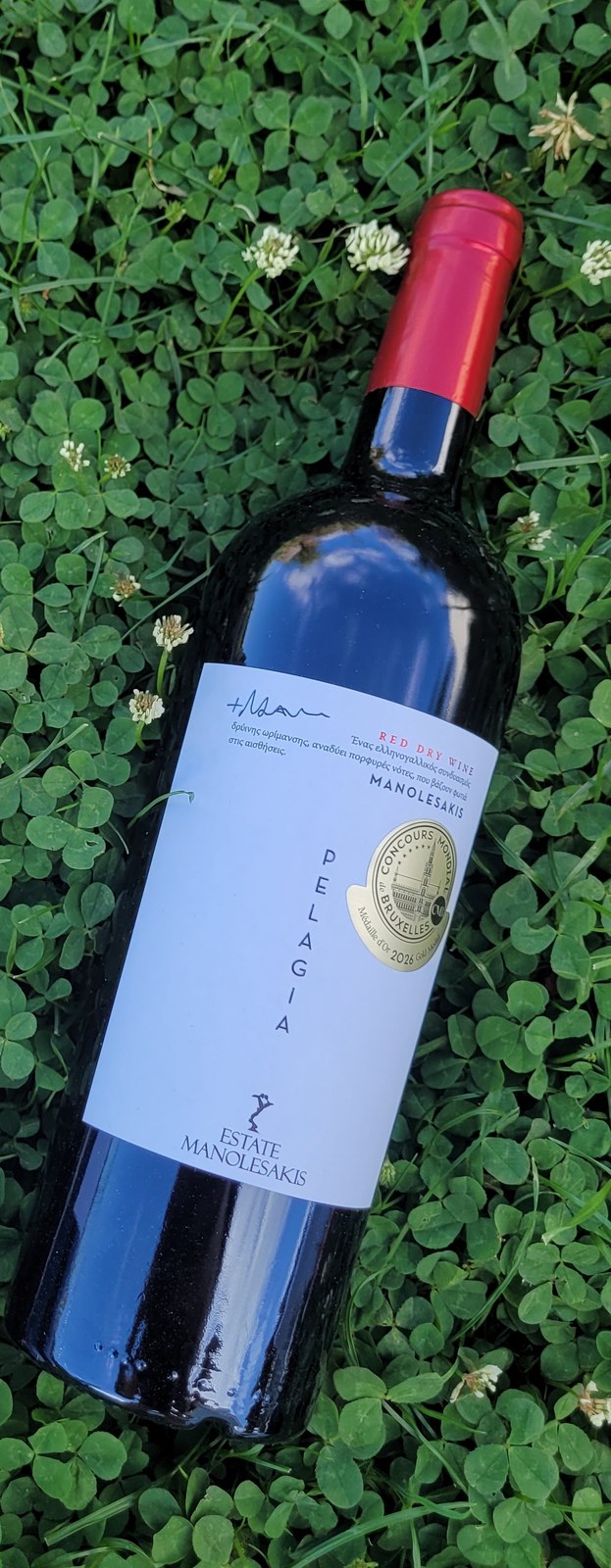
Tasted: August 2026
Other vintages:
Estate Manolesakis – Pelagia 2017 (89, 2021)