
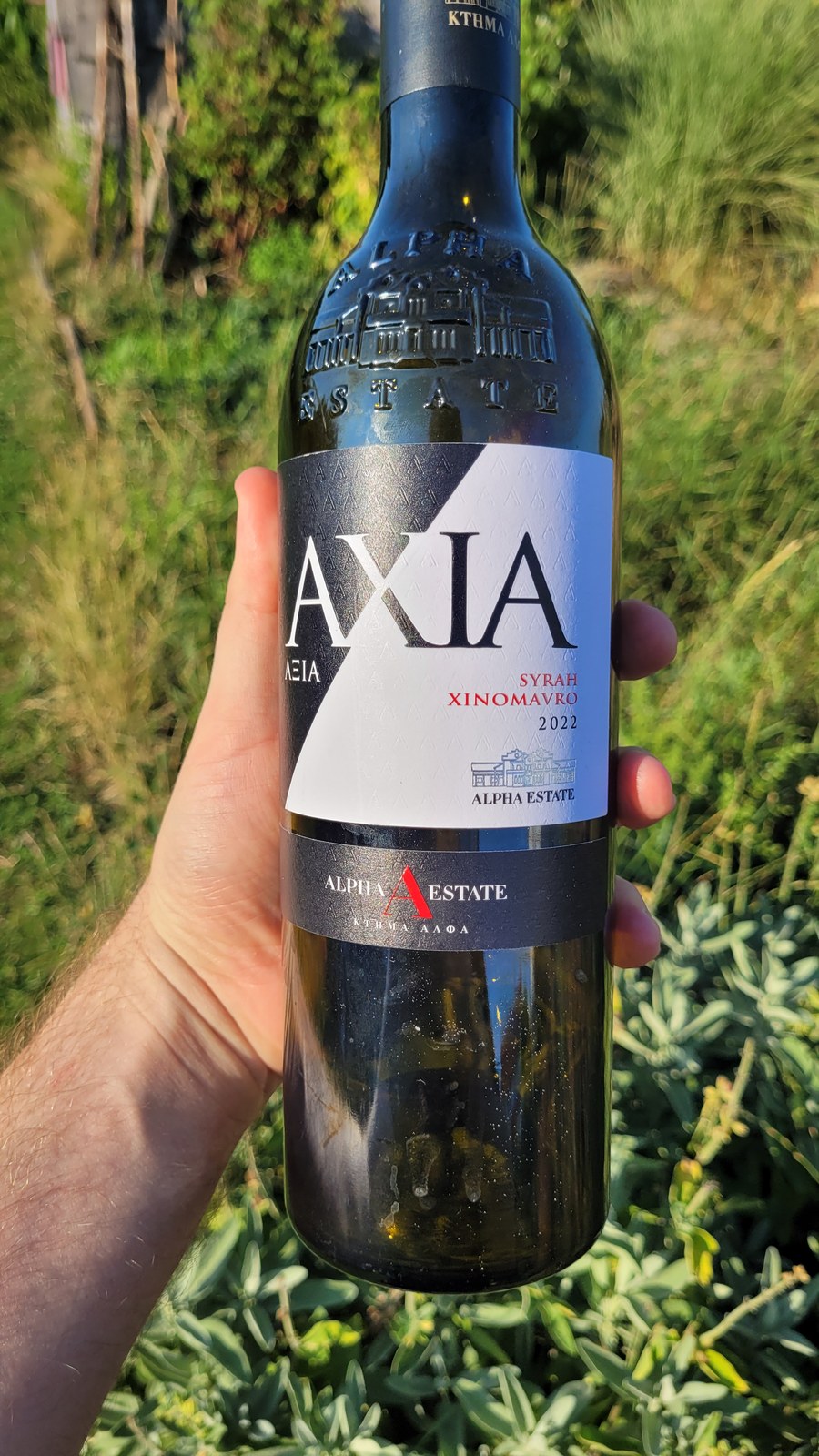
Alpha Estate – Axia 2022
PGI Florina
50% Xinomavro, 50% Syrah
Macedonia, Greece
Red | dry
14.5%
Drinking window: –2030
The Axia is Alpha Estate's more approachable red, positioned beneath the estate's icons – a blend of 50% Xinomavro and 50% Syrah. This very combination also explains the appellation designation: because PDO Amyndeo requires single-varietal Xinomavro for red wines, a 50/50 blend with Syrah can only be labelled as PGI Florina. The grapes come from the Petres and Dromos parcels on the Amyndeon plateau, at 620 to 710 metres, on sandy soils with cool nights and the NW winds that define this zone. Hand-harvested into small crates, cold maceration, followed by twelve months in Allier oak with medium-light toast and bottle ageing; the vine grower is Makis Mavridis, the cellarmaster Angelos Iatridis, the two founders of the estate, which was launched in 1997 and comprises 220 hectares of high-altitude vineyard in Amyndeon.
As a vintage, 2022 is regarded as very good in Macedonia, and Amyndeon had the advantage here. The critical moment was heavy rainfall of 100 millimetres in early September; the harvest was saved by around forty hot days with cool nights afterwards, which were extremely favourable for Xinomavro in this zone. Kir-Yianni openly admitted "tricky tannins" for the vintage, which ultimately turned smooth and velvety. What one can expect, then, is a structured, deeply coloured vintage, precisely in Axia's home region.
And this structure is exactly what I encounter in the glass. On the nose the Xinomavro comes through nicely with sun-dried tomato. On the palate the wine first shows its tannin, but then dark fruit arrives to rein it in – blueberry and cherry, a touch peppery, with well-integrated alcohol at 14.5%. A delicious wine, and for me a good introduction to Xinomavro if you don't want the full blast right away.
As for the drinking window, I'm torn. At first I thought of 2032, but my experience with the 2017 counsels caution: I've tasted it three times – in 2021 at four years old, at 92 points ("very lovely red fruit, some tomato, soft clinging tannin", and at the time: "that it's already available for under €10 is honestly hard to believe"), in 2024 at seven years old at 90+ ("explodes with bright raspberry notes, no signs of age"), and in June 2026 at nine years old at only 89, by then past its peak. What's interesting is that the 2022 shows almost nothing at all after four years – but that's precisely what the 2017 didn't do at four years old either. So I'll stay cautious and say eight years after the harvest, i.e. until 2030; I can always revise upwards at a later tasting.
Price-wise, the Axia has crept up. A few years ago I called it one of the best red wines under ten euros; by now it sits a little above that, around 12.50 to 14.95 euros here in Germany. Within its own house it ranks clearly beneath the Alpha Estate Syrah Single Vineyard Turtles 2023, which I rated at 91 points in June 2026: that one is a notch more powerful and denser, and at around 17 euros also more expensive. The Axia sits one point below.
90 points.
Tasted: July 2026