
The Swiss Man Never Paid: La Tour Melas versus Saint-Émilion

Updated: Sep 15

This is how they tell it at La Tour Melas: at a dinner in Zurich, sometime around the turn of the millennium, Kyros Melas made a bet with a Swiss banking colleague. Melas, a businessman and lover of Château Lafleur, claimed he could produce a wine in Greece to rival the Pomerol star. From 2000 onward he planted French vines in Achinos, in Fthiotida - in a region without any winegrowing tradition whatsoever.
To this day the Swiss man has not paid - his argument being: French wines age better. This is not some old anecdote that no one can verify anymore; as recently as October 2025 the British wine journalist Jamie Goode, after a dinner with the estate, noted that the bet remained unpaid, for precisely this reason.
Two pairs of bottles later, one can say how far Melas has come. We pitted the La Tour Melas against Saint-Émilion twice: in 2024 the 2019 against Château La Gaffelière, in July 2026 the 2020 against Château Trotte Vieille. Both Frenchmen are Premier Grand Cru Classé, both duels were tasted side by side.
First Duel: 2019 versus La Gaffelière
The two wines are almost a mirror image of one another. La Tour Melas 2019 is made from 65 percent Cabernet Franc and 35 percent Merlot; La Gaffelière reverses the ratio, setting 60 percent Merlot against 40 percent Cabernet Franc. Two houses, the same two varieties, inverted weighting - and both at around a hundred euros.
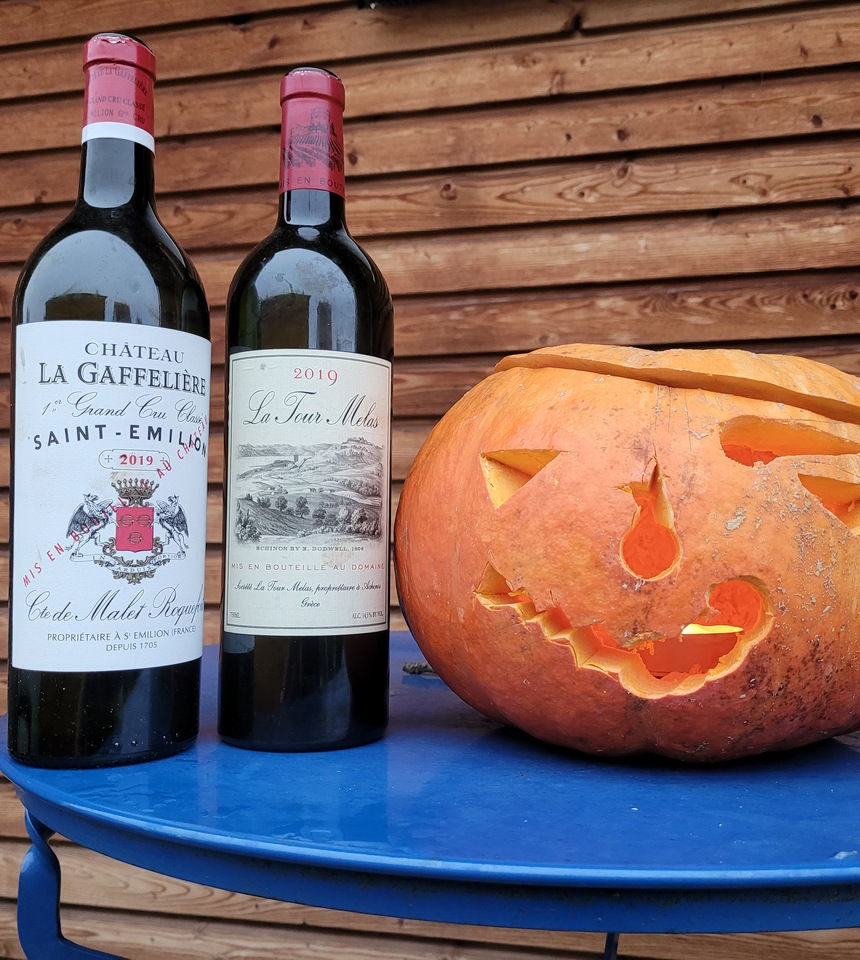
The Frenchman was the more serious of the two. Black cherry and marzipan on the nose, polished tannins on the palate and herbal notes that still took up plenty of room at the time of tasting. A wine that holds back and tells you that you have come too early. It stood at 93+ points, with the expectation of reaching 95 or 96 in five years.
The Greek took the other path. Red fruit instead of black, raspberry and sweet cherry, plus dark chocolate that lends depth without smothering the freshness. The oak fitted in without pushing itself forward. On the finish it lacked something of the Frenchman's length, but it was harmonious and immediately accessible. 94 points.
Thus the Greek came out ahead - but with a caveat that cannot be argued away: at that same point in time, the La Gaffelière had not yet come into its own. Anyone comparing them today is comparing a finished wine with one still in the making.
Second Duel: 2020 versus Trotte Vieille
Two years later the second attempt, this time against an estate that has been Premier Grand Cru Classé since the first classification of Saint-Émilion in 1955 and has held that rank through every revision. Twelve hectares on the limestone plateau, thirty to forty centimetres of clay over solid rock, an average vine age of sixty years, including an ungrafted Cabernet Franc parcel dating from 1868.
The Trotte Vieille 2020 is a wine the critics cannot agree on, and to a degree one rarely sees. Suckling and Dunnuck each gave 98 points, Leve 97, Anson 96, Galloni 95. On the other side, Neal Martin stayed at 93 in a blind tasting, William Kelley of the Wine Advocate at 92 - he calls the élevage the estate's weak point, too much creamy new oak, barrel-marked tannins.
On the nose it is a powerhouse, so dense that you almost drink against it. On the palate then more dense than complex, more demanding than opening up. I consider the criticism of the oak to be misdirected; the real problem is oxidative notes, more of them than does the wine good. That is why I also do not believe in the twenty, thirty years of future that some ascribe to it. A very good wine that would have benefited from a little more Merlot. 95 points.
The La Tour Melas 2020 grows on terraces at two hundred metres of altitude, two kilometres from the Gulf of Euboea, where the evening wind cools and preserves the acidity. Sixty percent Cabernet Franc, forty Merlot, wild yeasts, twenty-two months in predominantly new barriques, unfined and unfiltered. The vintage is considered outstandingly fresh in central Greece; Panos Zoumboulis calls it a vintage of perfect harmony.
The nose is beguiling, floral and fruity, with blackberry, clearly above the 2019. On the palate a gripping tannin that breaks off a little too quickly and leaves a flat spot in the final third. The aftertaste catches this again, with smoky notes and sloe. 95 points.
The duel ends in a draw.
What the Alcohol Reveals
One cliché persists stubbornly: the south delivers the powerful, high-alcohol wines, Bordeaux the restrained ones. The numbers say the opposite.
In Saint-Émilion the median in 2020 was 14.5 percent, the range reaching up to 15.5. Greek red wines of the same vintage come in at a median of 13.7 percent in our database, and from central Greece not a single one exceeds the 14.5 mark - for the region that is the upper limit, not the norm. Both wines in this duel lie at their respective upper edges; the Greek there just reaches what in Saint-Émilion is the average.
The difference therefore lies not between these two bottles, but between the two distributions from which they come. Anyone expecting the heavy southern wine from the Greek has them exactly the wrong way round in their head.
Price and Rarity
Here the Frenchman wins, and clearly so. The Trotte Vieille costs ninety to one hundred and eight euros and is priced strikingly accessibly for a Premier Grand Cru Classé; at the en-primeur release the 2020 was even cheaper than any traded vintage going back to 2013. The La Tour Melas sells in Germany for 119 euros. For what stands in the glass, that is a lot - a Greek Cabernet Sauvignon of comparable quality can be found for half the price.
This comparison isn't entirely fair, though. Of the Trotte Vieille 2020, around 29,000 bottles of the Grand Vin were filled, of the La Tour Melas 4,700, so not even a sixth. But these figures measure two situations that have little to do with each other. The Trotte Vieille is a great among giants: a classified estate in a region where markets and trade routes have existed for centuries and where such quantities surprise no one. The La Tour Melas is something else, namely a still rather rare experiment from a region that has no such tradition behind it. I think one shouldn't hold this rarity against it merely as a logistical disadvantage. It is also part of what makes this wine what it is, and as such it may have its value.
Unplanned Duel: Cyrus One 2020 versus La Gaffelière 2017
Anyone wanting to spend less can try the Cyrus One 2020, the estate's second wine. It costs 33 to 44 euros at the same merchant, while for the Grand Vin 188 to 220 are demanded. And in doing so one gives up considerably less than this gap would suggest.

The Cyrus One owes its existence to an act of renunciation. In 2009, eleven vintages before the one tasted here, La Tour Melas bottled no Grand Vin; around sixty barrels that hadn't made it into the top cuvée still had to go somewhere, and out of them came the very first vintage of this wine. It is therefore no entry-level product planned at the drawing board, but the child of a strict selection, and today you no longer hear that origin in it.
The grape origin alone is unusual. Merlot and Cabernet Franc come from Achinos in Fthiotida, where the estate cultivates around ten hectares on terraced slopes up to about 200 metres in altitude; the Agiorgitiko comes from Nemea on the Peloponnese. Kyros Melas speaks of the marriage of two terroirs, two worlds: here the old Nemea with its silt and limestone soils, there the younger, sea-bordered terroir of Achinos with its limestone. For the expectation of the 2020 vintage one therefore needs two figures, and both speak for this bottle: Nemea stands in 2020 for red at 9.0 out of 10, a top value against a Greek median of 6.5, while neighbouring Lokris for central Greece is at 8.0.
The most interesting point, however, is the weighting of the cuvée. For the 2020 it stands at 60 percent Merlot, 25 percent Cabernet Franc and 15 percent Agiorgitiko, whereas the Grand Vin 2020, with 60 percent Cabernet Franc and 40 percent Merlot, is built exactly the other way round. The Cyrus One is thus no diluted first wine, but a differently constructed one: Merlot-led, where the big brother relies on Cabernet Franc. In the cellar the three varieties were vinified separately and with the vineyard's own yeasts, then aged for 13 months in barrels of 225 to 400 litres, bottled unfined and unfiltered. Hand harvest, around 6,000 bottles, yields of 40 hl/ha for Merlot and Cabernet Franc and 55 hl/ha for the Agiorgitiko, average vine age 25 years.
In the glass the 2020 stands astonishingly vital six years after harvest, with a slight cloudiness that suits its making. The nose is racy and lively, with a very gentle farmyard note and a bloody, iron-tinged pull. On the palate little coarse tannin shows, but instead a great deal of fruit: cherry and plum stand in the foreground, some bay leaf sets a spicy counterpoint, and a lovely fruit sweetness always stays on this side of any sugariness. The aftertaste is fiery and peppery without seeming alcoholic, which at 14 percent is an achievement, and leaves a light coffee note behind. The Agiorgitiko makes itself heard above all through the plum, gently, without overlaying the underlying structure of Merlot and Cabernet Franc. It is the smallest share of the cuvée and nonetheless the one by which you recognise the origin.
And then there is a story that wasn't planned this way. I had briefly considered bringing in Château La Gaffelière as a comparison wine to the Cyrus One, but then discarded the idea. Pitting a Premier Grand Cru Classé from Saint-Émilion against a second wine would have been a lopsided comparison, especially since La Gaffelière had already served here as a reference for the first wine of La Tour Melas. At some point the suspicion would otherwise arise that the Greek was deliberately being confronted with as prominent an opponent as possible. But then, by chance, Château La Gaffelière 2017 and Cyrus One 2020 happened to be open at the same time. So the comparison after all, and the result was astonishing: it fell in favour of the Greek, and not narrowly. The La Gaffelière still showed a lot of tannin that evening, but behind it seemed flat and already quite clearly oxidative; I would not have given this bottle more than 93 to 94 points.
To be fair, a few things must be said about this. 2017 was a difficult, frost-marked year in Bordeaux; La Gaffelière lost around 35 percent of its production, and only about 15 of the 22 classified hectares went into the Grand Vin at all. The critical reception of this wine is moreover extremely split, from Jeb Dunnuck's 91 points up to 97 awarded three times. The oxidative impression comes from a single bottle, and there is no evidence that the vintage has a systematic oxidation problem. And despite the flat impression, the Frenchman possessed a good saltiness that must be counted in his favour.
The pivotal point nonetheless stands: six years after harvest, the Cyrus One 2020 shows no oxidative fatigue whatsoever. The fruit is holding, the tannin carries, the aftertaste has energy, whereas the classified Bordeaux three years its senior already seemed distinctly wearier that evening. For me the Cyrus One 2020 comes in at 95 points, the same score the Grand Vin from the same estate and the same vintage received here. Which, conversely, means that with the first wine, at our next encounter, I should perhaps be a touch more generous. From the 2020 vintage, moreover, the Palies Rizes sits at 94 points, a single-varietal Agiorgitiko from own-rooted vines over a hundred years old. La Tour Melas evidently had a very good run in 2020.
The Bet, Twenty Years On
Twice contested, once narrowly won, once a draw. A wine from a region with no winegrowing tradition standing on equal footing with two Premiers Grands Crus Classés - that was the substance of the bet, and on this count Kyros Melas has delivered.
The Swiss man's objection is not thereby settled, however. Whether French wines age better cannot be answered with two duels of young bottles; for that, one would have to line the same wines up side by side again in twenty years. The La Gaffelière still has its development ahead of it; with the Trotte Vieille I doubt it will reach as far as claimed. And the La Tour Melas 2020 needs no more patience - you can drink it now.
Perhaps that is the most honest answer to the bet: the estate has proven that it can. The makings for 96, 97, perhaps 98 points are visible. What remains outstanding is the proof over time, and that no one can shorten.


Comments