
Château Trotte Vieille – Château Trotte Vieille 2020
Premier Grand Cru Classé
AOC Saint-Émilion Grand Cru
50% Merlot, 49% Cabernet Franc, 1% Cabernet Sauvignon
Bordeaux, France
Red | dry
15%
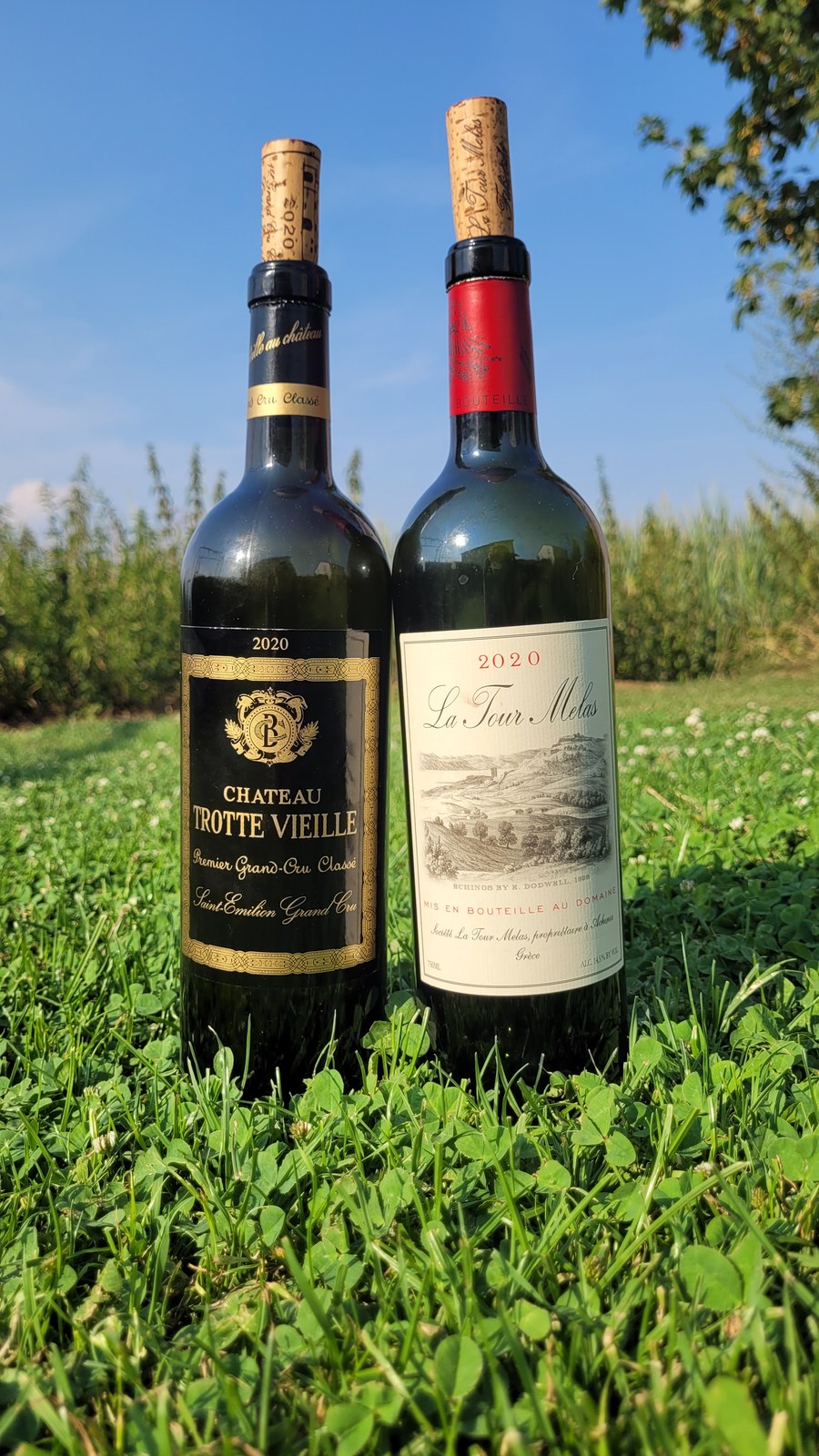
I tasted this wine in July 2026 side by side with the Greek La Tour Melas 2020 – a wine that was once expressly made to take on Bordeaux. The verdict of this duel up front: both land at 95 points with me. What this tie means, and where the two nonetheless diverge, more on that at the end.
Château Trotte Vieille – the estate itself writes "TrotteVieille" – has been a Premier Grand Cru Classé since the very first classification of Saint-Émilion in 1955 and has held that rank through every revision; the legal text singles out only the A-tier estates, and directly beneath them ranks Trotte Vieille. The property is documented since the 15th century, its name deriving from the legend of a curious old lady who "trotted" over to the nearby coach stop to catch the latest news. Since 1947 the château has belonged to the Borie/Castéja family, and today it is run by Philippe Castéja; Christophe Dussutour has been régisseur since 1999, and since 2011 the team has been advised by Thomas Duclos. The twelve hectares form a single enclosed enclos on the limestone plateau northeast of the town: just thirty to forty centimetres of clay over massive limestone, a southwest-facing slope, an average vine age of around sixty years – including a Cabernet Franc parcel planted in 1868, own-rooted and pre-phylloxera, a rare old holding on the right bank, though its oldest vines go into a separate, non-commercialised Vieilles Vignes cuvée of 135 hand-engraved bottles.
The 2020 Grand Vin is composed of roughly half Merlot and half Cabernet Franc – the official data sheet gives 50% Merlot, 49% Cabernet Franc and 1% Cabernet Sauvignon, though the figures are disputed across the sources; the Wine Advocate's barrel note at the time even spoke of 95% Merlot. Hand-harvested into small crates, vinified parcel by parcel, malolactic fermentation in barriques and tanks, then 18 to 24 months of ageing in virtually all-new French oak. At 15 percent alcohol it sits in the upper tenth of what Saint-Émilion produced in 2020, where the median and the most common figure are 14.5 percent – while in my database not a single red from central Greece exceeds that 14.5 percent. A noteworthy aside: 2020 is the last vintage from the old cellar, the new precision chai only arriving with 2021.
As a vintage, 2020 is regarded on the right bank as the classic of the 2018/2019/2020 trilogy: a wet winter, then 55 days of drought in summer, with the mid-August thunderstorms falling extremely locally – parts of Saint-Émilion received barely 45 millimetres of rain over the entire summer window. On the water-retaining clay-limestone soils this translated into concentration rather than stress: small, thick-skinned berries, high acidity, firm but ripe tannins. The right bank is considered the star of the vintage.
Against this backdrop, this wine is highly contested – you really cannot go by the average score here. James Suckling gave 98 from the bottle ("muscular yet polished", from 2029), Jeb Dunnuck likewise 98, upgraded from 92–94 in barrel, with the note that the wine is closed, needs plenty of air, seven to eight years of cellaring, and has 25 to 30 years of development ahead of it. Jeff Leve finished at 97 with a drinking window to 2050, Jane Anson at 96, Antonio Galloni at 95 ("rich, inky and explosive"). On the other side: Neal Martin gave only 93 in the Southwold blind tasting in November 2024 – the bouquet initially put him off, the wine then gaining freshness, "perhaps due to a healthy dollop of Cabernet Franc", but lacking nuance on the finish. William Kelley of the Wine Advocate stayed at 92 from the bottle and took issue with the generous use of creamy new oak and the oak-marked tannins; he calls the ageing regime the estate's weak point. Julia Harding rated the wine blind at 16 out of 20, Jancis Robinson from barrel at 16.5.
Who is right – the 98-point camp or the sceptics? It sounds like a cliché, but in fact both are. Just not for the reason one might think. The criticism hangs on the new oak, and I consider that mistaken. The real problem is that the wine shows too many oxidative notes – more than do it good. Which is why I don't believe it actually has a twenty-year drinking window still ahead of it, as Martin's horizon to 2048 or Leve's to 2050 would suggest.
On the nose, though, it is without doubt a powerhouse right now. Dense beyond measure – you're practically drinking against a wall. On the palate, however, it comes across more dense than complex, more demanding than opening up new horizons. A very, very good wine, no question. Only, in my view, it could have taken a touch more Merlot. That it's the Cabernet Franc bringing the freshness here, as Neal Martin surmised blind, I don't really see it that way: for me a very good Merlot is ultimately being sold short here.
My 95 points may look like a compromise score between the camps – but it is one that actually does the wine justice: to its strengths, which it plays out quite clearly and which cannot be argued away, as well as to its weaknesses, which in my eyes go beyond mere matters of taste. That leaves the price question: the Trotte Vieille costs around 90 to 108 euros, making it strikingly accessible for a Premier Grand Cru Classé – at the en primeur release, the 2020 was even offered more cheaply than every vintage then trading back to 2013. The La Tour Melas 2020, which reaches those same 95 points with me, sits above it. So the Greek can hold its own against the classified Bordeaux; the price argument, however, this time speaks for Saint-Émilion. One counterweight does remain on the Greek side: of the 2020 Trotte Vieille, by the estate's own account, around 29,000 bottles of the Grand Vin were filled, against just 4,700 of the La Tour Melas – a good six times as many. So the classified Bordeaux is not only the cheaper wine here, but also the far easier one to find. 95 points.
Tasted: July 2026