
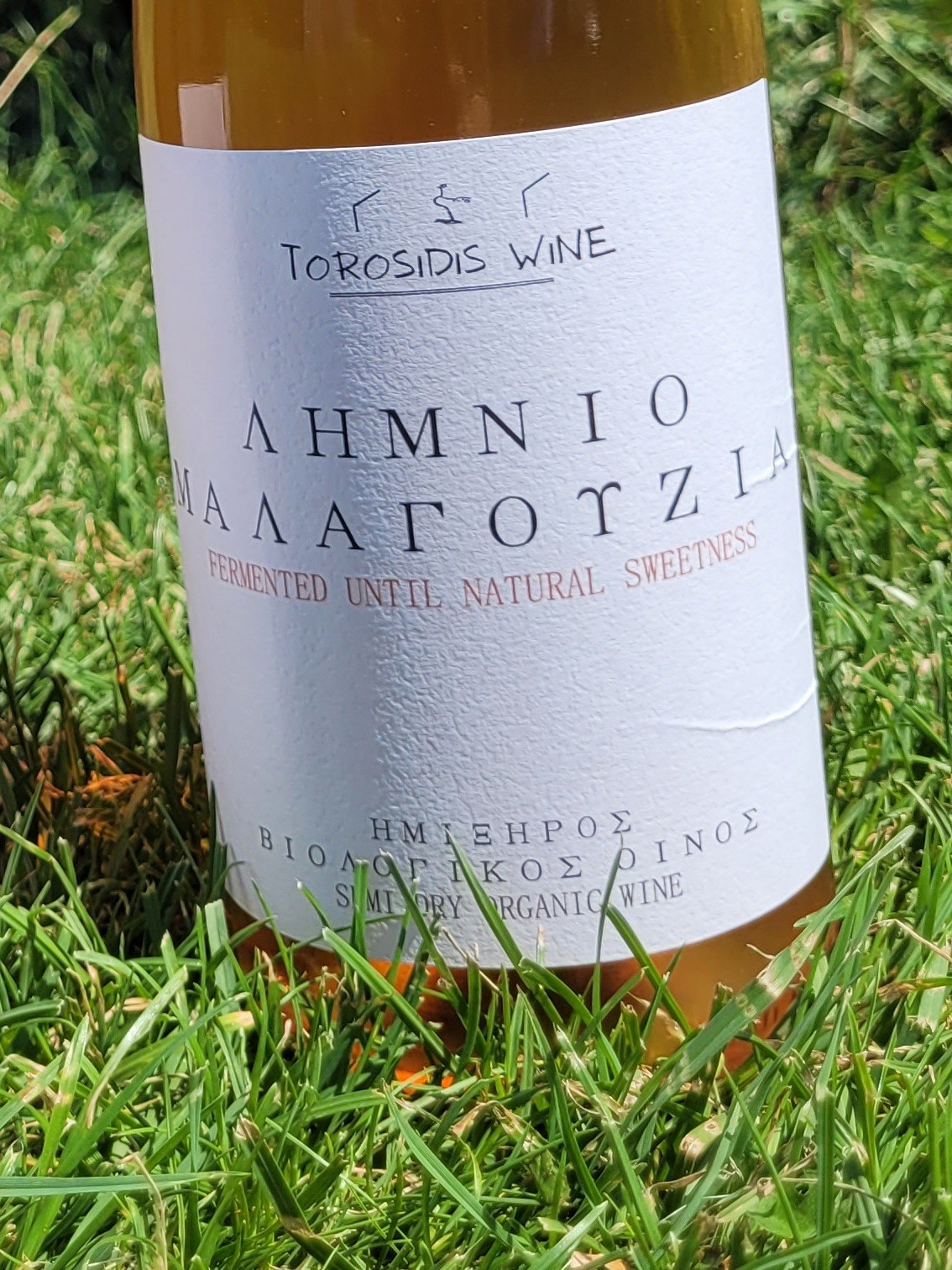
Torosidis – Limnio Malagouzia 2023
65% Malagouzia, 35% Limnio
Thrace, Greece
Rosé | medium dry
15% | Organic
Torosidis is, for me, the newcomer of the year, my discovery among Greek wineries. In Peteinos, around five kilometres from Xanthi in Thrace, Stathis Torosidis farms a vineyard he himself describes as extremely small. He sees the site as an experiment. It lies deliberately away from the well-known vineyards around Avdira and away from the altitude and coastal sites regarded as safe bets. After years of trial plantings, Torosidis established his first own vineyard in 2013. Between 2017 and 2019 he added Malagouzia, Limnio, Syrah and Vidiano, and in 2020 he bottled his first wine. The estate has no winery of its own; vinification takes place, according to the producer, at the Anatolikos Winery in the region. There are deliberately no technical data sheets, because, as the producer explains, he is still in a phase of experimentation and ongoing trials.
The Limnio Malagouzia simply names its two grape varieties. The red Limnio and the white Malagouzia were picked at advanced ripeness and not blended after the fact but fermented together in tank at low temperatures. Torosidis sets the proportions at each harvest; in 2023 it was 65 % Malagouzia and 35 % Limnio. The wine then spent six months on the fine lees. Fermentation and ageing took place exclusively in stainless steel, as Torosidis uses no wood for any of his wines. The label reads "Fermented until natural sweetness". According to the producer, the 8.5 g/l of residual sugar at bottling come from the sugar left over after fermentation. The wine is thus off-dry, and this at 15 % alcohol. The producer lists it as a still rosé. Peteinos does belong to the municipality of Avdira, but according to the producer it lies outside the zone permitted to carry the PGI Avdira. The wine is therefore classified as a varietal wine without protected origin. In May 2024 Torosidis presented it as his first certified organic wine; the estate's organic certification through GMCERT was, by its own account, completed in 2023.
I tasted the wine in August 2026, almost three years after the harvest, in a line-up with further samples from the estate: the white wines Malagouzia Vidiano Chardonnay 2024 and Viticulturist Malagouzia 2025, the red Syrah Vidiano 2023 and, as a second rosé, the Limnio Syrah 2024. The sixth wine, the Vidiano 2025, I had in the glass only in October.
The Limnio Malagouzia has so much carbon dioxide that it really pops when you pull the cork. For me that already counts as half sparkling. The nose is caramelly but actually relatively restrained. On the palate it then shows a very lovely sweetness, and the carbon dioxide plays nicely with it. A touch more acidity would not hurt. The finish is, for my taste, too oxidative. I also detect a bit of Brett or wet dog there, though I am somewhat torn on that point.
For me it does not quite fit the concept. The wine thus lacks something that most of the other wines of the house have, namely proper drive. The Viticulturist Malagouzia 2025 from the same flight, for example, had incredible drive. The two rosés were interesting but not quite impressive. The Limnio Syrah 2024 is the rather dull, well-behaved one of the two and, for me, edges ahead with 89 points. This one is the bold but not very convincing one. The remaining wines of the flight I noted with 90 points for the Vidiano 2025, 91 for the Malagouzia Vidiano Chardonnay 2024 and 94 for the Syrah Vidiano 2023. The idea behind the Limnio Malagouzia is very good, but here I still see room for improvement. The wine costs around 8 euros in Greece. The 15 % alcohol is not at all disturbing on the finish; it comes across as not remotely hot. For me this is 88 points. With plenty of upside.
Tasted: August 2026