
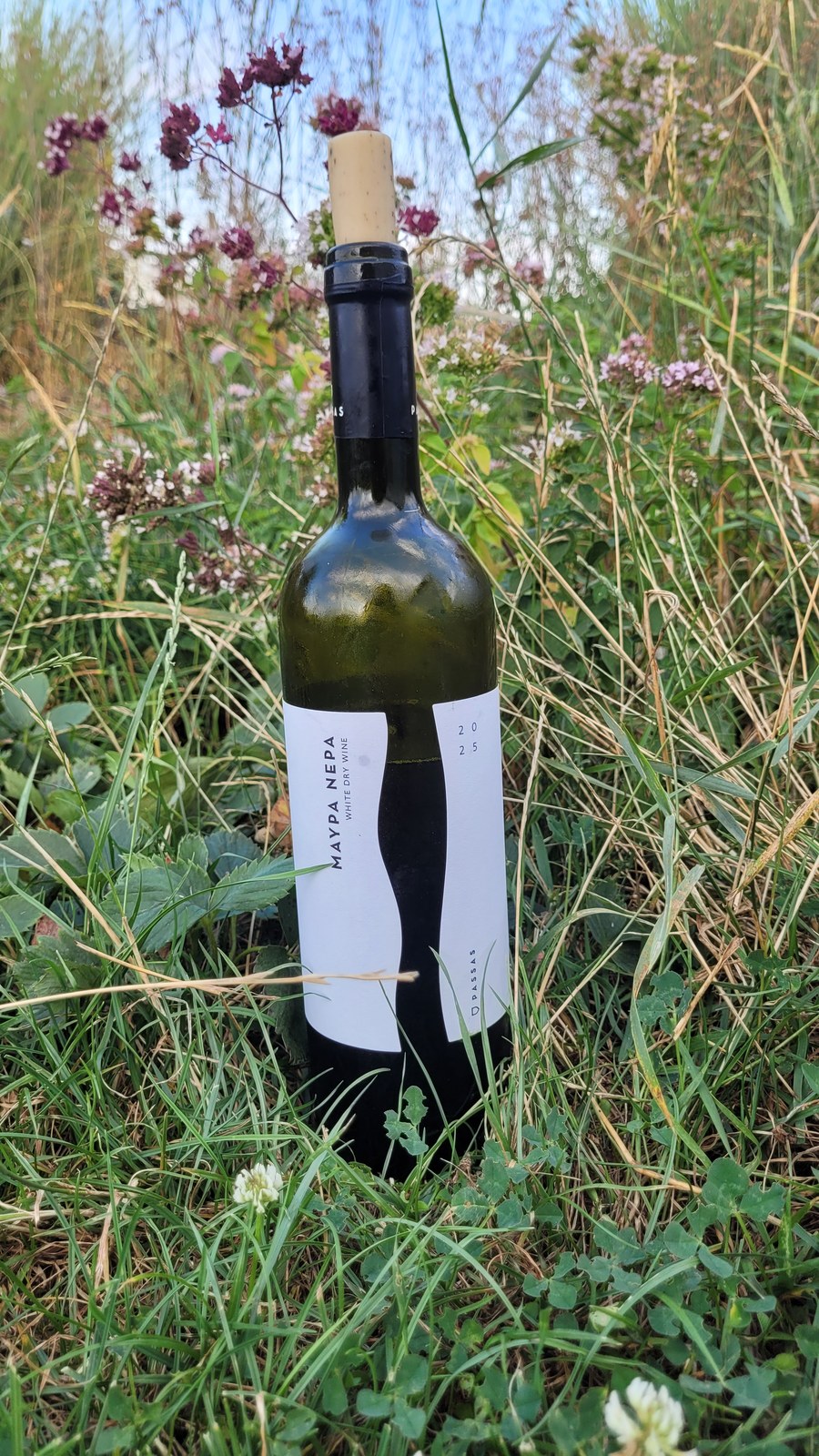
Passas Winery – Mavra Nera White 2025
40% Assyrtiko, 30% Vidiano, 30% Sauvignon Blanc
Thrace, Greece
White | dry
13%
This note belongs to a side-by-side tasting of two wines. On 4 August, the Mavra Nera White 2025 from Passas Winery and the Gennima Psychis white 2025 from Ktima Manolesakis stood together in the glass, two cuvées that resemble each other on paper and are separated by a border.
Passas lies in Stavrochori in the regional unit of Xanthi, in Thrace, on the northern slopes of the Nestos valley at the foot of the Rhodope mountains, at 110 to 130 metres. The topsoil carries a good thirty centimetres of sand, beneath which lie clay and loamy-clay layers with schist down to more than a metre deep, and the climate is continental in character, with wide day-night swings. Viticulture had all but disappeared from this area for around a hundred years, because tobacco had crowded out everything else. Kyriakos Papadopoulos and his wife Sara, themselves tobacco and apple farmers, planted the first vines in 2007; the winery has existed since 2016, and today their son Giorgos, a trained oenologist, works alongside them. The name Passas is a family epithet passed down over generations – the grandfather Kyriakos, who had fled from Pafra in Pontos, was respectfully called this by his younger sister. Mavra Nera means black waters and refers to the land along the Nestos.
What is interesting is what does not appear on the label. The wine carries no protected origin; it runs as a varietal wine. This is not carelessness but has two reasons that apply independently of each other. Stavrochori is not among the municipalities of the PGI Thrace, and Vidiano is not permitted there as a variety in any case. Both are derived from the official dossier; the estate itself makes no comment on the matter.
This very Vidiano is the innovation. In 2019, at launch, the wine was a two-part cuvée of 70 percent Sauvignon Blanc and 30 percent Assyrtiko; today the data sheet lists 40 percent Assyrtiko, 30 percent Vidiano and 30 percent Sauvignon Blanc, and Vidiano only entered the vineyards in 2017. It is made without any wood, after ten hours of cold maceration in stainless steel, then eight weeks on the fine lees. 18,000 bottles.
Less can be said about the vintage than I would like. There is no separate vintage classification for Thrace, which is a real gap, and simply adopting the value of neighbouring Drama would be wrong, because Drama, as one of the very few Greek wine regions without access to the sea, follows its own logic. That leaves the national framework, and 2025 was a good year across the country, with milder temperatures and few extreme events.
In the glass the wine is very clear, and on the nose noticeably more intense than the Manolesakis beside it. A little jasmine blossom, some green apple, plus hints of passion fruit. On the palate then an acidity that grips from the first contact with the tongue and, this surprised me, remarkably little richness for the Vidiano share. Instead plenty of mirabelle rolling along the palate. A surprisingly mouth-filling wine.
The 13 percent alcohol does it a great deal of good. With the 2020 I had noted at the time that it lacked some extract and did not come across as so round, which was also down to only 12.5 percent – here that is precisely remedied. To be honest, the alcohol is not the only change; between the two bottles there is also a different vintage and a reworked cuvée. It is the interplay, not the half percent alone.
The most remarkable thing comes at the end. In the finish the Sauvignon Blanc emerges once more, in a fruity-exotic guise. The structure is thus unusual: acidity on the attack, mirabelle and little richness from the Vidiano in the mid-palate, and only at the back the exotic fruit, which unfolds quite organically. It is precisely here that the difference from the Manolesakis shows, where the same Sauvignon Blanc serves the herbal-grassy side. Two paths with one variety, side by side on a single evening.
What is missing is complexity in the sense of several layers appearing at once. But what is there unfolds so harmoniously that I speak without hesitation of an exceptional vintage of this wine.
One more word about the closure, because it caught my attention. It is a synthetic stopper, and it seals poorly when you put it back and place the bottle in the fridge. This does no harm to the wine, there is nothing against it technically and there was no trace of a cork taint, and it can also be explained – such stoppers are strongly compressed by machine during bottling and expand again in the neck of the bottle, so by hand you can no longer fit them back in evenly. Even so, this wine would have deserved a better cork.
Outside ratings are scarce. The FNL Guide rated the 2023 at 7.5 out of 10, Simos Georgopoulos praised a fresh, balanced blend in which none of the three varieties pushes itself to the fore; for 2025 there is nothing available.
The price at the Greek specialist retailer is 10.90 euros, across the market as a whole between 10 and 12, in Germany just under 11. For that you get a wine that is barely known in Greece and that additionally comes from outside any protected designation. I am curious whether I will encounter Vidiano more often in the future in these cuvées of Assyrtiko and Sauvignon Blanc, and curious about this estate's single-varietal Vidiano in any case. For me this is 90 points.
Tasted: August 2026
Other vintages:
Passas Winery – Mavra Nera White 2020 (89, 2022)