
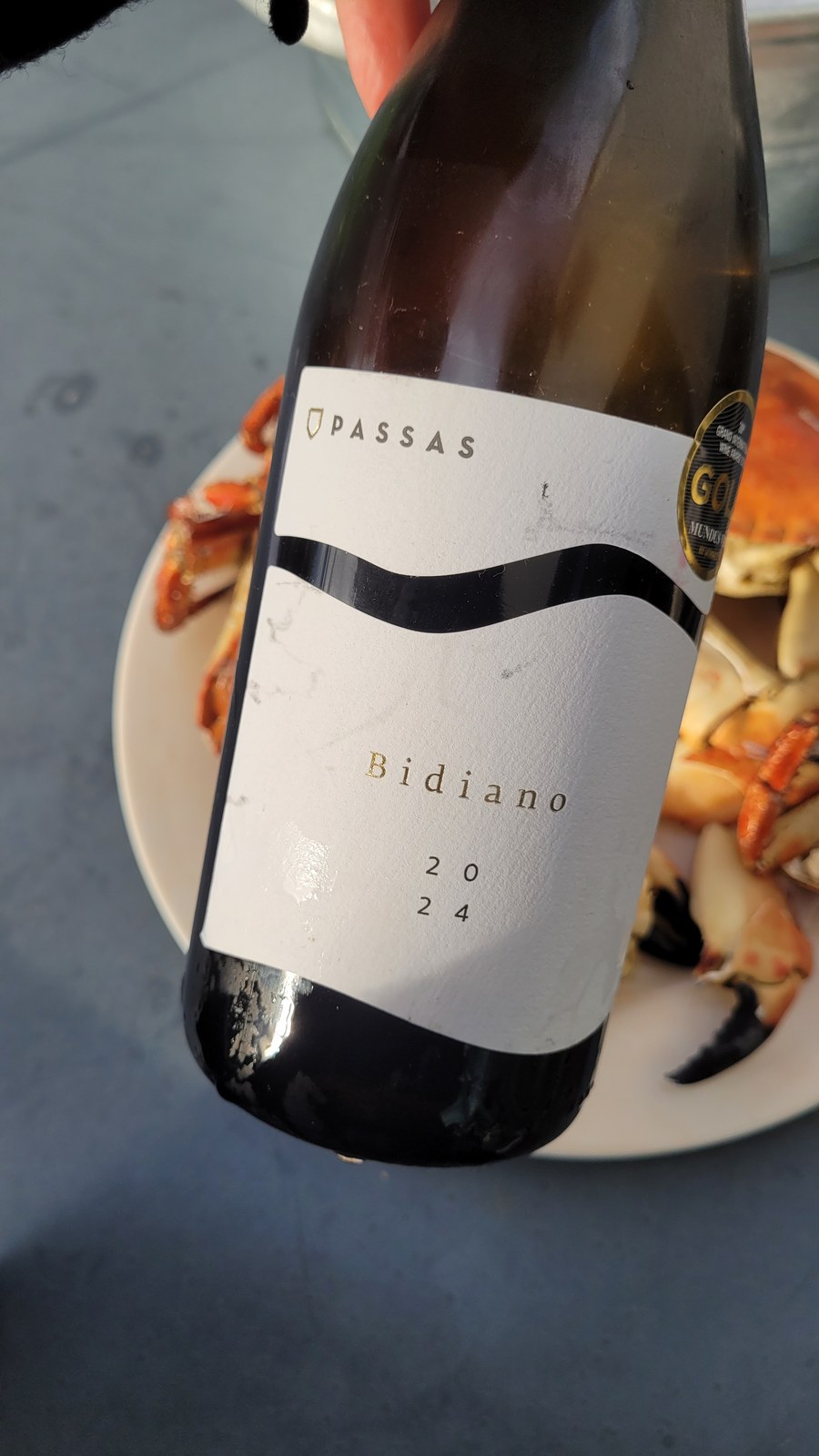
Passas Winery – Bidiano 2024
100% Vidiano
Thrace, Greece
White | dry
13%
In October 2026, I opened a white wine tasting with the Bidiano 2024 from Passas Winery, a tasting that led from Vidiano to Assyrtiko. It stood at the beginning, as a Vidiano with oak-barrel ageing. It was followed by further single-varietal Vidiano, among them the EXIS Vidiano White Dry 2025 from Estate Manolesakis and the Vidiano 2025 from Diamantakis. Then came the Diamantopetra White 2025 and the Petali Assyrtiko 2025 from the same house, and finally two Assyrtiko from Kir-Yianni, The North 2025 and the Single Block Tarsanas 2023. "Bidiano" is simply the estate's spelling for the grape variety; in the glass it is 100 percent Vidiano. The variety is actually Cretan.
Passas Winery lies in Stavrochori in the regional unit of Xanthi in Thrace, north of the Nestos valley at the foot of the Rhodope Mountains. For the Bidiano the estate cites an altitude of 130 metres. For its vineyards the estate describes about thirty centimetres of sand on top, with clay and shale beneath. The climate is continental in character, with large differences between day and night. The operation grew out of a family farm that previously produced tobacco and apples, and underground drainage channels had to be laid for the vineyards. The winery has existed since 2016. It was founded by Kyriakos Papadopoulos, and today his son Giorgos, a trained oenologist, works alongside him. Five hectares of the estate's own vines are cultivated. Passas was the nickname of the grandfather, who came from Bafra in Pontos, and the family has passed it down over generations.
The estate planted Vidiano in 2017. For the Bidiano it cites yields of 6,000 to 7,000 kilograms per hectare. In the cellar, ten hours of cold maceration are followed by fermentation in stainless steel and then around 15 weeks on the fine lees in oak barrels of up to 300 litres. The 2024 has 13 percent alcohol and, with 1.4 grams of residual sugar per litre, is dry according to the vintage data sheet. Total acidity stands at 5.3 grams per litre, which is analytically on the moderate side. A total of 3,000 bottles were filled. The wine carries no protected designation of origin; it runs as a varietal wine. Stavrochori and Vidiano appear in the specification of the PGI Thrace neither as a municipality nor as a variety.
I have not found a critic's rating for the 2024 vintage of this wine. Meiningers Weinwelt rated the preceding 2023 at 91 points in issue 03/2025, following a tasting in spring 2025.
On the nose the Bidiano 2024 is nicely yellow-fruited, with a touch of vanilla that suits the barrel ageing. On the palate, a lovely fruit stands out right on the attack. Then comes a surprisingly good, supporting acidity that one would not expect from 5.3 grams on paper. It also makes the wine a very good food companion. The finish is subtly abrasive for a Vidiano, so slightly rough, but without overdoing it. Nor is it overly oily. In fact this is an extremely balanced, almost filigree wine.
That places it, for me, ahead of the Vidiano from Diamantakis at 90 and the EXIS at 88 points. Across the entire tasting only the Tarsanas 2023 ranked higher, at 93 points. I had noted the Mavra Nera white 2025 at 90 points in August 2026, around a year after the harvest. The single-varietal Vidiano now ranks above that cuvée, and I have so far not rated any wine of the estate higher. A really very positive wine worth singling out, and a truly gastronomic one. It costs around 16 euros in Greece. For me that is 92 points.
Tasted: October 2026