
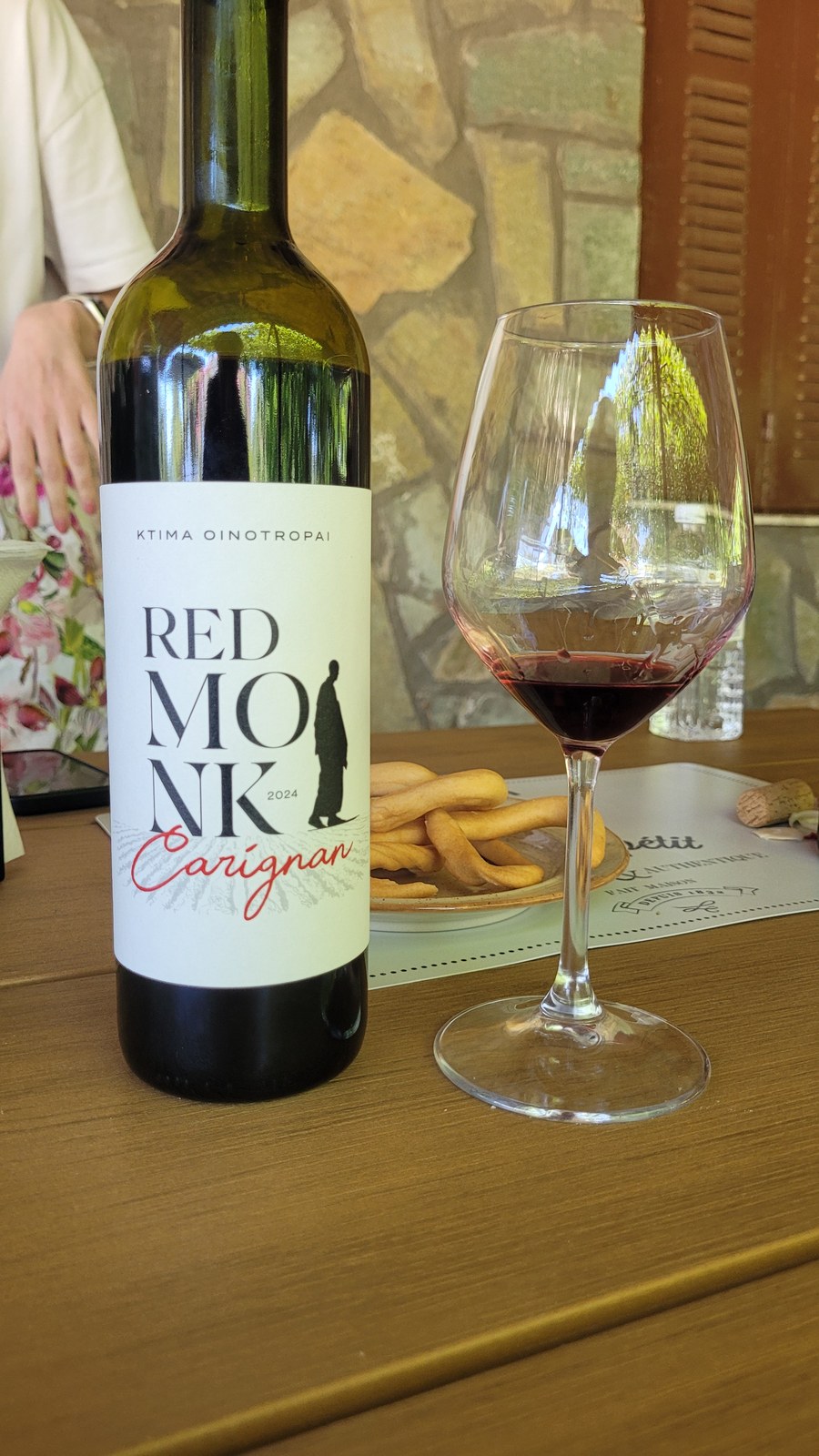
Oinotropai Winery – Red Monk 2024
PGI Messenia
100% Carignan
Peloponnese, Greece
Red | dry
13.3%
Drinking window: 2029–2034
In early June 2026 I sat with the Kapopoulos family at Ktima Oinotropai in Zevgolatio, not far from Kalamata, and after the Nomade Chardonnay came the wine that has preoccupied me most here for years: the Red Monk. I already know two vintages, and I rated both highly – more on that shortly. The name is a homage to the fact that this wine is unique, travelling entirely on its own – the only red Carignan in Greece, at the moment and probably for some time yet – steadily going its own way, a way to the very top of Greek wine. For me it is one of the country's most exciting reds, precisely because it is so atypical. It used to be labelled "Roes Carignan", in 2018 as "Roes Carignan Vieilles Vignes"; for a few years now the same tiny old-vine parcel has been called Red Monk.
And it really is something special: a small, own-rooted, ungrafted block of around 0.4 hectares with roughly forty-year-old Carignan vines, farmed without irrigation and without fertilisation, bottled as 100% Carignan under the PGI Messinia. Carignan is a genuine rarity in Greece, and Vasilis and Maria Kapopoulos draw from this little patch a wine that runs stylistically against everything one would expect from the region.
Because as a vintage, 2024 was the hottest and driest year of the recent run in the Peloponnese. A July heat dome with over 40°C on twelve days pushed ripeness so far along that they picked as early as never before – not because the grapes were unripe, but to get ahead of the runaway sugar and to save acidity and freshness. Yet from the heat and the small, concentrated berries came, in many places, powerful, tannin-rich wines with risks of overripeness and alcohol that need cellar time; old, deep-rooted vines – like this block – were at an advantage. This Carignan sets itself squarely against exactly that: bottled lean at 13.3%, upright and fresh. That fits the estate's clear developmental trajectory, having pulled back the alcohol vintage after vintage: 15.5% in 2018, then 14% in 2021, now 13.3%.
The 2024 immediately seduced me with a stunning bouquet – a wine you really just want to keep sniffing at, a whole bouquet of fruit underpinned by appetising herbal notes. On the palate it shows fascinating acidity and very solid tannin, which may still soften a touch and make more room for the aromas on the finish. And what is lovely is also what is missing: the chocolate you otherwise so often get in Greece with more powerful wines of this kind – say from Merlot.
The 2024 slots into my own vertical. I saw the Roes Carignan Vieilles Vignes 2018 in December 2022 at four years old at 94 points: the 15.5% alcohol not hidden, atypically nutty aromas, but nonetheless good acidity, decent fruit and a long finish – back then in direct comparison with the Chilean cult Carignan Vigno. Simos Georgopoulos gave this 2018 a 9 out of 10, Pavlos Gegas 90 points. I also rated the Red Monk 2021 at 94 in 2025: with a more moderate 14% more accessible and fruit-forward, lush and refreshing, with lovely acidity and good complexity – the clear departure from the nutty, high-alcohol 2018. The 2024 consistently continues this journey with its 13.3%, its acidity and the absence of any chocolatiness.
At around €16 this is a wine you'll see rewarded in the cellar: drinkable now, but best from next year; I could well imagine it showing in full bloom from 2029, and a window through to 2034 should certainly be feasible. Of course, with these wines that still has to be tested – and I hope to be able to report on more mature bottles at some point. 93+ points.
Tasted: June 2026