
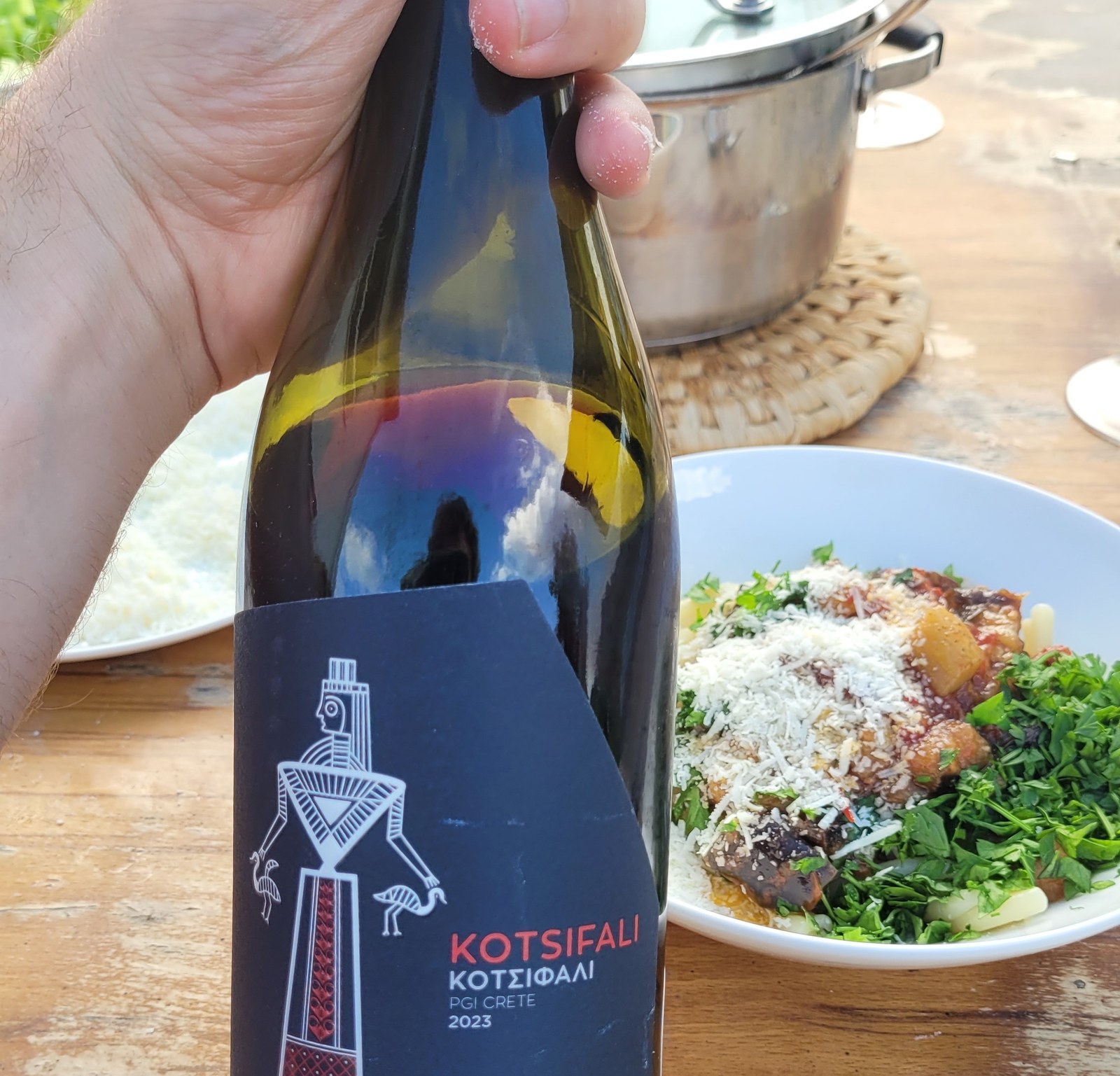
Lyrarakis – Kotsifali Queen 2023
PGI Crete
100% Kotsifali
Crete, Greece
Red | dry
13.5%
Lyrarakis, founded in 1966 by the brothers Manolis and Sotiris Lyrarakis in Alagni near Heraklion and today run by the second generation, has made itself the pioneer of the Cretan varietal revival – it is to this estate that we owe the survival of grapes such as Dafni, Plyto and Melissaki. The "Kotsifali Queen" belongs to the "Queens" line, in which four Cretan varieties – Vidiano, Liatiko, Vilana and Kotsifali – each appear as a "queen"; the label of the "4 Queens," designed in 2023 by Wine Wonders, draws on early Cretan textile history. The vineyard lies at 500 metres on loamy sand with a northern exposure, within reach of Archanes and Knossos.
That the wine is labelled PGI Crete rather than under a PDO has a simple reason: the red PDO Peza, and likewise Archanes, is traditionally a blend of Kotsifali and Mandilaria, so a single-varietal Kotsifali inevitably runs as PGI. And that is precisely the point here. It is aged without wood, in stainless steel alone – following a hand harvest on 6 September 2023, pre-maceration at 12 °C for 40 percent of the grapes, spontaneous fermentation with native yeasts and malolactic fermentation. A single-varietal, unoaked Kotsifali, then, dry (2.07 g/l residual sugar), with 5.35 g/l acidity and pH 3.41 – and vegan.
As a vintage, 2023 was an extreme year on Crete: downy mildew and heat pushed yields down by up to 70 percent, and the harvest was significantly delayed. 2023 turned out riper and drier than the preceding years – only 292.6 mm of rainfall against 746.8 mm in 2022, the harvest on 6 September as opposed to 22 August 2022, and with a good 13.5 percent alcohol above the 13.0 percent of 2022 and 13.2 percent of 2021. It is precisely the late Cretan reds – Liatiko, Kotsifali, Mandilari – that are considered promising this year in terms of high-quality tannins, owing to the delayed ripening.
And that is exactly what I taste here. On the nose the wine is fruity, with a hint of plum. On the palate there is good acidity, which builds further, alongside the alcohol, moderate at 13.5 percent – moderate for Kotsifali, if somewhat higher than in previous years, which suits it well. On the finish, faintly barnyardy notes emerge. And then the decisive thing: a tannin that is respectable for the variety. Kotsifali is otherwise regarded as soft and aromatic but structurally lacking, and usually needs Mandilaria as a scaffold for tannin and colour – this is a Kotsifali that needs no Mandilaria.
Still, I am not entirely without reservations. Overall it remains a little rustic and not very polished; it comes across with a certain lightness that leads you to expect elegance, and that elegance fails to materialise – which does not become it. That, frankly, is my general problem with Kotsifali. The finish is long but not lavish in flavour. Yet, for all that: respectable.
There is no named review for the 2023. Across the vintages the Kotsifali Queen is a solid wine at around 16.5 out of 20 with Julia Harding on JancisRobinson.com – she rated the 2022 at 16.5/20, and older Kotsifali repeatedly came in at 16 to 16.5, while Wine Enthusiast gave the 2014 92 and the 2009 87 points. No sensation, then, but reliable, and my 88 falls into line with this. In Greece the wine costs around 9.90 euros, which is very good value for money; on British import the price jumps to about 16 to 16.50 pounds. 88 points.
Tasted: June 2026