
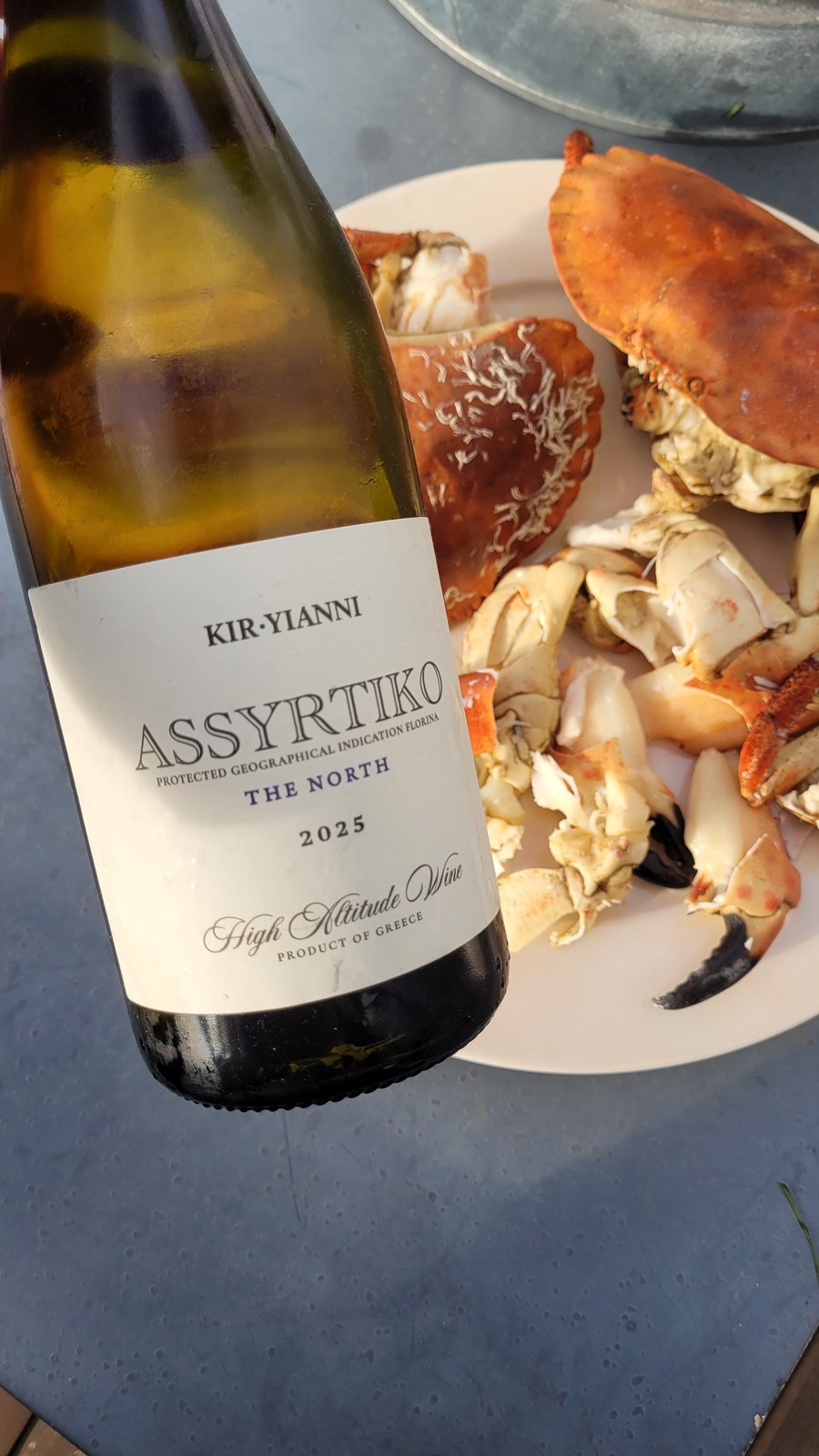
Ktima Kir-Yianni – Assyrtiko The North 2025
PGI Florina
100% Assyrtiko
Macedonia, Greece
White | dry
13.5%
This Assyrtiko from Kir-Yianni is called „The North“, and the name refers to its origin in northern Greece. Some labels also carry the note „High Altitude Wine“. The grapes do not grow in Naoussa, where the estate is based, but on the high plateau of Amyndeon in Western Macedonia. These are selected parcels near Agios Panteleimonas at 600 to 700 metres, with nutrient-poor sandy soils, pronounced differences between day and night, and the moderating influence of four lakes and north winds. The vines are predominantly young, averaging around ten years of age. Because the PDO Amyndeon is tied to Xinomavro, this single-varietal Assyrtiko is released as PGI Florina. Kir-Yianni was founded in 1997 by Yiannis Boutaris, and the name picks up the respectful form of address for the founder, roughly „Mr Yiannis“. Today Stellios Boutaris runs the house, and the chief oenologist since 2010 has been Antonis Kiosseoglou. Within the range, The North is the accessible entry point into the estate's high-altitude Assyrtiko, below the single-vineyard wine Tarsanas. In March 2025, Kir-Yianni still explicitly described the 2024 as a label sold only abroad. By now the wine can also be found in Greek retail.
The 2025 was hand-picked between 20 September and 1 October and strictly selected on the sorting table. Kir-Yianni itself reports healthy grapes and a quantitatively good harvest. Following a short cold maceration, the wine ferments in stainless steel and remains there for three months on the fine lees, seeing no wood. 13.5 percent alcohol, dry, screwcap. On paper it shows 5.0 grams of total acidity per litre at a pH of 3.37. The 2024 had 5.5 grams and 3.26, from a harvest that began a week earlier.
I had the wine in the glass in October 2026 at the white wine tasting „Vidiano & Assyrtiko“. It ran across eight wines from Vidiano to Assyrtiko, pitting Crete against northern Greece and pursuing the question of acidity. The bottle came as a sample. The North stood in seventh place, directly after the Diamantakis Petali Assyrtiko 2025 from PGI Crete (91 points) and directly before the Single Block Tarsanas 2023 from the same estate (93 points). The Tarsanas comes from Block 10 Samaropetra with vines from 2004 and has 14 percent. It aged for six months in 225-litre French oak barrels, half of them new, with three months of bâtonnage. For the Petali I had noted that you should look elsewhere if you are seeking competition for the great wines of Santorini. Whether this wine from the north can keep up with Santorini was therefore the question with which I took it into the glass.
Expectations were not low. In the Wine Advocate the 2025 received 92 points in June 2026, according to the producer from Monica Larner, who found it precise, straight and taut, with citrus, tropical fruit and blossom. Emily Saladino gave it 90 points in the Wine Enthusiast (issue of 1 November 2026) and noted lemon, lime and a mineral undertone. Vintage Assessments in Canada lists it with 90 points as a „Best Buy“. At the Balkans International Wine Competition 2026 it took gold with 90 points, and at Mundus Vini 2026 likewise gold.
On the nose it is, no question, much closer to Santorini than the Petali, a balanced Assyrtiko. On the palate, too, it shows a really good acidity. With the Petali, however, it shares the banana that was so abundant on the nose there. Here, for my taste, there is a little too much of it. And the wine is also a touch too brushed towards acidity.
By no means is this a bad wine. What did it some disservice that evening was that immediately afterwards we had a second wine from northern Greece from the same estate in the glass, namely the Tarsanas. Anyone looking for an entry-level Assyrtiko from Santorini need look no further, because here they get the wine at half the price. The North costs around 15 euros in Greece. For me, that is 88 points.
Tasted: October 2026