
Kokotos Estate – Kokotos Estate 2017
Cabernet Sauvignon - Merlot
PGI Attica
90% Cabernet Sauvignon, 10% Merlot
Attica, Greece
Red | dry
14% | Organic
Drinking window: –2057
That the Ktima Kokotos 2017 from Kokotos Estate (PGI Attica) couldn't be a bad wine was clear at the latest when it landed 15th place in the 50 Great Greek Wines competition, making it the best international cuvée among all the wines tasted. The estate near Stamata, not far from Athens, was founded by Anne and Jorgos Kokotos as a refuge and has been bottling since 1985. Konstantinos Lazarakis MW once described the house's Cabernet Sauvignon, alongside that of Katogi Averoff, as 'the coolest, firmest, most old-world Cabernet Sauvignon in Greece, needing years to soften.' After a phase of expansion, the founding of a winery in Nemea, and the transfer of the name 'Semeli' to that venture, the Kokotos couple have returned their full attention to their vineyard near Stamata; since 2011, the wine has been bottled under the name Kokotos Estate.
The 2017 is composed of 90% Cabernet Sauvignon and 10% Merlot and was aged 26 months in French oak at 14% alcohol. Incidentally, from the 2019 vintage onwards, the Merlot proportion has been increased after the couple noticed a significant quality leap in the Merlot vines planted in 2002, some 15 years on.
In a blind tasting, the Ktima Kokotos was compared directly with Château Ducru-Beaucaillou 2017 – a second growth from Saint-Julien that in the same vintage also happens to be 90% Cabernet Sauvignon and 10% Merlot. Visually, the wines differ markedly: the Ducru-Beaucaillou leans far more into the violet spectrum but also shows more sediment already. What is downright shocking, however, is how close the two wines are on the nose. Especially as they warm up a little, without the glasses side by side you'd struggle to tell them apart. The Ducru edges slightly more toward red fruit, while the Kokotos has more smoky aromas. On the palate, too, there's barely a hair's breadth between the two cuvées: Ducru-Beaucaillou is a touch more filigree, Kokotos in return more complex. On the finish, they hold equally long. Two wines that could hardly be better for their type – and that could each improve further with time.
The fact that the Kokotos so effortlessly keeps pace with one of the finest Bordeaux wines of the vintage – and in the blind tasting actually came out ahead – cannot be overstated. For context: the Ducru-Beaucaillou 2017 has an average rating of 96.37 points on Global Wine Score, placing it 11th among dry red Bordeaux, on the Left Bank immediately behind Latour, Margaux, Haut-Brion, Léoville-Las-Cases, and Mouton Rothschild. At around €50, the Kokotos is admittedly one of the most expensive Greek reds, but it costs only a third of the Ducru-Beaucaillou.
This is, without a shadow of a doubt, a phenomenal wine that deserves at least 98+ points – and with more maturity, still has room to climb higher.
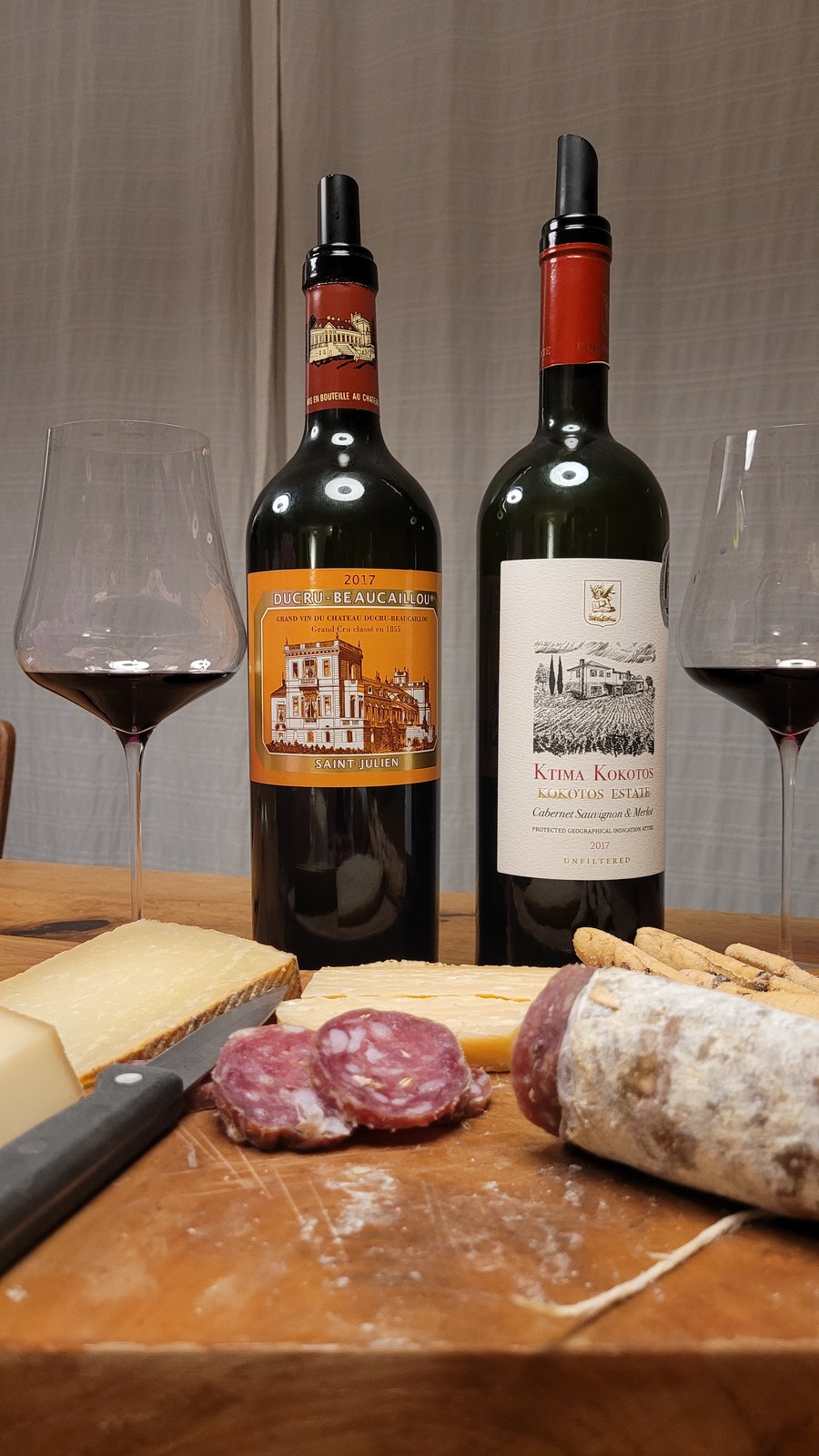
Tasted: 2022
Other vintages:
Kokotos Estate – Kokotos Estate 2020 (96, 2024)