
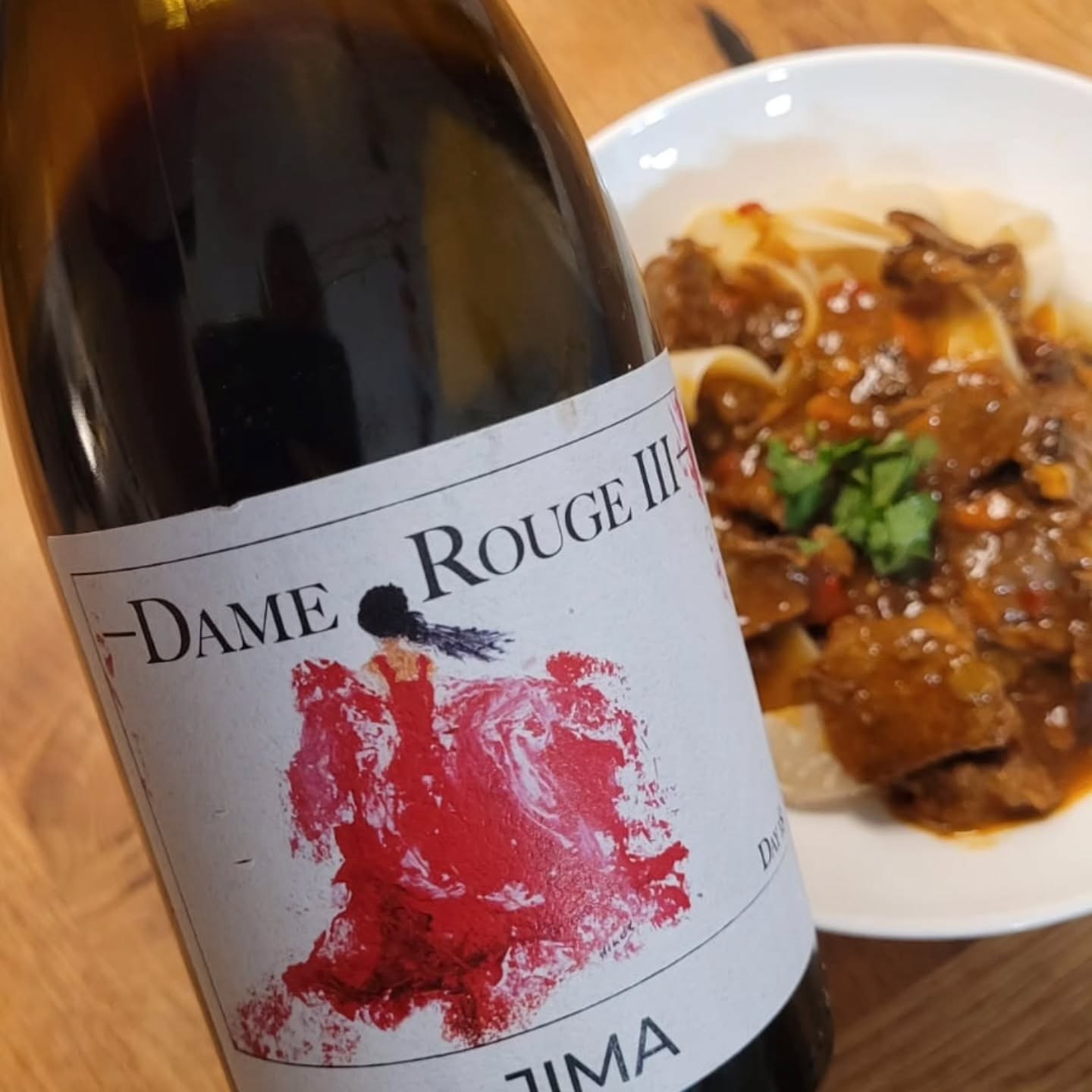
Jima Winery – Dame Rouge III 2021
Day 18
90% Merlot, 10% Cabernet Franc
Epirus, Greece
Red | dry
14.5%
After all that concentration and power, here is a wine that shows Greek Merlot can also go in a completely different direction. Jima Winery in Kalomodia near Arta, just a few kilometers from the Ambracian Gulf, is a family operation founded by oenologist Panagiotis Jimas and his wife Kristy Karagiannidou. Jimas holds the WSET Diploma – a rarity among Greek winemakers, and you can tell from his wines. The estate produces two very different cuvées from Merlot and Cabernet Franc: The Odyssey 2021 (85% Merlot, 15% Cabernet Franc, 13.4% alcohol, 90+ points) is the more fruit-forward, approachable version – a wine that in earlier vintages went by the name Âge d'Or and which I liked slightly better in the 2020 vintage. The Dame Rouge is the other extreme: more ambitious, more experimental, more uncompromising.
The Dame Rouge III is the outlier of this tasting in several respects. The grapes – 90% Merlot and 10% Cabernet Franc – come from Block 13, a tiny parcel of just 0.45 hectares on calcareous clay soil with marine fossil deposits. Planted in 2013, these are by far the youngest vines in our comparison – only eight years old at the time of the 2021 harvest, while Lacules looks back on over 40 years and Hatzimichalis on over 20. And the elevation: 3.3 meters. Practically sea level. Where the Emperor sits enthroned at 850 meters and the other wines lie between 300 and 350 meters, the Jima parcel stands almost at the waterfront, cooled only by the breezes from the Ambracian Gulf.
What sets the Dame Rouge apart from everything else in this tasting is the winemaking. A portion of the Merlot grapes is dried in the shade after hand-harvesting on September 5th – appassimento-style, to concentrate aromas, tannins, sugar, and acidity. These partially dried grapes are then added to the already fermented fresh wine, triggering a second fermentation. The fermented juice is then separated from the stems in a vertical basket press; fermentation continues in a new oak barrel until the following February. In December 2022, it is bottled unfiltered and without any further treatment; afterward, the wine remains at the winery until November 2023. Taken together, this amounts to aging over two calendar years – a considerable commitment for a winery of this size.
The analytical data show the result: 14.5% alcohol, 6.4 g/l total acidity at pH 3.8. The acidity is thus higher than that of the Galatrona and the Hatzimichalis; only the Emperor has more. For a partially dried Merlot, this is remarkably taut – what emerges here is not a sweet, opulent Amarone style, but something with its own identity.
In the glass, a wine that immediately heads in a different direction. On the nose, a downright drastic amount of leather stands out, underneath ripe cherries and plums. On the palate, a very fine tannin that lends the wine elegance and removes any brutishness – after the power displays of Lacules and the hefty tannins of the Emperor, a welcome change. Lots of olive paste on the palate, long finish. 93+ points. A wine that probably would have shown even better with more air and that will find its fans especially among those who, even at 14.5%, are looking for a more filigree Merlot. Anyone who has one of the few hundred bottles should give it more time – from this year onward, you can gently start trying it.
In general, the Dame Rouge still needs considerably more bottle age. Last summer I opened the Dame Rouge IV from the 2023 vintage, and it was clearly too early – it felt like a barrel sample. The same applies to the Odyssey III and the single-varietal Cabernet Franc 2023 from Jima. These wines have enormous potential, but they need patience. One shouldn't offload the restraint onto the consumers, and I wish Jima Winery that the quality of their wines soon generates enough revenue to allow for longer bottle aging before release.
Tasted: February 2025