
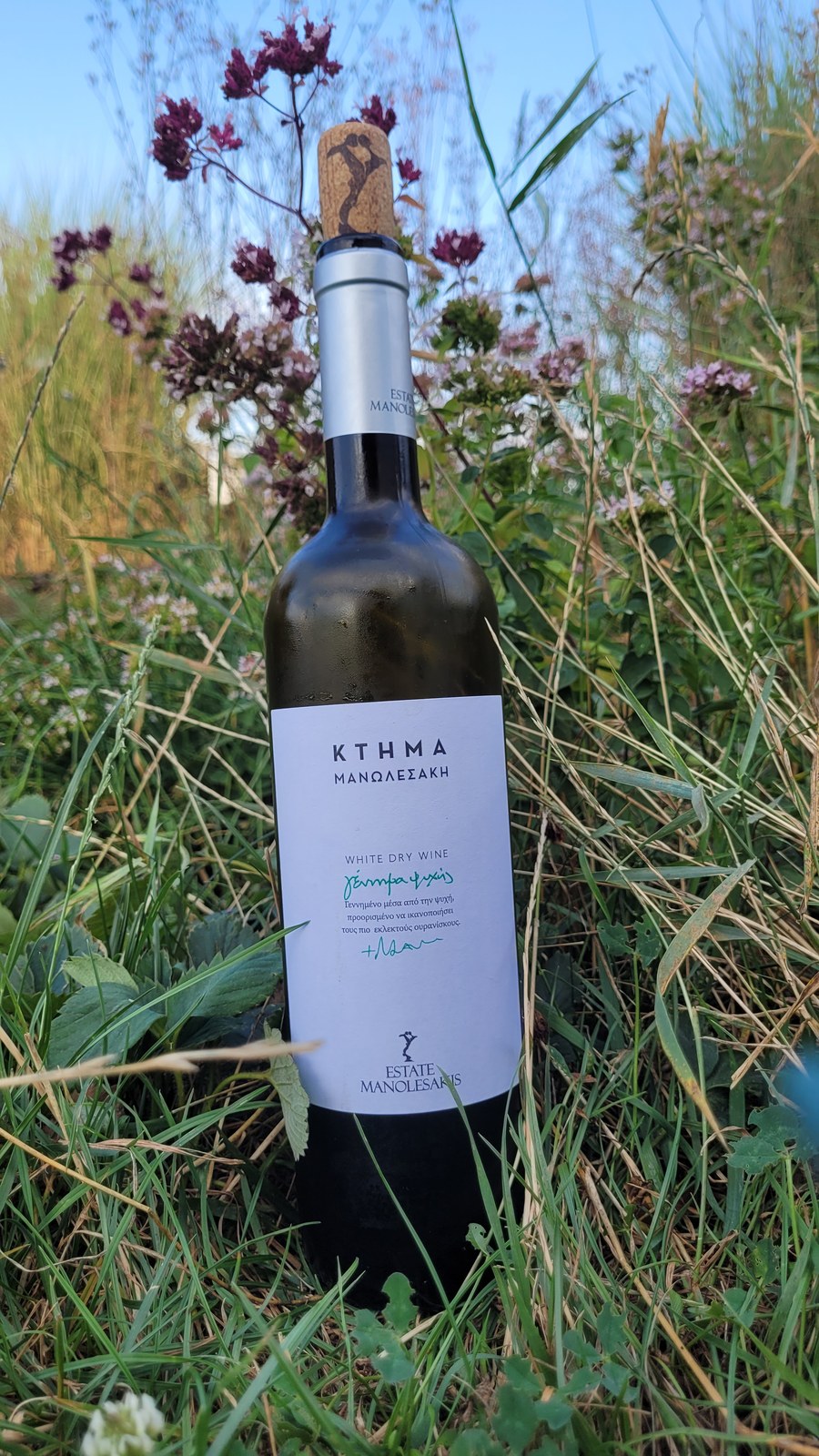
Estate Manolesakis – Gennima Psychis White 2025
Sauvignon Blanc - Assyrtiko
PGI Drama
70% Sauvignon Blanc, 30% Assyrtiko
Macedonia, Greece
White | dry
12%
On the 4th of August, two white wines stood side by side in the glass, wines that look similar on paper: the Gennima Psychis white 2025 from Ktima Manolesakis and the Mavra Nera White 2025 from Passas Winery. Both are built on Sauvignon Blanc and Assyrtiko, both come from the northeast, and a border runs between them. Manolesakis lies in Adriani and thus in the heart of the PGI Drama, while Passas is a few kilometres further east in Thrace and outside any protected origin.
At Manolesakis, the Gennima Psychis is the middle tier, clearly above the entry-level EXIS series and below the single-varietal wines such as the Malagouzia. The name roughly means Creation of the Soul, and it carries a small history: it was once the name of the entire estate. In 2007 the operation traded as Estate Gennima Psychis, in 2015 it was again called Manolesakis, and the name lived on as a wine line. The grapes come from two hectares of the estate's own row-planted parcels near Adriani at 200 to 300 metres, on clay soil with small pieces of limestone that ensure drainage. Harvesting is done at night so the grapes reach the cellar cool; this is followed by pre-fermentation cold extraction, the use of free-run must only, separate vinification of the two varieties and two months on the fine lees. No wood. 7,000 bottles.
One detail is worth a glance back at earlier vintages. The wine was long a three-way blend; in 2020 it held 60 percent Sauvignon Blanc, 30 percent Chardonnay and 10 percent Assyrtiko. In the 2025 the Chardonnay has disappeared, giving 70 percent Sauvignon Blanc and 30 percent Assyrtiko. Exactly when the change was made is not documented, but it explains why older scores are only of limited use: the FNL Guide gave the 2021 a 7.5 out of 10, though back then still with Chardonnay in the mix.
The vintage speaks in the wine's favour. 2025 was the strongest year in Drama since 2020, with ample winter snowfall, mild ripening temperatures and a harvest that began within the normal range on the 7th of August. For the first time, Adriani received its own paragraph in the harvest bulletin, describing a balanced year with favourable day-night swings and white wines with typicity and good balance. The caveat is that this is so far an expectation drawn from a harvest report and not a verdict confirmed by tasting.
All the more reason to taste closely. On the nose a little honey, underlaid with a hint of mint, plus a touch of nectarine. On the palate the wine sets off with good grip, which nonetheless somewhat smothers the acidity, and with it the refreshing quality. There is a shortfall of alcohol, so the wine remains a bit thin and shows quite a few rough edges. The finish is rather short, with something herbal coming through at the back.
In fact the acidity is not lacking at all; the data sheet cites 5.1 grams. It is its effect on the attack that strikes me as not refreshing enough, and this stands out especially when you have the Mavra Nera from Passas in the glass alongside, where the acidity grips from the very first moment. With the alcohol, too, my impression matches the lower of the two circulating figures; the bottle says 12 percent, the producer's website claims 12.5.
I wrestled with myself over the score. I quite like the rosé from the same line, and by rights this white should sit a point below it. But then it becomes too little, and that does not do it justice. So it gets the same as the rosé.
Because what it does, it does well. This is a lovely quaffing wine, the kind one often finds in Greece made from Malagousia with more floral notes, which you do not always want with food. With light fish it is a very good option, and it brings enough acidity for that. Anyone who likes Sauvignon Blanc in its somewhat grassier expression is in the right place here, and therein lies precisely the contrast with the Passas, where the same variety shows an exotic, fruity character on the finish. Two paths with one grape variety, and the more interesting one came, of all places, from outside the appellation.
At the estate the wine costs from 12.40 euros. That is fair for what it is, and it is deliberately nothing else. For me, that is 87 points.
Tasted: August 2026