
Estate Manolesakis – Gennima Psychis Rosé 2025
Syrah - Agiorgitiko
PGI Drama
60% Syrah, 40% Agiorgitiko
Macedonia, Greece
Rosé | dry
13.5%
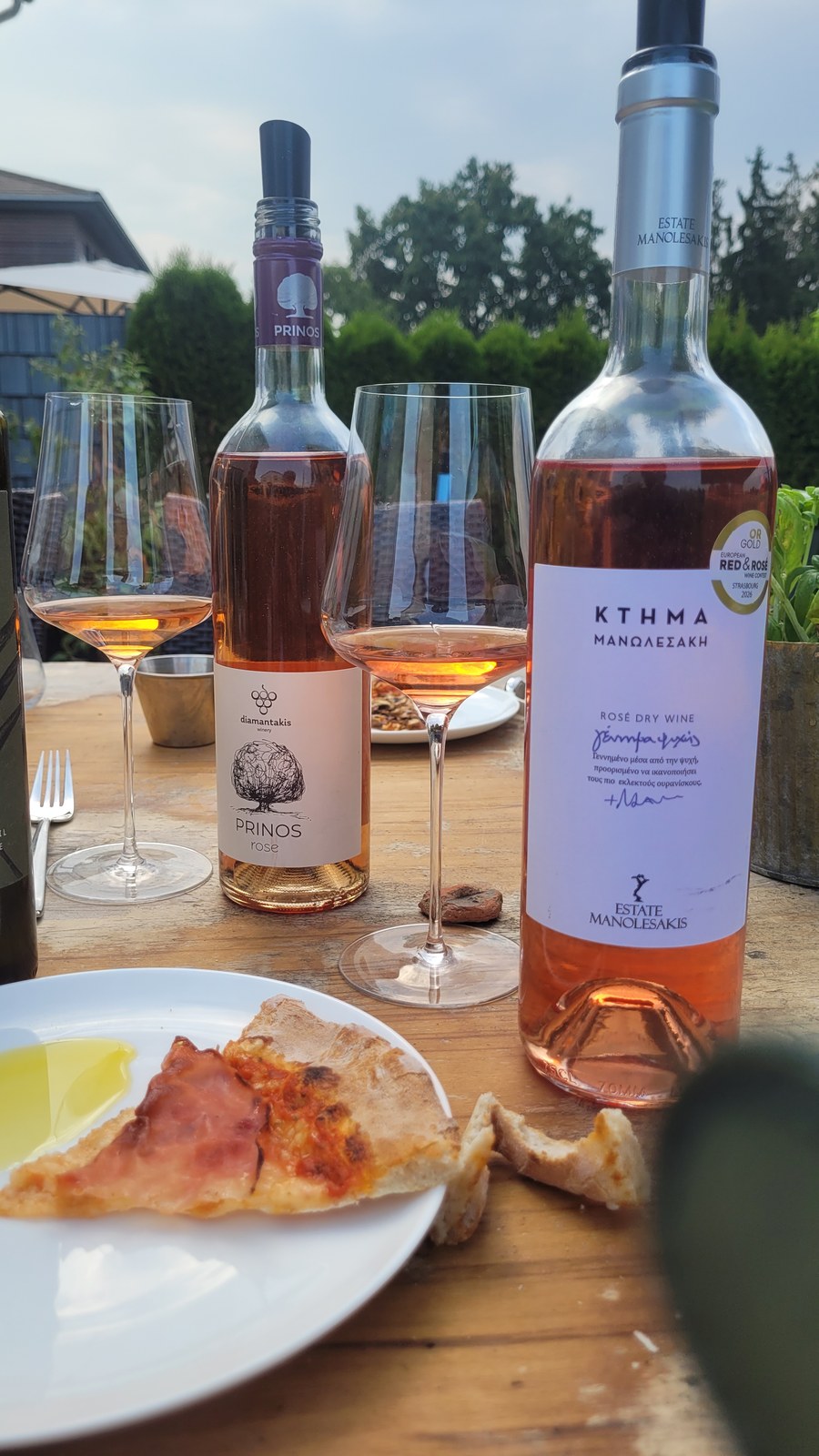
This note comes from a joint tasting of two Greek rosés that I call my two "pizza rosés from northern and southern Greece": the Prinos Rosé 2025 from Diamantakis in Crete and this very Gennima Psychis Rosé 2025 from Estate Manolesakis in Drama. The parallels are appealing: both wines are Syrah-dominated and pair the Rhône variety with a Greek grape, both come from the same vintage, both are very similar in alcohol, and both are darker rosés. One hails from the southernmost tip of Greek viticulture, the other from the north. In fairness, one has to note: the Cretan brings a genuinely indigenous variety with Mandilaria, while the wine from Drama relies on Agiorgitiko, a variety that is now grown throughout Greece but originates in the Peloponnese, from the area around Corinth, namely Nemea. So in the northern Greek wine, the Greek variety is itself an immigrant.
Estate Manolesakis sits in Adriani near Drama, in the northeast of Macedonia, on clay soils whose drainage benefits from embedded small limestones. The Gennima Psychis Rosé – the trade translates "Γέννημα Ψυχής" as "Born Soul" – has been on the market since 1998 and, according to the estate, consists of 60% Syrah and 40% Agiorgitiko from 1.5 hectares of its own vineyards, at 800 to 900 kilograms per stremma. Harvesting is done at night, a house principle for all the estate's wines: the grapes are meant to arrive in the cellar cool rather than warm, so they can go into the pre-fermentation cold extraction without heat shock. Syrah and Agiorgitiko then rest together on the skins for one to two hours until the desired colour is reached, followed by classic rosé vinification and two months on the fine lees – entirely without wood. The wine is classified as PGI Drama, with alcohol at 13.5%.
As a year, 2025 was strong in Drama – an 8 in my vintage rating: abundant winter snowfall and spring rain replenished the water reserves, the ripening phase was mild, and the harvest start on 7 August fell within the normal range. For the Adriani growing site, that is precisely the estate's location, a balanced year is described, with favourable day-night swings and a problem-free harvest, whereby some cool rains are said to have enhanced the aromatic and phenolic ripeness. I provisionally rate Crete 2025 at 7.5 – so the northern Greek in this flight comes from the slightly better year.
In the glass, the Gennima Psychis is the darker of the two – its deep colour is more apparent, while the Prinos tends towards orange. On the nose it is cut a little cooler than the Prinos, with a touch more mint, plus a tiny bit of blueberry. On the palate then a good, gripping acidity – and that tallies with the analytics: 6.05 g/l total acidity here against 4.95 g/l for the Prinos, which in my view lacked precisely this acidity a little on the palate. The tannin is coarsely chalky; whether that has anything to do with the small limestones in Adriani's clay soil, I leave open. The finish is, as with the Prinos, medium-long. All in all, this is a very well-made rosé, just one with a few rough edges, not quite so polished. Though I must qualify: anyone who prefers elegance, and specifically quick-drinking, simple elegance, may indeed find the Prinos, which I rate at 86 points, more to their taste – the difference is a question of style, not a gap in quality. I would drink both wines now, but I credit the Gennima Psychis with a bit more ageing potential; one can wait another year here.
Until now I knew two wines from Estate Manolesakis, both tasted in 2021: the Pelagia 2017 as a four-year-old with 89 points and the red Gennima Psychis 2018 as a three-year-old with 79 points – a different type of wine, seven years apart, so no direct comparison, but worth a footnote. The estate recommends the rosé at 10 to 12 °C with lobster pasta, stuffed tomatoes, mushroom pie or Greek ladera; in my case, as mentioned, it was on the table with pizza.
87 points.
Tasted: July 2026