
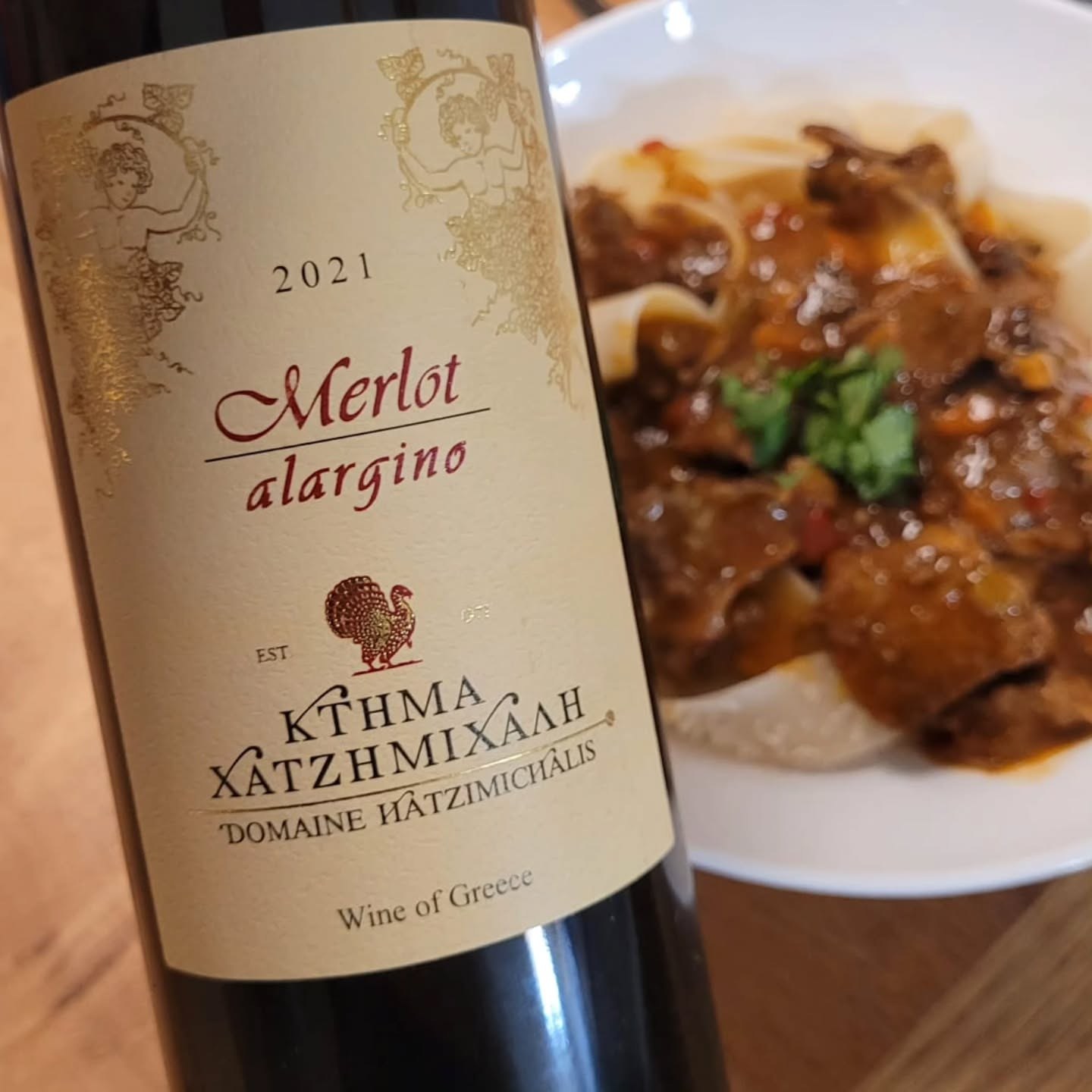
Domaine Hatzimichalis – Merlot Alargino 2021
PGI Atalanti
100% Merlot
Central Greece, Greece
Red | dry
14.5%
Drinking window: –2051
If there is a single wine through which the story of Greek Merlot can be told, it is the Merlot Alargino from Domaine Hatzimichalis. In 1973, Dimitris Hatzimichalis founded his winery in the Atalanti Valley in central Greece – a stretch of land between Parnassus and the Euboean Gulf, whose cool cross-breezes give the vines the nighttime recovery they need in this climate. Hatzimichalis was one of the first Greek wineries to plant international varieties alongside indigenous grapes, and the very first to bottle Merlot as a varietal wine – starting with the 1989 vintage. That is not a footnote. It means that the story of Greek Merlot begins here.
I have been following the Merlot Alargino for several years now, and the vertical tasting that has resulted is among the most illuminating experiences I have had with Greek wine. My first contact with Hatzimichalis Merlot was rather sobering, though: the Merlot Yataki 2017, the estate's entry-level version, failed to convince me with its 86 points and a hot, spirity finish. All the greater the surprise, then, when I got to know the Alargino – a completely different world. The 1992 – which I only had in my glass in 2025, more than thirty years after harvest – was reportedly the first Greek wine ever to appear on the IWC Top 100 list. At just 12% alcohol, it still showed fresh and juicy, with dense raspberry aromas interwoven with mushroom and earth, and soft but still perceptible tannins: 93 points, and a wine that should easily hold until 2030. The 2004 was then the high point of my Alargino experience to date: leather, liquorice, flint, graphite, blackberry, superb acidity – at the peak of its development. 95 points. The 2011 surprised with an entirely different story: initially mushrooms and undergrowth, but a remarkable improvement over several days, with the black olive aromas typical of mature Hatzimichalis Merlot and a complexity that even surpassed the 2020. 94+ points. The 2020, finally, showed a bright colour, reminiscent of a Pomerol from a hot year – cherries, marzipan, powerful but finely polished tannins, outstanding finish. 93 points, with room to grow. What this vertical shows: the Merlot Alargino is not a wine that plays all its cards in the first year. It needs time, and it rewards it.
Technically, the Alargino is more closely related to the Galatrona than one might think: it too is an unirrigated, low-yielding single-vineyard Merlot – the grapes come from the "Alargino" site in Zygos, meaning "the most distant," at 320 to 350 metres elevation, with a yield of only 3,500 kg/ha. The total acidity of 5.8 g/l is nearly identical to the Galatrona (5.89 g/l), and the altitude is comparable. In terms of oak ageing, however, there is a clear contrast: where Petrolo opts for 18 to 20 months with only one-third new oak, Hatzimichalis chooses 12 months in exclusively new French 228-litre barriques, followed by a further 12 months of bottle ageing in the underground cellar before release. With 100 percent new oak, it is the fruit concentration of the vintage that determines whether the wood overwhelms the wine or provides the right framework.
In the glass, the 2021 presents itself quite expressively on the nose, with generous cherry jam – denser and more inviting than the somewhat more reserved 2020 at the same age. On the palate, then, sea buckthorn and marzipan, a good aftertaste, and right at the very end a subtle plum note sneaks in behind the sea buckthorn. 93+ points – on the same level as the 2020. Both will one day reach 95 points, of that I am convinced. Interestingly, though, the 2021, after a roughly comparable time since harvest, already shows slightly better integrated oak than the 2020 at the same stage. For a wine with 100 percent new oak, that is a good sign. Leonidas Hatzimichalis said in August 2021 that the harvest had begun about ten days earlier than usual due to the heat and that 2021 was an excellent vintage – the concentration and ripeness in the glass prove him right.
With only 3,000 bottles and a price significantly below that of the Galatrona, the Merlot Alargino occupies a singular position in the Greek wine landscape: a pioneer wine with over three decades of documented ageing ability that international critics have largely ignored so far. The vertical speaks for itself.
Tasted: February 2025