
Diamantakis Winery – Vidiano 2025
PGI Crete
100% Vidiano
Crete, Greece
White | dry
13.5%
The Vidiano from Diamantakis is a single-varietal Vidiano from the PGI Crete. By their own account, the brothers Ioannis, Michalis and Zacharias Diamantakis founded the family estate at Kato Asites in the prefecture of Heraklion in 2007. They have been planting Vidiano ever since. The first vintage of this wine was 2010 and came onto the market in early 2011. Today the three of them farm 15 hectares across 30 parcels. Zacharias studied oenology in Athens and runs the cellar. The grapes grow in the Vorina vineyard at 350 to 550 metres. It faces northeast, lies under the influence of the sea winds from the Aegean and has calcareous and clay-rich soils with limestone. The data sheet cites a yield of 8 tonnes per hectare. In the cellar things stay simple. Fermentation takes place in stainless steel at 14 to 18 degrees. The wine then rests for three months on the fine lees, likewise in steel and entirely without wood. According to the winery there are 19,000 bottles of the 2025, with alcohol at 13.5 percent. Simos Georgopoulos included the wine in his Vidiano Top 10 for FNL in 2022, as a typical example of steel ageing.
I tasted the 2025 in October 2026, a good year after the harvest, as a sample from the estate. It featured in a white wine tasting that moved from Vidiano to Assyrtiko, pitted Crete against northern Greece and was intended to probe the question of acidity. Three Vidianos from the north preceded it. The opener was the Bidiano 2024 from Passas Winery in Thrace, aged in oak barrels on the fine lees. These were followed by the EXIS Vidiano 2025 from Estate Manolesakis in Drama and the V diano 2025 from Torosidis in Xanthi. After it came the house's two other whites. The Diamantopetra White 2025 is half Vidiano and half Assyrtiko. It finishes fermentation in barrel, with bâtonnage and 50 percent new French and American oak. The Petali Assyrtiko 2025 is aged exactly like this Vidiano, in stainless steel with three months on the fine lees. The two are thus directly comparable in the cellar. Rounding things off were two Assyrtikos from Kir-Yianni in northern Greece, The North 2025 from Florina and the Single Block Tarsanas 2023.
According to the data sheet, the Vidiano was harvested between 15 August and 10 September 2025. The data sheet shows more acidity for it than in the previous year, namely 6.35 g/l total acidity at pH 3.30. For the 2024 the figures were 5.9 g/l and pH 3.39.
With this wine, acidity is the theme in any case. I rated the 2021 at 87 points in 2023. It fascinated because it still held up against hearty dishes even after several days. But it suffered from excessive acidity. Interestingly, that was not the case in the blend with Assyrtiko in the Diamantopetra 2021 from the same house, despite the acid reputation of the Assyrtiko. The Diamantopetra earned 93 points from me. Whether the bottle of the Vidiano had a problem was hard to say. As a perfect introduction to the variety, I could not recommend the single-varietal Vidiano at the time. Greg Sherwood MW gave his scores to three older vintages in September 2024, awarding the 2023 91 points, the 2019 89 and the 2017 93 points. For the current 2025 vintage the winery reports Bronze with 88 points at the Decanter World Wine Awards 2026 and Bronze at the Thessaloniki Wine & Spirits Trophy 2026. The wine also ranks among the winners of The Wine Merchant's Top 100 2026. Julia Harding MW tasted the 2025 in August 2026 for JancisRobinson.com and describes green fruit, pear and some florality. Andreas N. Androulidakis called it full-bodied, almost oily and lively in Cantina in May 2026, with a lingering citrus finish. More acidity on paper and a wine I had already seen suffer under its acidity – with that, the question was posed whether the 2025 would come across as more tamed or even more angular.
On the nose it is quite yeasty, alongside which stand the three months on the fine lees. On the palate there is then a very good acidity and a pleasant creaminess. For a Vidiano this is actually rather smooth and yielding. On the finish comes the typical chalkiness, plus a rock-hard acidity. Were the apricot not there at the same time, while the acidity dominates on the finish, one would think of Assyrtiko here.
That is precisely what the comparison with the two wines that followed it in the house hinges on. The Diamantopetra White does not have as much drive as the Assyrtiko and lacks the brute force of the Vidiano. In the aftertaste too it is not on a par with the Vidiano. It comes across as an intermediate piece between the tame Assyrtiko and the wild Vidiano of the house. The Petali is treated the same way in the cellar. It felt as though it had noticeably less acidity than the Vidiano, even if analytically that is not quite so clear-cut, and it was the most drinkable of these wines. The roles are thus the same as with the 2021 – the single-varietal Vidiano is the acid-driven wine of the house. Only this time the acidity sits in a wine that has creaminess and apricot to set against it.
Anyone who knows Vidiano as a fruity food companion should definitely give this one a try. It has nothing to do with the supple pork accompaniment from Ktima Biblia Chora, but it is genuinely very authentic. After the three wines from the north, this is for me without doubt one of the Vidianos of Crete that should be brought out again and again whenever an attempt is made elsewhere in Greece to interpret this variety. This too is how it can be done. In the end, though, the wine is simply too angular to truly convince across the board. It costs around 11 euros in Greece. For me that is 90 points.
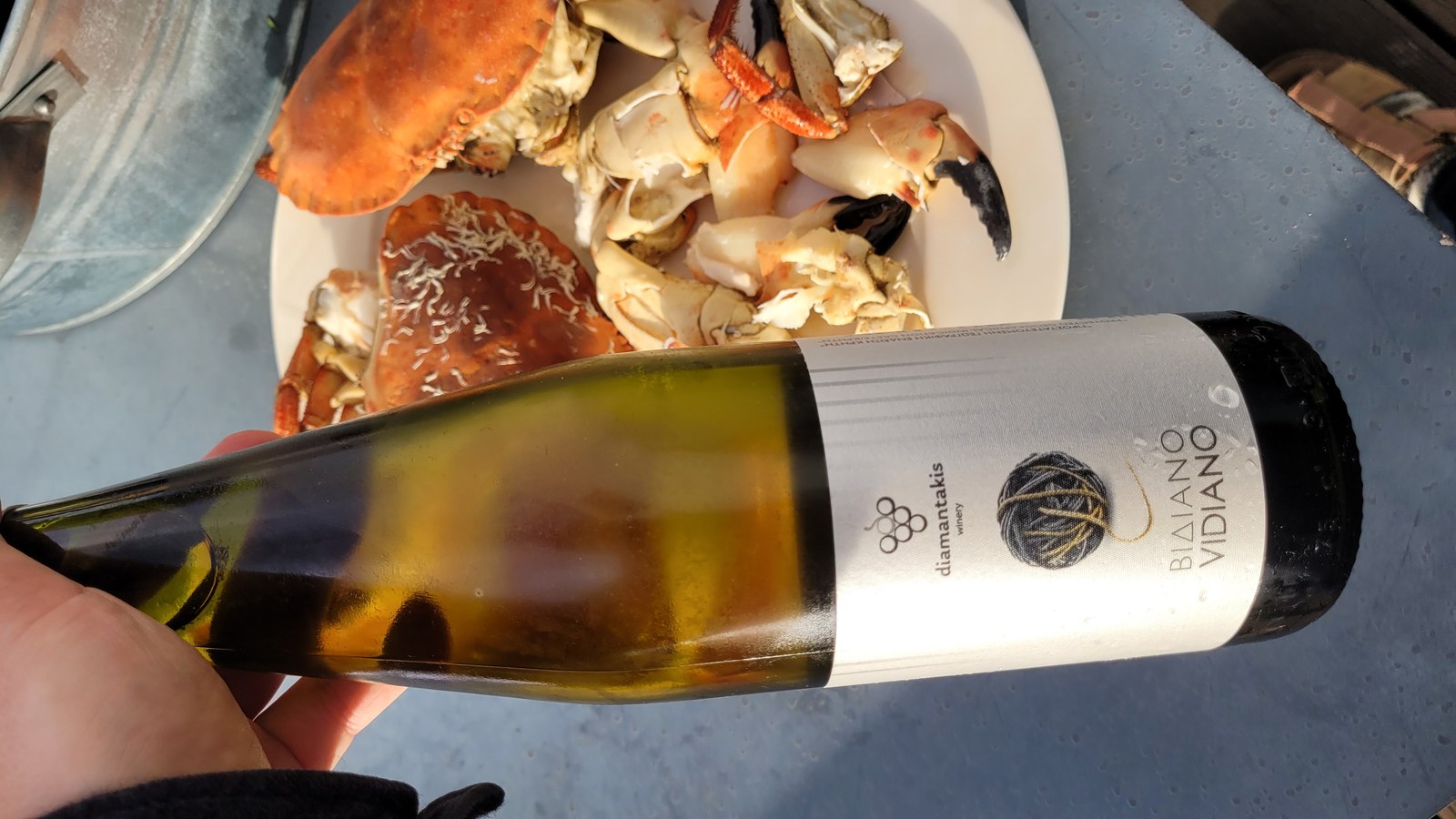
Tasted: October 2026
Other vintages:
Diamantakis Winery – Vidiano 2021 (87, 2023)