
Diamantakis Winery – Prinos White 2025
Malvasia di Candia Aromatica - Chardonnay
PGI Crete
50% Malvasia di Candia Aromatica, 50% Chardonnay
Crete, Greece
White | dry
13.5%
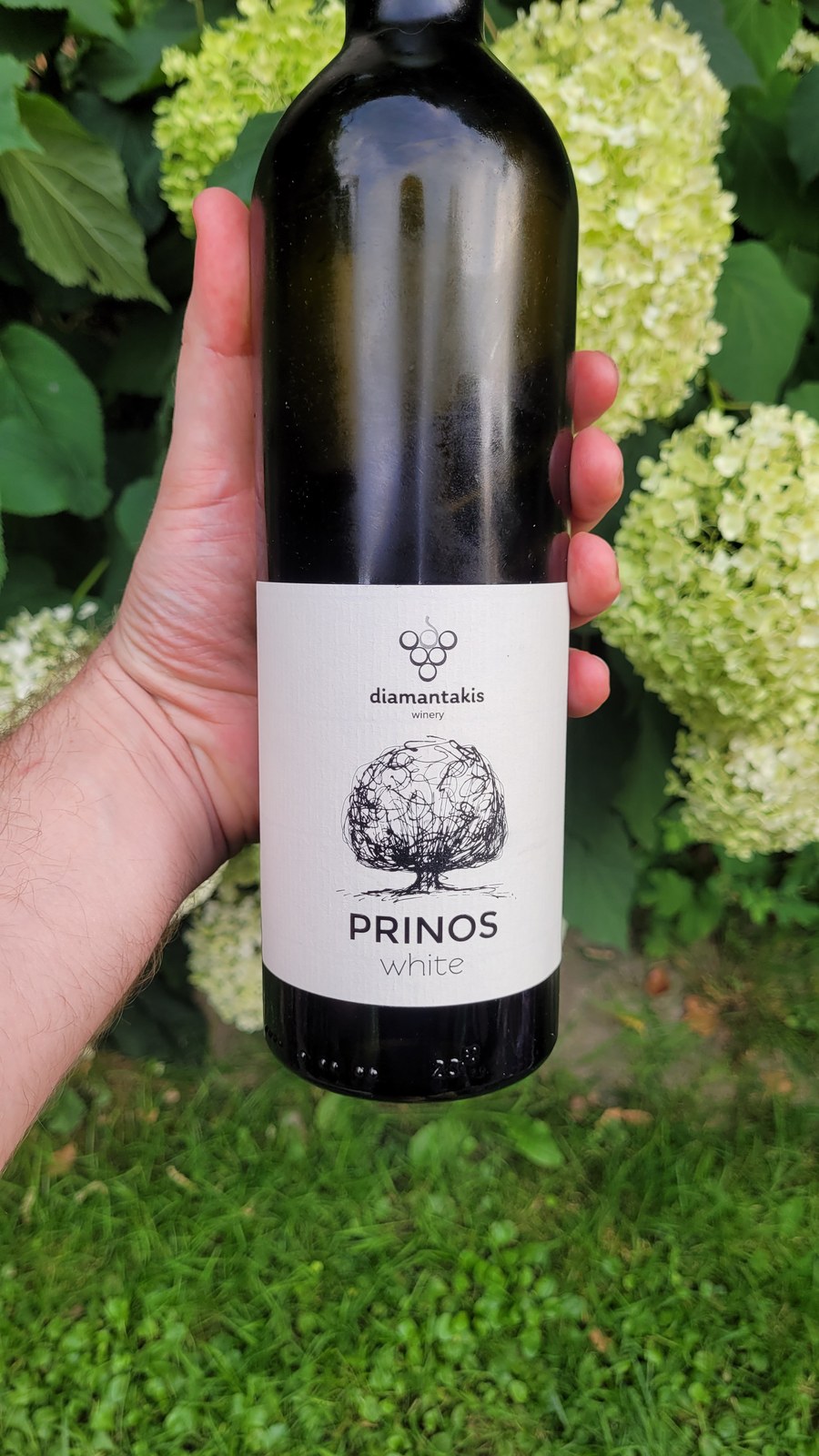
With Diamantakis' Prinos white I have arrived at the very origins of the estate: the Prinos White 2008 was the first wine the estate ever bottled – bottling took place in 2009, two years after the estate was founded in 2007 by the brothers Zacharias, Yiannis and Michalis Diamantakis, third-generation heirs to a Cretan winemaking tradition. Zacharias, trained in Athens in oenology and beverage technology, serves as chief oenologist; today the family farms 15 hectares across 30 parcels and bottles some 120,000 bottles a year. The Prinos is the entry-level and core cuvée, positioned well below the Diamantopetra.
In the glass is a PGI Crete made in equal parts from Malvasia di Candia Aromatica and Chardonnay – each variety vinified separately, fermented in stainless steel at 17 °C and aged three months on the fine lees, with no documented use of oak. The grapes come from the Sinani Cambos and Corfi vineyards near Kato Assites on the eastern foothills of the Psiloritis, from altitudes of up to 550 metres on calcareous clay and limestone, with a north-easterly exposure and cooled by the Aegean winds. The harvest ran from 5 to 25 August 2025, and the wine was bottled under screwcap in a run of 23,500 bottles, declared vegan. At 13.5 % alcohol, 5.0 g/l total acidity and pH 3.45, the vintage is analytically clearly rounder than the 2023, which at 6.15 g/l and pH 3.20 was built along distinctly tauter lines.
As a vintage, 2025 looks set to be exceptional on Crete. After three extreme years, the whites are showing a slow, even ripeness, aromatic concentration with acidity preserved – even though the starting point was harsh: the fourth drought year in a row, with a three-year rainfall deficit, two heatwaves in July and August, and yield losses of up to 50 %. My vintage expectation for Cretan whites in 2025 sits well above 2021.
The wine delivers on it. Floral on the nose, round on the palate, carried by a lovely minerality. It is precisely this roundness that Simos Georgopoulos confirms too, having awarded it two and a half stars on 14 July 2026 and called it "rounded and balanced rather than sharp and acid-driven"; he did, however, criticise a merely moderate intensity of flavour and an alcohol that stood out a little on the finish. Here I disagree: for me the finish is long and lasting.
How does it stand against its own predecessors? The Prinos 2021 – the same 50/50 cuvée, then at 13 % alcohol – I rated at 90 points in 2022, at one year of bottle age, as an uncomplicated food companion. The 2025 is a touch better, and that can now be put in figures too: 91 against 90. The exceptional vintage explains this small edge. There is as yet no international critic's score or competition result for the 2025. Peter Moser rated the 2017 at 88 points in Falstaff, the International Wine Review gave the 2021 89, Greg Sherwood MW likewise gave the 2023 89, and the 2024 took silver at Thessaloniki in 2025 with 88 points.
On price, the Prinos remains a wine of this price bracket in the best sense – around seven euros in the Greek trade. It is to be drunk now, this year, with no claim to ageing potential. The finish is long, and not just for a wine at this price. 91 points.
Tasted: July 2026
Other vintages:
Diamantakis Winery – Prinos White 2021 (90, 2022)