
Diamantakis Winery – Prinos Rosé 2025
Syrah - Mandilaria
PGI Crete
70% Syrah, 30% Mandilaria
Crete, Greece
Rosé | dry
13.5%
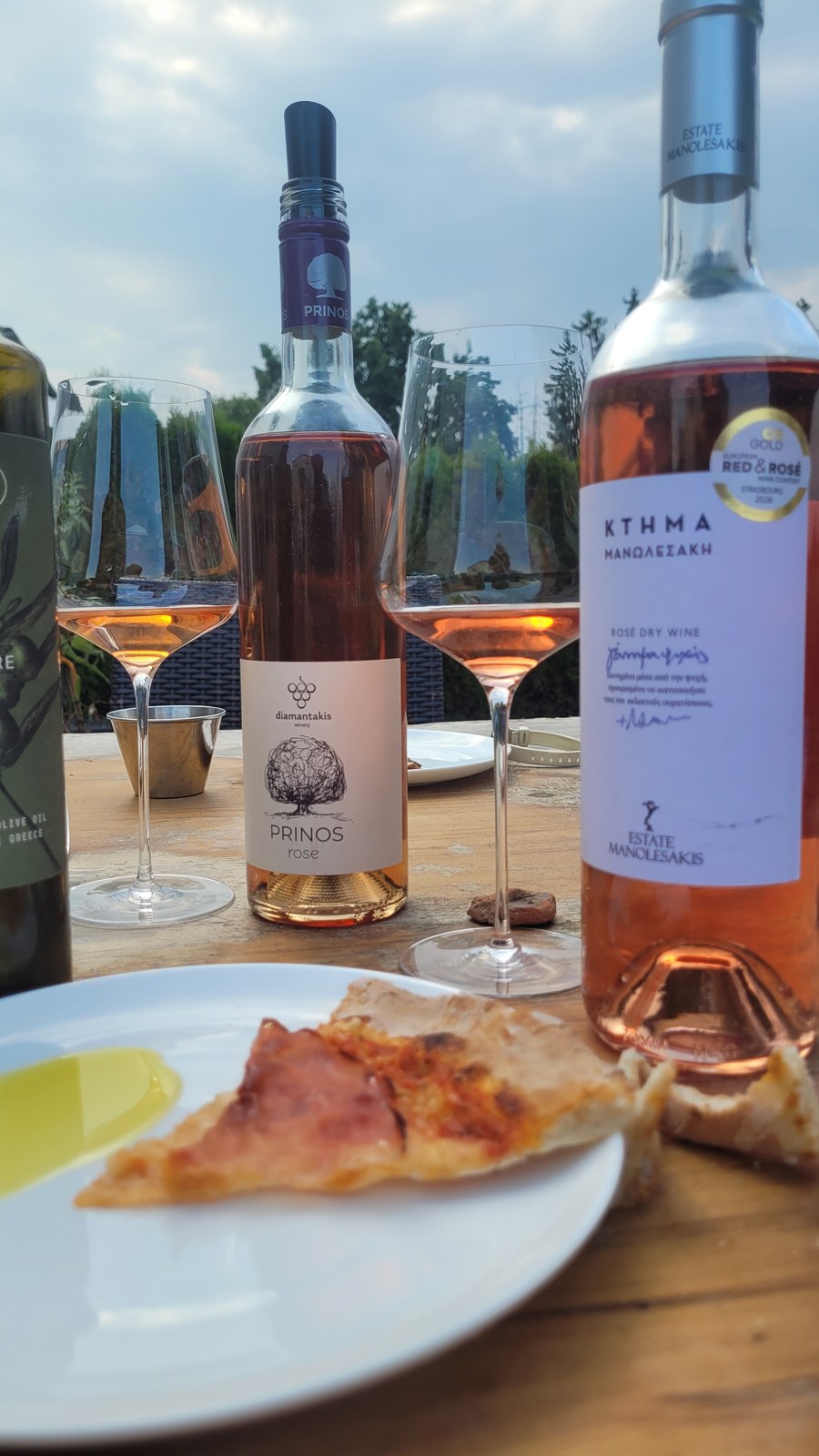
Pizza rosés from northern and southern Greece: that is probably the best way to caption this tasting. Standing side by side in the glass were two rosés from the 2025 vintage, both dominated by Syrah and both combining this international variety with a Greek one: the Prinos Rosé from Diamantakis Winery in Crete, that is from the southern end of Greek viticulture, and the Gennima Psychis Rosé from Estate Manolesakis in Drama, right up in the north. To be fair, one difference must be named: the Cretan relies on Mandilaria, a genuinely autochthonous variety of the island, while the wine from Drama uses Agiorgitiko, a variety that hails from the Peloponnese, from the area around Corinth, namely from Nemea, and that is grown throughout Greece today. In terms of alcohol the two are also close together, each at 13.5 %.
The Prinos Rosé is a cuvée of 70 % Syrah and 30 % Mandilaria, classified as PGI Crete. Incidentally, this is not a downgrade, since a PDO was simply not available for this wine. Kato Asites, the home village of the estate in the regional unit of Heraklion, does lie on the edge of the PDO Dafnes zone, yet its specification for dry wine knows only red wine made from at least 80 % Liatiko and no more than 20 % Mandilaria, so Syrah and dry rosé do not feature in it at all. The grapes grow in two parcels named "Pezoules Tyri" and "Pefki" on the eastern foothills of Psiloritis, on limestone soils at 350 to 550 metres altitude. In the cellar, Syrah and Mandilaria are vinified separately, fermentation takes place in stainless steel at a controlled 16 °C, after which the wine rests three months on the fine lees, explicitly without wood. Responsible for it is Zacharias Diamantakis, one of the three brothers who founded the family estate in 2007; he studied oenology in Athens. "Prinos" (Πρίνος) is the Greek word for the kermes oak, a drought-resistant tree of the Cretan mountain regions, and the stylised tree motif on the label certainly fits with that. The rosé first appeared with the 2013 vintage, in early 2014, as the third member of the Prinos line, which forms the entry line in the Diamantakis range, with the Diamantopetra line ranking above it. Ex-cellar the Prinos Rosé costs 4.90 euros, and 12,000 bottles were filled of the 2025.
As a year, 2025 was hard in Crete, at least that is how the estate's own harvest report describes it: the fourth drought year in a row following a three-year rainfall deficit, plus two heatwaves in July and August and yield losses of up to 50 %. At Diamantakis the harvest accordingly began early, on 4 August with Liatiko; the Mandilaria for this rosé came in during September, with the harvest ending on 30 September.
In the glass the Prinos is a darker rosé that also tends towards orange, though the Gennima Psychis is even deeper in its colour. On the nose the Prinos comes across as red-fruited and very inviting, with a little touch of caramel. On the palate it is very creamy, almost oily. Here, however, I miss a little acidity; the wine is a touch too round for me, shows slightly oxidative notes, plenty of caramel and a little herbaceousness. The finish is medium-long. The Gennima Psychis, by contrast, is cooler-styled on the nose, with more mint and a little touch of blueberry, and brings a good, gripping acidity as well as coarsely chalky tannin to the palate, a very well-made rosé with edges and corners, not quite so polished. The white Prinos, by the way, I liked very much; this rosé is somewhat plainer by comparison.
It is interesting how closely my impression aligns with ratings of earlier vintages. Simos Georgopoulos, in the FNL Guide, likewise noted caramel and a rather dark rosé colour alongside blackcurrant and watermelon for the 2017 (7/10), and Greg Sherwood MW credited the 2023, which he rated at 87 points, with a round, fleshy body and a "barely sufficient freshness." This is evidently a stylistic thread of this wine, not a vintage slip. The 2021 reached higher, with the International Wine Review awarding it 90 points; the 2020 took 87 points and Bronze at the Decanter World Wine Awards.
Both wines in this tasting I would drink now; I trust the Gennima Psychis with a little more ageing potential, so one could even wait another year. For me it is the slightly better wine, though: anyone who prefers quick-drinking, simple elegance may actually find the Prinos more to their taste. Both cut a good figure with pizza. 86 points.
Tasted: July 2026